Something new I’ve been seeing in the weather alerts

Living along the ocean, I’ve seen gale warnings become a regular part of the forecast. You’ve heard of gales of course. But freezing spray?

I hadn’t given it much thought till now. Remember that magical “sea smoke” I’ve been observing? It no doubt condenses on vessels. As does moisture whipped up from the surface by those gale-force winds. Either way, here’s what the weather service says:

Freezing spray may render mechanical and electronic components inoperative. Ice accretion on decks and superstructures may result in some loss of stability. Very strong winds will cause hazardous seas which could capsize or damage vessels and reduce visibility.

During freezing spray conditions the U.S. Coast Guard advises that you ensure all lifesaving equipment remains free of ice.

Mariners should prepare for accumulation of ice on their vessel and consider altering plans to avoid or mitigate these hazardous navigating conditions.

Mariners should prepare to remain in port, alter course, and/or secure the vessel for severe conditions before conditions deteriorate.

And that’s for today’s steel-hulled ships. Imagine what it was like back in the days of sails and no warnings. As for trying to walk on decks or man the rigging?

And you thought freezing rain was bad? Seems it has a nastier brother.


Come on down to where the town really connects

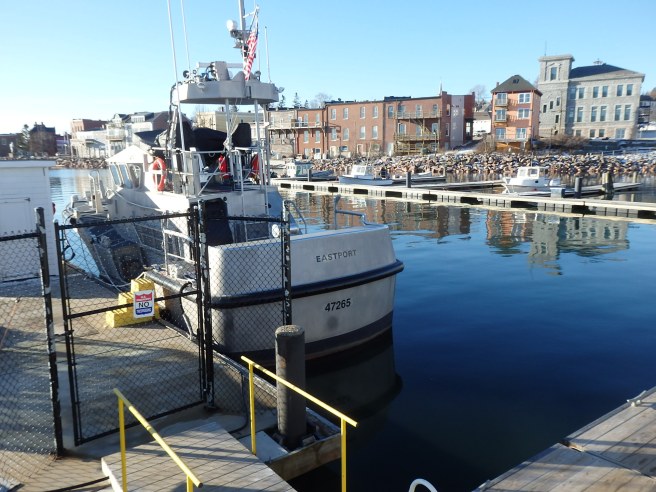
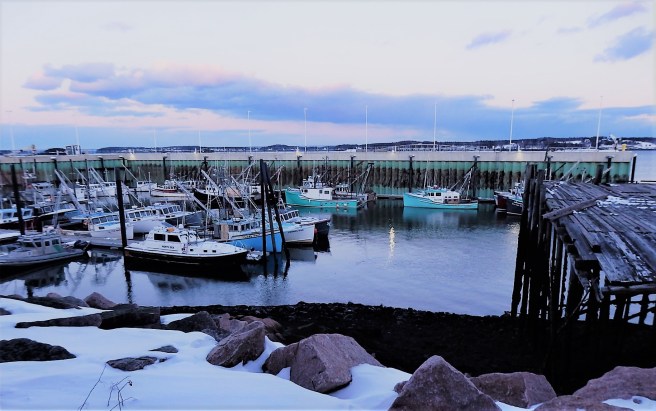
Locally, it’s known as the Breakwater, rather than the town pier or wharf or dock or safe harbor. And it’s the heart of Eastport, the centerpiece and focal point, as well as the home of the commercial fishing fleet and U.S. Coast Guard station.

It’s snuggled up right next to our small, struggling, and potentially quaint downtown. Here’s how it looks from the walkway this time of year.

It even broke down and collapsed in the winter of 2014, taking a few fishing boats with it.

Rebuilding was another matter. Officially, it reopened in September 2017, though details may have been completed later. The versions differ, up to “two winters before last.”

Eastport has the deepest natural harbor in the continental United States and is said to have rivaled New York’s in shipping at one point. I’ve seen photos of a cruise ship tied up here, and it truly overwhelmed the dock and town in its size.

The waterfront has – and had – other piers, with pilings that can still be seen – the old vaudevillian appearing steamship dock, for one, or the more recently gone Northeast Marina and Fuel Depot, as prominent examples. And, yes, definitely, what was once the world’s largest sardine cannery, as well as a solitary brick shell from the era still standing over the water with some folks hoping for a redevelopment before it caves in.

Significantly, there is the Cargo Terminal, our industrial shipping complex at Estes Head just around the bend. It has both high security and tractor-trailer traffic, so you don’t stroll around there.

Still, the breakwater at the end of Sullivan Street beckons us, even with its seemingly perilous heights above the water at low tide.

And here’s how downtown looks from the Breakwater.

Another twist on everyday personal unease

Everybody is searching for something. So I’ve heard.

That, rather than mere “anxiety”?

As if I ever had an answer, short of some piety.

Still, I am the son of a born worrier.

So just what, exactly, is that “something” in your life?

What, exactly, is your life (or mine) missing?

And just how much will it cost?

Some observers will argue it’s really an enemy, villain, or opponent in our life that we require.

Maybe even the devil in the details.


In and out of fairy tales

does he ever have a name other than “the handsome young prince” or is he merely an anonymous provider of wealth, comfort, and status, a male figure, nonetheless, out of range of any rival, consequential to fallopian tube roulette which is, of course, a fate we all share besides, to say “they lived happily ever after” is the greatest irony in all literature so read the story over again and again to those in the throes of childhood as our own cruel joke or empty promise awaiting our own crown or at least an electric guitar with the drums, bang, bang, bang

A ‘mild case’ can still be the sickest you’ve ever felt

Here we are, coming up on the second anniversary of the Covid outbreak here and abroad, and we’re still in the midst of its disorder. So much for that initial hope of a two-week or six-week lockdown, max, which even then unfortunately had too many holdouts from the precautions. Can we blame them for leaving the Pandora’s box open for all that’s followed?

Once that first round passed, after its devastation in large urban areas like New York City, we had a breather in which medical procedures were more clearly understood and improved and vaccines became available. We’ve even been able to gather in public again, albeit in fewer numbers and spaced apart while still wearing masks. Surface contamination is no longer a major worry, either.

Where I live, the illness has often seemed to be a distant threat. While I have friends who came out of retirement to resume long hours as medical professionals, their tales of a stress still seemed confined to largely quarantined hospitals and clinics, even though they were only just down the street. Well, I also got updates from fellow clergy who couldn’t visit patients in person, that sort of thing. Still, two years later, I knew of only two cases in our Friends Meeting, both quite mild. Further east, in remote Washington County, Maine, fewer than 3,000 cases and 43 deaths have been tallied, last I looked, though those figures have nearly tripled since November.

Still, the threat kept getting closer and more personal. The surge in the Omicron variant forced the cancellation of the final Christmas performances of our beloved Boston Revels, for example. Traditionally low-rate New Hampshire recently reported the highest per capita figures in the nation. Our twice-a-month local newspaper’s half-dozen or so obituaries now regularly mention “of Covid complications” as the cause of death. (Nobody, presumably, dies directly of the infection or is at least willing to admit that openly. Am I guessing there’s a social stigma?)

We have endured the screeching dissent and violent reactions from those who feel entitled to do whatever they want in public, regardless of any harm to others, and that seems to be spiking.

How long, though, will it take for the emotional frustration of the other side to erupt?

For starters, there’s a growing weariness among those of us who have been wearing masks and getting our booster shots, in part to protect others from suffering from the illness, while enduring the arrogance of those who pooh-pooh the odds, putting their own “liberty” above the common good, and then putting the rest of the populace at risk while expecting overworked medical professionals to come to their rescue and forcing heart attack patients and crash victims to be juggled about for unavailable intensive-care beds.

Look, I know Christian Scientists who have gotten the shots, not for themselves – remember, they generally avoid doctors as a matter of their faith – but out of a sense of social responsibility for others. In contrast, I’m sensing that many of those who refuse vaccinations are also among those accusing lower-income Americans of “entitlement” when it comes to economic and social support, rather than turning the focus to the One Percent who actually benefit financially from overt entitlement in public legislation and regulation. Are these the same ones who scoff at widespread examples of global warming and impending disaster? The willful ignorance, selfish, self-centered behavior, and bullying outrage me. And before they quote – or misquote – Scripture for their positions, I can imagine them refusing Moses’ orders to paint lambs’ blood above their doors for protection from the Angel of Death – “Who are you to tell me what to do?” – but it’s the firstborn who suffer if they don’t. Drat! I can confess a vindictive urge – you know, of the smite-my-enemies vein – but revisiting the Exodus text, I’m seeing that in only one of the first nine plagues are the Israelites exempted from the evil consequences. Pointedly, all Egyptians, not just the pagans, suffer from Pharaoh’s refusal to act in accord with Divine direction.

No matter what, in the end, reality will win out, though it won’t be selective in choosing its victims.

What happens if this affliction spreads to strike down all who haven’t been vaxxed? Costly treatments that could have been avoided will be borne by all, regardless, through Medicare, insurance companies, and unpaid debts to hospitals, more than by the defiant unvaxxed ill and dying. The workforce will continue to be impacted, too.

The Omicron variant, as we’re seeing, is also hitting vaccinated people, but with lesser impact.

We look at the statistics and hear the stories that the new variety is less deadly but more infectious, along with the note that breakthrough cases among the vaxxed hit far more gently than among the unprotected, but we need to listen more closely.

Unless a patient is in need of a respirator, the diagnosis is to stay home, there’s no room at the hospital. Good luck if you’re living alone, and good luck to the rest of the household if you’re not.

Moreover, it’s considered a mild case unless you’re hospitalized or die.

As for those “mild” cases? More than one person has been quoted as saying they’ve never felt so sick in their life.

So far, I’ve been lucky, but my family’s finally been hit, notably in their recent visit to me. My test and my wife’s came back negative, but not so for the rest, despite all their precautions.

Would coming down sick be a sufficient lesson for the nay-sayers? Or would it make them dig in more deeply in denial?    
 

The Piscataqua’s first European settlers set up at two sites

From the git-go, there’s been a rivalry between Portsmouth and Dover, though a closer look reveals it’s more nuanced than what we usually think.

The 1622 contract for developing the Piscataqua watershed allows for more than one vessel to arrive and more than one settlement to be planted along the river.

Scotsman David Thomson is the head of the operation. He sets forth in the Jonathan and establishes his fortified Pannaway plantation at the mouth of the river in today’s Rye – not Portsmouth, contrary to the Port City’s claims of founding. He’s highly placed politically, somehow having the ear of King James I. And specifically, he’s the only one named in the grant.

Pannaway faces the open Atlantic, with salt marsh to its back.

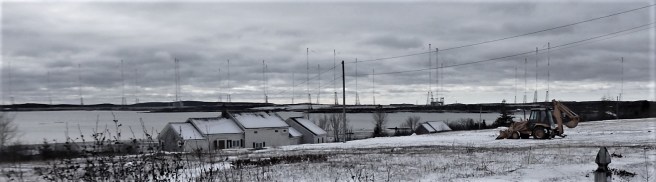
As the scene stands today. The landscape has changed but not the waterways.

~*~

IN CONTRAST, when the Providence arrives a month later, she apparently sails straight up the river to today’s Hilton Point aka Dover Point, where Edward Hilton and Thomas Roberts then set up operations. They disembark at Pomeroy Cove, which they name for Leonard Pomeroy, one of the three principal backers of the project. He’s also Lord Mayor of Plymouth, England, home of the company, and co-owner of the ship that’s brought them this far.

As I detail in my upcoming book, Hilton likely knew of the site even before setting sail. It was far enough inland to be sheltered from violent storms. Vast forests extended from the riverbanks, with timber for shipbuilding, piers, and barrels as well as homes and bridges and wild game for the taking. Best of all, the point was a confluence of rich tidal waters, with the Great Bay estuary on one side along with its tributary streams and, on the other side, the Piscataqua and its Cochecho and Salmon Falls rivers. Cod, salmon, sturgeon, eels, herring, oysters, clams, and lobsters are bountiful. Why go out to sea when the fish come right up to you?

While Pannaway is thoroughly documented, in part through its stream of visitors, its existence is short-lived, and the site’s abandoned by 1626, when Thomson relocates to an island in Boston Harbor and disappears soon after. His widow then promptly marries Samuel Maverick – yes, the source of that word. It’s a rough-and-tumble world.

~*~

OUT OF THE SPOTLIGHT of documentation, Hilton and Roberts continue on, in time joined by Edward’s brother William and their sister or possibly cousin Rebecca along with more family.

Either way, Roberts and Rebecca soon marry and start a farm about a mile from the point – they later move it another mile-and-half – but theirs will still be the oldest family-owned farm in the future United States well into the 20th century.

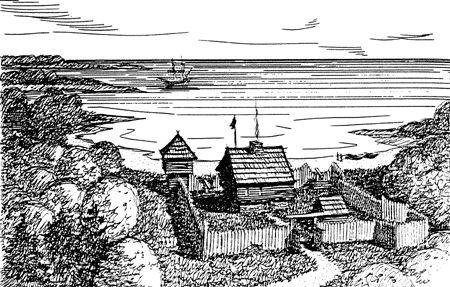
The Hilton Point settlement as it’s commonly been envisioned.

It must have been lonely through much of that first decade. The Hilton-Roberts clan was definitely on the frontier, and ongoing war in Europe cut off much ship traffic.

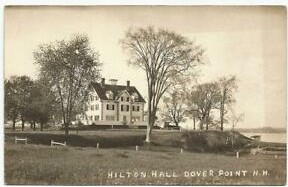
How much, if anything, did Hilton Hall originate in the early settlement at Dover Point? If the house was anywhere near this size, my perspective changes completely.

Edward Hilton is, however, definitively rewarded for his six years of habitation and hard labor by a charter giving him clear control at Dover Point. And they must be prospering, as seen in assessments placed on their province or his brief return to England for the legal document, perhaps a fish delivery, and definitely a marriage.

While Thomas and Rebecca Roberts remain in Dover for the rest of their lives, her brothers eventually move on – Edward to Exeter and William, by degrees along the Maine side of the Piscataqua. All of their lives take colorful turns along the way, which I relate in the book.

Even though Portsmouth baldly claims 1623 as its founding date, it had no European settlement until the Laconia Company chose to set up operations there in 1629 or 1630, calling their site Strawbery Banke. Yes, that was one more convolution of investors.

~*~

AND THAT’S THE BARE-BONES VERSION. There’s plenty in my upcoming book to flesh it out, some of it rather earthy – especially when we get to the contemporaneous and scandalous Merrymount plantation down on Plymouth Bay.

Fact: New Hampshire is the second-oldest state to be settled in New England. Older than Connecticut, Rhode Island, Maine, or Vermont.

On relating to some special place you’ve explored in depth 

Tourists may get a taste of a distinctive natural wonder in a particular landscape during their brief stay, usually in prime season, but it’s not the same as dwelling there through an entire year. A winter night or storm, for example, is a much different cosmos than a summer day.

I’ve been fortunate to have experienced some remarkable destinations through all their varying weather, thanks to my career moves, but never to the degree of living largely alone, as Henry David Thoreau did at Walden Pond or Henry Beston along the dunes on Cape Cod.

I’ve come to know both places firsthand over the rotating years, and so reading the two classic books that emerged from them evoked personal awareness of scenes that likely struck the general reader as exotic or even confounding. I never would have appreciated them the same way had I still been in the Midwest or Pacific Northwest, for certain. Quite simply, the encounters provided a stronger foundation for revelation of so much I had missed.

One of the fringe benefits of my second marriage was that my stepdaughters’ Grandpa Jim lived in Wellfleet on the Lower Cape, or what Beston more clearly calls the Outer Cape. (Understand that the Upper Cape is south of the Lower Cape, much the way Downeast Maine is really up the coast. Welcome to New England.) So we got to visit throughout the year, making me a big advocate of visiting popular travel sites in the shoulder season. There’s no way to describe walking several miles along the surf below the bluffs and having the expanse totally to myself – in perfect weather the week after the normally crowded Labor Day.

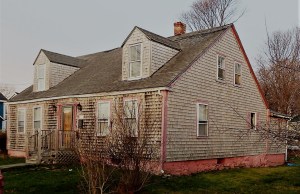
There’s a reason it’s called a Cape, or more technically, a full Cape. Here’s how ours in Eastport looks before the renovations begin. It was likely built more than a dozen years before Henry David Thoreau retreated to Walden Pond.

My wife used to gaze on the few remaining gray cabins atop the bluffs and voice a dream of living in one of them – the National Parks Service has been removing them piecemeal – noting that you wouldn’t want to have anything there you wouldn’t mind losing to a hurricane or nor’easter.

Beston’s 1928 The Outermost House tells of spending a year in just such a house only one town south of Grandpa Jim’s, and so I could envision and even smell much of what he describes.

At first, I was put off by the feathery, slightly Victorian language, as well as the affectatious British spellings rather than American, but once Beston presented some sharp, detailed observations of wave and wind motion and sound, I was captivated. His examination of waterfowl and other birds, especially, is admirable, but the range of shore and sea life he portrays is also encyclopedic.

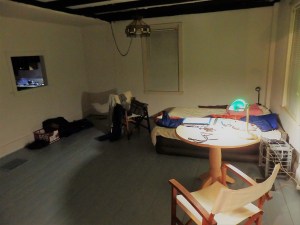
Here are my luxury accommodations the first months in town. I essentially lived in two rooms, spilling over into two more.

He writes from a time when the Cape still retained an older character that was being overlapped by newer ways that included telephones and flashlights, both unlike today’s suburban feel, and his book is credited with inspiring the creation of the Cape Cod National Seashore to protect the wildlife and geology he treasured – as many of us do today, thanks to the protections.

My reading came a few months after moving into my own equivalent of Beston’s cabin, albeit it much further up the coast and in a fishing village – still in view of the ocean.

You’ll be hearing a great deal about it through the coming year.

Are there books you’ve especially enjoyed because they’re rooted in places you know?