
Welcome, Quinn

remember after two months racing highway construction crew deadlines your Indian dig crew unearthed an infant’s grave that justified the stall but nightfall forced departure and returning the next morning, you discovered the skull smashed, bones scattered across drunken greed, ignorance, or hatred that strikes repeatedly, yes, the repeated sound, as you relay it Take care

Take a look at tricksters

They cross boundaries and break rules but have strong intellects. You need them but also need to be wary of them, especially when it comes to your wife or daughter.

In mythology, they appear across cultures, and not always as an animal or immortal. And we’re not talking about trick-or-treat night.

Take a look, here are ten.

  1. Coyote, largely among western Native cultures in North America, has been at the forefront of a new consciousness about tricksters. His tales were recorded by early ethnologists, who shifted to Latin when the stories turned randy.
  2. Kokopelli, the hunchback piper from the American Southwest, has become especially popular as an image, though not yet his stories.
  3. The rabbit or hare in West Africa and its transport into the Americas via the slave trade. Leads us to Br’er Rabbit.
  4. The spider. Just don’t get caught in the web.
  5. Froggy the gremlin on the early TV show “Andy’s Gang.” Not that we got it as kids, Froggy was just weird. And maybe perverted.
  6. The clown as an archetype. Well, I do know a professional firefighter who’s frightened of them.
  7. A figure in fairy tales who tests the status quo. He frequently changes hats. Or even genders.
  8. The fairy Puck. Or a leprechaun. Or even Robin Hood.
  9. Lilith, in Babylonian cultures.
  10. Jesus.

When an author listens to the characters

The ending of my novel What’s Left, is not the one I anticipated. Rather, it’s the one Cassia dictated to me as I was drafting. Believe me, it came as a surprise, but I trust her. It really feels fitting, from my perspective.

Up to that point I’d been thinking of swapping the placement of the last two chapters, ending with Rinpoche, the Tibetan teacher, telling Cassia of her father’s last moments and maybe setting her on a new lifetime pathway. Instead, her story concludes on a rainy Saturday morning as she converses with her best friend forever, her cousin Sandra.

Not that this should be a spoiler for you.

If you’ve ever lived in Indiana, you know how commonplace the rain is, especially on Saturdays, or so I remember. But this one is truly special.

~*~

It’s one thing to be writing and other to be reading or watching.

In reading a novel or watching a movie, have you ever felt a character wanted to go in an independent direction from the one the plot follows? Can you say why or which way you’d go?

~*~

My novel is available at the Apple Store, Barnes & Noble’s Nook, Scribd, Smashwords, Sony’s Kobo, and other fine ebook distributors and at Amazon in both Kindle and paperback.
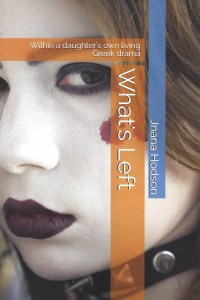
The paperback cover …

Among my most treasured possessions

Yes, I’ve always had a penchant for history.

  1. A hand-scrawled letter by my great-grandfather on scratch paper. (You can view it and my analysis on my Orphan George blog.) And the small autograph book he carried in Indiana his first years after leaving North Carolina. (Again, see the blog.)
  2. A stone breastplate pendant from an ancient burial mound in northwest Ohio. Plus, flint arrowheads.
  3. My Eagle Scout award, reflecting lessons in self-reliance, natural wonder, wilderness, and the outdoors in general.
  4. My Max Rudolf LPs. Working largely out of the spotlight, the conductor shaped the Cincinnati Symphony into a precise, glowing musical machine. Each performance was a revelation.
  5. James Nayler’s collected works, the second-oldest of the books in my personal library. Warped and hard to use as it is, with the ink bleeding through on many pages, it was published in 1829 in Cincinnati. He’s still my favorite writer from the emerging Quaker period. Also on my shelf are John Gough’s History of the People Called Quakers, in a four-volume set published in 1790 in Dublin. And then there’s Fernando G. Cartland’s Southern Heroes or The Friends in a Time of War (1897, Poukeepsie, New York), which details many of the travails of my ancestors under the repressive Confederate regime.
  6. A bone-handled antique fork, which I often used when visiting my grandparents. I wonder how far back in the family it really goes, but it’s still quite elegant in its primitive simplicity.
  7. An 1840s cherry table made in Ohio. Wobbly and warped, the wood itself is gorgeous.
  8. My journals, now numbering around 200 volumes. It’s what I often have rather than photos as a prompt to my memories. For the most part, I’d say the pages are more an outline of what happened, rarely of my inner thoughts and feelings, often tedious in their surface reporting, but they can still take me deeper into so much that’s otherwise slipped from my mind.
  9. Our copper cod weather vane. The one on the roof of the barn.
  10. A perfect trilobite, collected as a young rock hound in southwest Ohio.

~*~

Tellingly, many of these items are irreplaceable, unlike many other treasures that would still have replacements.

Which of your possessions do you most treasure?