Made my own sashimi!

We’ve once more subscribed to the community fishery’s summer season weekly catch selection, which we pick up every Friday at our natural foods grocery. Often, what’s offered is a sustainable variety not often even sold at the supermarket, but this time, it was tuna. A beautiful, fresh, one-pound sirloin, which indeed looked like a steak.

Yes, sirloin is the term I found used in the recipes.

So far, I’ve never attempted homemade sushi, but looking at our tuna and then the recipes, I took the leap into sashimi, which I first encountered in a four-table Japanese restaurant in San Francisco back in the ’70s and maybe two times since. And yes, that first time remains memorable, even the plum wine accompaniment.

In a restaurant, it appears so daunting. As one recipe said, though, nothing could be further from the truth. Sashimi is a staple dish in Japanese homes.

I had no idea this would be so simple. Using a very sharp chef’s knife, you firmly cut long strips across the grain – no sawing. One swipe! And, by definition, no cooking. Sashimi is raw fish from the ocean, not fresh water.

It just happened that we’re growing daikon radishes for the first time, as an experiment, so I went out to the garden and pulled one, which turned out to be larger than we were expecting. No problem. Came in, sliced it, put those rounds into a ramiken, and covered them in rice vinegar as my side dish.

The dipping sauce was a ramiken of soy sauce mixed with the juice from half a lemon.

That was it. Easier than making a salad, actually.

Accompanied by a cup of sake (which we also chanced to have in the cabinet), this made for one of the most heavenly meals ever, at least from my hand. And this wasn’t even sushi-grade fish, which gets flown immediately to Japan for a much higher price. I can only imagine.

Still, this was fresh, and that’s much of the secret.

Great cuisine is about respecting the ingredients.

Sorry I didn’t take pictures.

Finding another dimension of personal growth

In my novel What’s Left, one of Cassia’s big discoveries is how much her father had changed in the span from high school to his return to the college town a few years after his graduation.

Among the passages I cut from the final version is this:

No, I guess Baba takes it all in stride because of all the healing and growth that had happened within him since Nita introduced him to Tibetan practice.

~*~

Not everyone, of course, looks deeply into the people and the world around them. Some seem oblivious to the cosmic harmony or greater good that could be shared.

Too many, in fact, remain blatantly superficial, considering the threats now before human existence.

But I’m preaching. I’ll apologize.

There are other options, as I discovered when I took up yoga.

Who or what have you seen helping people you know change for the better? Is there any practice or teaching you’d recommend?

~*~

Cassia’s hometown may have looked something like this. Front of the store at 109-113 South College Avenue in downtown Bloomington, Indiana. Built in 1895, it is part of the Courthouse Square Historic District listed in the National Register of Historic Places. (Photo by Nyttend via Wikimedia Commons.)

~*~


A glorious big sunburst  

Sometimes I think it’s worth growing squash plants simply for their lovely big blossoms. The fact they also fill our plates with all kinds of squashes, including zucchini, simply adds to the pleasure. The blossom is a common motif in Native American artwork, too, one that reminds me of living at the edge of the Yakama Reservation in Washington state many years ago.

Ever take a ferry for fun?

When I lived in the desert in Washington state, we used to joke about the “rainy side” of the Cascade mountains, the strip where most of the people resided and worked.

When we visited that side, though, we often found ourselves driving the car onto a ferry and venturing onward. The state government manages an impressive fleet, some of them small and others, well, more substantial. It’s the largest ferry service in the country and fourth largest in the world. Its boats even show up in my novel Nearly Canaan.

Here are its nine routes plus one, all on Puget Sound but the last, which is a private operation.

~*~

  1. Seattle-Bainbridge Island: 6,429,853 riders a year. Big-time commuter run from downtown. (That’s still only a fourth of the volume on the Staten Island ferry, and there’s no Statue of Liberty along the way. But the New York line has eight boats compared to this route’s two.)
  2. Edmonds-Kingston: 4,114,181. With a terminal just north of Seattle, this route offers a quick hop across Puget Sound. Obviously, popular with commuters.
  3. Mukilteo-Clinton on Whidbey Island: 4,073,761. It’s the first leg to Port Townsend from Seattle. Most of the riders are commuters who live on Whidbey Island.
  4. Fauntleroy-Vashon-Southworth: 3,059,587. Operates as a “triangular” route from West Seattle.
  5. Seattle-Bremerton: 2,739,926. Includes some hairpin turns getting into Bremmerton while passing a U.S. Navy shipyard.
  6. Anacortes-San Juan Islands: 2,009,438. The San Juans are four gemlike isles north of Seattle. Popular with sailboat owners.
  7. Port Townsend-Coupeville on Whidbey Island: 819,285. Port Townsend, at the “anvil” on the Olympic Peninsula, has become a trendy, artsy waterfront town.
  8. Point Defiance-Tahlequah: 812,786. Links Tacoma and Vashon Island.
  9. Anacortes-Sidney, British Columbia: 123,001. Also stops at Friday Harbor in the San Juans. Landing is a 30-minute drive from Victoria.
  10. Port Angeles-Victoria, British Columbia. Its 90-minute voyage across the Strait of Juan de Fuca links the Olympic Peninsula to downtown Victoria. The vessel carries up to 110 vehicles and a thousand passengers. The Black Ball Ferry is not a state-run route, but it is truly a “poor man’s cruise.” I remember eating well and being agog at our landing in the heart of the classy Canadian city. (A foot-passenger-only rival sails from downtown Seattle.)

~*~

How about your experiences riding ferries?

The Washington state ferries have views of both the Olympics and Cascades mountains.

The FM antenna as a victim of technological advances

When we moved into the house 20 years ago, one of the items left behind was an FM antenna for the roof, still unopened in its box.

As a radio geek, I expected to mount it inside the rafters of the barn to enhance my reception of Boston stations, but somehow that never happened.

Last summer, I finally decided to take to the town transfer station (i.e., dump), a victim of changing technology. I usually listen to on-air broadcasts when I’m in the car, not at home.

These days, when I’m home, I usually stream those stations and others via the Internet, hard as that is to admit. The reception’s definitely better.

Still, it means letting go of a self-image I’ve long carried of “making it” in life. The one that included a reel-to-reel tape deck and a wall of LPs in my living room with the big glass window overlooking a busy metropolis.

Where the coastline remains an Impressionist impression

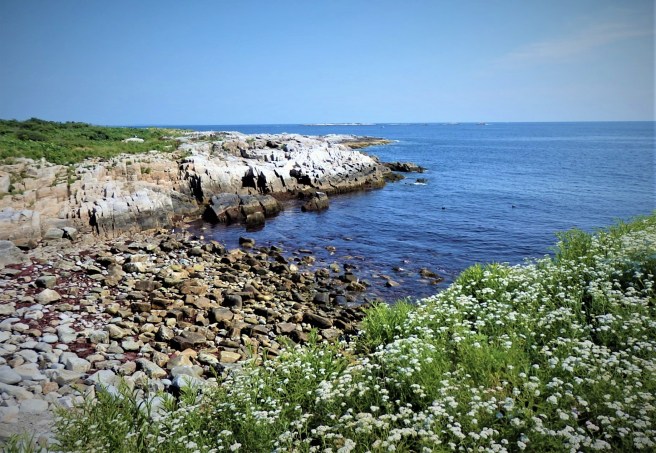
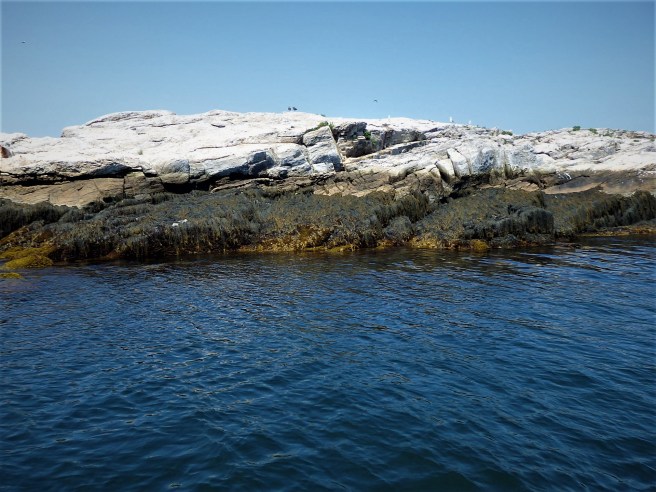
Appledore Island scenes like this, off the mainland of Maine and New Hampshire, inspired some of American Impressionist master Childe Hassam’s great paintings.


There was no nude model with her back to us when we visited, unlike at least one of Hassam’s paintings of this geologic rift formation.


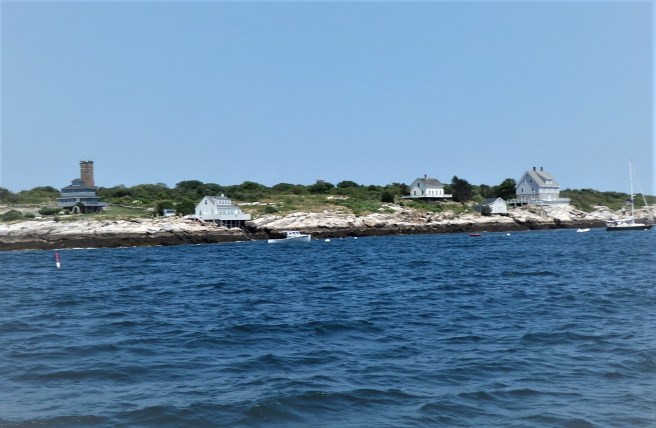
One end of rugged Appledore Island is still home to fishermen.


Rockweed on the intertidal zone of a white rock makes a bold image. The standing gulls add their own touch.