When it’s time to downsize

Think of your “desert island list” applied to real life.

Gee, trying to cut it to even a thousand books or recordings seems impossible, at least in my case.

Would there even be sufficient room for all the survivors at the new destination?

And that’s before the clothing and kitchenware and …

What would be hardest for you to pare down?


On the road to satori

Like Zen, my mind works in strange ways, and this is how I too often see things.

How I often see or hear life around me.

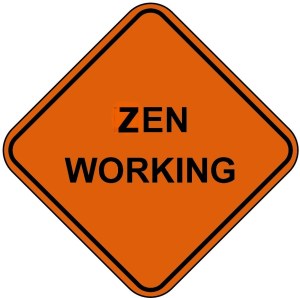
I can imagine a Buddhist sutra in which two monks observe the sign. They’re walking, of course, rather than driving.

The first says something pithy asking how Zen, being nothing, can do anything, much less work.

And the second replies that work’s nothing, too. But it’s not lazy.

Better, I suppose, than “ZZZ Working,” which many assume while passing the usual sign and seeing the crew standing by idly.

If you like this, please clap with one hand.

I’m feeling a little vindication

When I recently applied subtitles to my novels, I gave Reports From Trump Country to Hometown News, even though the events in the story take place, by implication perhaps, during the Reagan years in a small industrial city out in the Rust Belt.

Now the August issue of Harper’s magazine has come out with “The Challenge of the Rust Belt: Can Biden pry it from Trump’s grip?” touted on the cover, and I’m feeling some vindication in the Trump connection in my subtitle.

Vindication? I hate to admit that the Vindicator was a big rival for me in a town that looked very much like Rehoboth, and it had entrenched strength against a small upstart like ours. We were responding quite well, until the larger economy turned against us.

The Vindicator’s home base already resembled a bombed-out German city, left with only several miles of steel mill shells, so we were well within the Rust Belt.

Many communities, especially in the Midwest, simply haven’t recovered from the sharp decline of American manufacturing in the ’70s and ’80s or from the blow to the myth that you’ll be rewarded if you just work hard enough. So much for the work ethic itself.

No wonder this is my dystopian novel.

Now, 40 or so years later, those things really haven’t improved. Let’s be honest. There really is a Groundhog Day surrealism in many locales. We really need a better end for the story – mine and Harper’s – than what I’m seeing.

Not that Cassandra had an easy time of it. either.
How divinely appropriate

In my novel What’s Left, her mother inherits a name whose attributes suit her well. The chaste Roman goddess Diana (or Artemis in Greek) rules the hunt, the moon, childbirth, and nature. In the story, she’s calm and faithful, with a spark of fire that infuses her music-making and likely much more. I even have her evolving into much more of a night-person than her early-rising husband, though I hadn’t thought about that connection till now.

~*~

As I wrote earlier:

The real hunt had begun. With practice, within this lifetime, however long or brief, a remarkable enlightenment might yet blossom into wisdom. From flowers and bees, the harvest comes.

“Come, Dhyana, let us sit together. Let us ride in unison. That is all.” He accepted fully, “The female energy is my Shakti power.”

~*~

Given the urgency of her father’s Buddhist practice, it’s entirely fitting that his wife — Cassia’s mother — would share in the experience. Here he also recognizes an Eastern perception of a uniquely feminine spiritual energy that would complement his own nature — in a way also honoring the goddess essence of Diana’s own name.

By the way, if you’re interested in the origin, meaning, and pronunciation of my name Jnana, visit the Bio page here at the Red Barn. Think it fits me?

Do you know anyone whose first name perfectly suits their personality? Or how about someone who’s the exact opposite of what you’d expect?

~*~

Roman goddess Diana

~*~


With a few distinctive touches

The transformation of the former newspaper plant downtown continues. What had been an essentially blank wall against the children’s museum and park is opening up to take advantage of its views that include the bend in the river.

The crown, common to the late 1800s buildings up the street, came as an unexpected but traditional touch.


I happen to love big windows with a corner view, as I imagine these have.


Police staffing rates in various big cities

  • Baltimore: 40.6 officers for every 10,000 residents / 48.2 total personnel
  • Boston: 31.5 / 39.7
  • Chicago: 43.9 / 48.2
  • Dallas: 24.8 / 29.0
  • Miami Beach: 26.7 / 34.7
  • New York: 42.3 / 60.0
  • Philadelphia: 40.2 / 50.9
  • Los Angeles: 24.6 / 31.7
  • Seattle: 19.8 / 27.8
  • Washington, D.C.: 55.1 / 63.9

In contrast, Dover, New Hampshire, where I live, the figures are 16.1 and 23.5.

(Based on 2016 FBI Uniform Crime Reporting data)

Now for a rash of Covid novels

Word on the street reports that with all of this downtime, wannabe novelists have turned to the No. 1 topic of conversation as their prompt, and already literary agents and editors are turning off at the first reference to coronavirus.

My take? Besides the fact a reader can devour only so many volumes, even if interested?

I think it’s too early to tell the story. We’re only in the opening round of this affliction, which was supposed to drop off in the face of warmer weather. Only it hasn’t. Let’s see what happens around the corner, likely the real whammer come September.

Though, as one writing buddy suggests, that first book could be the beginning of a series, if you do it right.

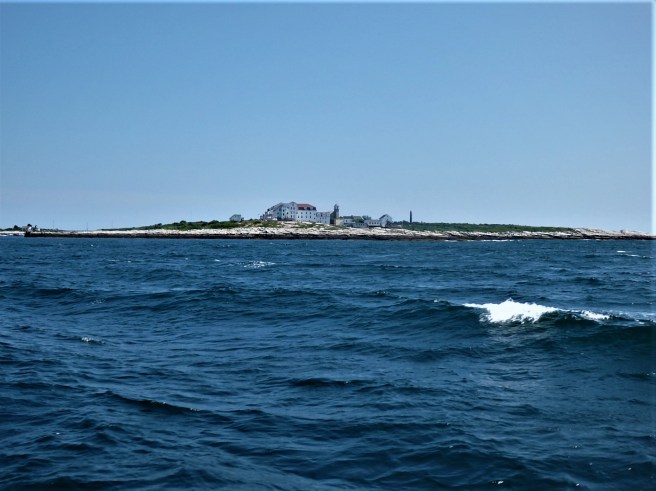
Does anyone else envy the summer guests on Star Island?

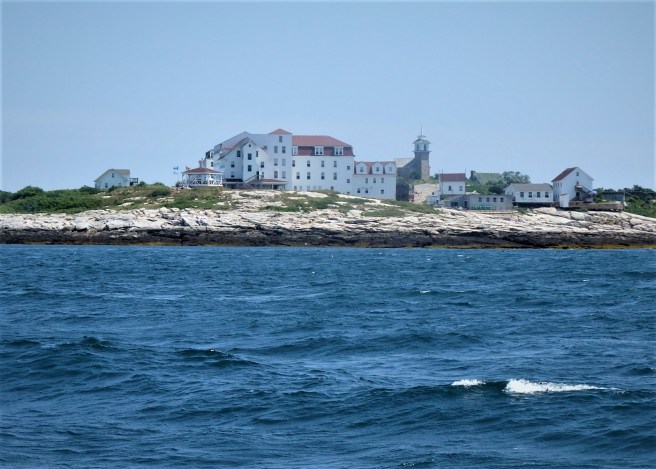
The historic Oceanic Hotel is now part of a conference center run by a consortium of Unitarian-Univeralists and the United Church of Christ. Its week-long programs are a popular family destination. Cape Ann, Massachusetts, sits on the horizon.

The second largest island in the Isles of Shoals, Star is the only one with commercial boat service to the mainland. The state line between New Hampshire and Maine runs through the small harbor.

Here’s an idea of the hotel’s isolation. You say you want to get away from everything? Apart from your fellow guests, this is just about perfect. But forget about going in winter. That ocean can get wild. 


Closer up. In the 1600 and 1700s, the Isles of Shoals became a major summertime fishing camp, where cod were dried for European markets. They garnered four times the price of Norwegian cod. The chapel remains from that era.

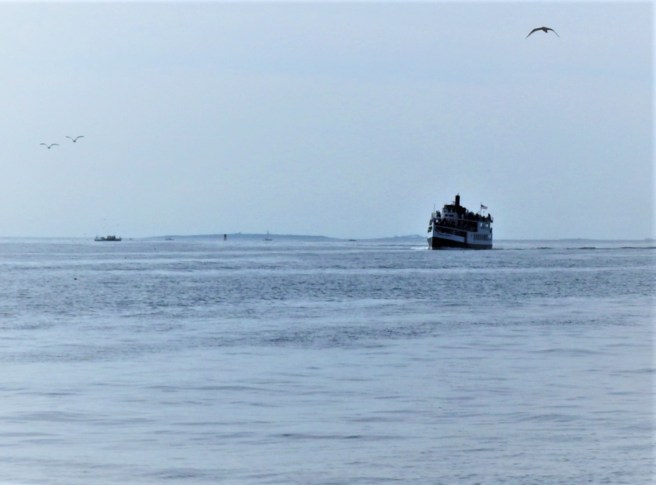
Guests and supplies get to the island on the Thomas Leighton ferry, which plies the waters from Portsmouth, New Hampshire. It can be a jolly experience, if the ocean’s on the calm side.

Regular service. This one’s returning to Portsmouth. Appledore Island rises to the left, while Star Island is just to the left of the ferryboat.


It can be a popular ride. Some people go out as a day trip.