Would I do a different novel about yoga?

The original novel that’s been recast into Yoga Bootcamp kept the action to a single day – albeit while recalling past events leading up to those 24 hours. The revised version retains that structure.

At the time I drafted the story, I was largely in the dark about what happened to the real ashram after the year-and-a-half I resided there. Nearly all of the teachers or organizations bringing Asian spiritual traditions to America eventually suffered sexual or financial scandals, or so it seemed. While introducing that element would have led to a juicier book, I refrained from the temptation, in large part because I wanted to retain the euphoric innocence we experienced or aspired to.

A few of the former residents I tracked down while drafting that story shared my sense that something powerful and life-changing had happened with us, but much of our teacher and the teaching remained an enigma.

A visit to the site, in fact, confirmed a sense I’d been ostracized and that our teacher had died in the interim.

In the years since the book first appeared, I’ve reconnected with some of the more central figures from the period. We’ve had intense emails and telephone conversations, and not everything was as rosy as my recollections. I hadn’t been ostracized, but the elements of self-destruction were in place.

I could have taken the revised work more in the direction of tragedy – there would be a morbid fascination, I’d assume – but chose instead for a comedy. Bootcamp was a term we accepted gleefully.

Still, there were other big changes.

Continue reading “Would I do a different novel about yoga?”

Don’t call me ‘Sir’

OK, we had an international student living with us and I understood that Jnana might be a difficult way to address me.

But being called “Sir” always came as a jolt.

It had me thinking of the cartoon strip – wait, you mean there’s a REAL Breathitt County in Kentucky? – where? Oh, it’s Bloom County! Who was that girl, anyway, the militant one?

Or was it Doonesbury?

Reminded me of the time at the library when I helped a high school student find the right LP of the “1812 Overture” and she called me “Sir” by way of thanking me. Made me feel old, indeed. And that must have been nearly 30 years ago.

At least she learned the piece in a performance with cannons. Hope it impressed the rest of her music appreciation class.

Well, let’s get back on focus.

Isn’t “Sir” what some men are called by their mistress? Or would want to be? Frankly, I find even that somewhat creepy.

Or the way soldiers address their officers? Still creepy.

The other day, though, someone was in the situation of trying to address me by something other than my name, and it rang right.

“Dude,” he said.

Yeah, I’ll puff up my chest at that and put a little gusto in my stride. Even at my age. Besides, it brings out the hippie in me, all these years later.

Even makes me start singing that Beatles tune. Wait, it’s not “Hey, Dude”? It’s “Hey, Jude”?

It doesn’t have cannons, does it? No siree bob!

What do you mean by ‘promise’?

One of the foundations of my novel Nearly Canaan is the varied meanings of the word “promise.” It’s central to a marriage, especially, as we see with Jaya and Joshua. It also centers on their vision of arriving in their own Promised Land.

Here are ten examples of its possibilities.

  1. Potential or vision. “I saw her potential.”
  2. Vow or oath. “I will do this, so help me God.”
  3. Agreement or contract. “My half of the bargain in exchange for your half.”
  4. “If you do that, I’ll do this.”
  5. Word of honor. “I place my reputation and character behind this.”
  6. Betrothal, engagement, marriage. Now we add romance and a life together, venturing into the unknown.
  7. Security, warranty, or insurance. As a shield against risk.
  8. “I agree to this willingly.”
  9. An emblem of the agreement, making it more fully visible. The Biblical Promised Land would fit in here, I’d say. Perhaps also the birth of Jesus.
  10. Obligation or devotion. “This is what I’m moved to uphold.”

~*~

What would you add to the list?

Truly New England

Here I am, running errands around town, realize I’m driving with my car window rolled down, the temperature is 56 degrees, Fahrenheit, and it’s still February. Look, the reading was only 20 degrees this morning, and the frost was heavy. Still, having the window open feels natural, and the fresh air’s wonderful.

At the next stoplight, I look around and realize half of the other drivers also have their car windows open. Makes me think of the joke about how the drivers in Florida would all have their heat turned on if it was ten degrees warmer than here.

As I move on, I start wondering about the drivers who still have their windows rolled up. Is it because they have their air conditioning on?

We still have March and the potential for some heavy snowfall ahead.

What happened to the yogis and their dream?

We were wide-eyed and innocent as doves though not wise as serpents, as the Bible would add.

We had room for exploration, certainly, and for some of us that included yoga or Zen. Hitchhiking was part of the scene, too. I touch on those in several of my novels.

I realize that in posing the question as “yogis,” I’m focusing on a corner of the hippie experience. The dream I’m thinking of is a better world for everyone, and not just a few who wanted to drop out altogether.

I don’t see that among today’s youth, who have good reason to be more cautious about the future. Besides, they’re shackled by college debt, an outrageous amount compared to their income realities.

But it’s not all economic. I’d say much of the current malaise is spiritual.

Without that element of hope and universal love, how can we possibly overcome the forces that are dividing and oppressing us?


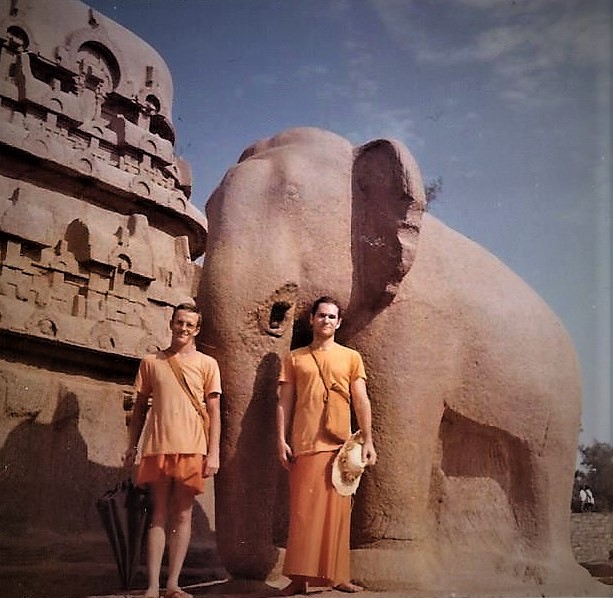
American yogis touring India

As young yogis living at the Poconos Ashram in Pennsylvania, Bhakta and Jay made a pilgrimage to India in December 1973. It was Bhakta’s first trip to the source of the religious tradition and Jay’s second. Unlike many young American and European aspirants who moved to India to study with a guru, they were teaching and practicing on a rundown farm not far from New York City. Their daily encounters in the household they shared resembled much of what I describe in my novel YOGA BOOTCAMP.

I remember our teacher, an American woman, telling of her first experience with a real elephant in India. I think she would have loved having one on our farm.

Mixmaster? Just look at ‘Nearly Canaan’

What, me as a Mixmaster?

Just look at the topics percolating in my novel Nearly Canaan.

Take just ten, shaken or stirred or mixed in a bowl:

  • Promise. The word has many meanings, including ability, talent, potential, opportunity, guarantee, understanding, agreement, contract, oath, pledge, vow. It can also have quite different meanings for each person. In this novel, especially, it’s a promised land, a dream, and sometimes even a broken promise.
  • Place. This story is rooted in the surrounding landscapes, beginning with a small-town on the prairie and moving on to the Ozarks before landing in the desert interior of the Pacific Northwest, where Mount Rainier and the Cascade Range and Seattle beyond also play into the action.
  • Intimacy. The story goes behind closed doors, for sure.
  • Friendships. In this story, these usually arise among the couples and their shifting inner dynamics. Often, these friendships prove essential for daily survival.
  • Family. Jaya becomes quite fond of her in-laws and their support despite their initial differences.
  • Spirituality. It’s not just faith and meditation but a meaningful faith community, too.
  • Career. Jaya isn’t the only young adult trying to navigate a demanding career in this story. The long hours and endless struggles of being a rising executive even in nonprofit organizations take a toll. As for their spouses? Finding their own niche is not always easy.
  • The seasons. Dwelling in an apple orchard, Jaya and her husband observe the rhythms of the year close up.
  • Wilderness. Part of the allure of the Pacific Northwest is its access to forests and mountains, but open desert is wilderness, too.
  • Lasting impact. For many in their circle, Jaya is seen as the Wise Woman who fosters a better life. How far does her impact extend?

Be among the first to read the novel!

The beaters were a pain to clean, though. Licking frosting from them was another matter.