A lingering insight on marital splits

The Divorce Culture, by Barbara Dafoe Whitehead (New York, Alfred A. Knopf, 1997, 224 pages, $24) – reviewed by Jean E. Milofsky, The Colorado Review, fall 1997:

“Whatever else divorce is, it is fundamentally a loss. As a writer friend of mine once said, ‘It’s like death except no one says nice things about you.’ In divorce one loses not only the relationship with one’s spouse, but also one’s location in the social fabric. Friends fade away, and families are thrown into turmoil. Then there are the inevitable economic losses, which Barbara Dafoe Whitehead rightly claims fall disproportionately on women. Nowhere in her polemic against divorce, however, does Whitehead conceptualize divorce as a loss. Rather, with increasing insistence as the book goes on, she views it as an expression of individual freedom in a highly libertarian age.” …

“Whitehead’s concept of divorce as an expression of unfettered liberty ignores what every divorcing individual realizes – no choice is without consequence, no decision is without obligation or work, and adult freedom never really comes from throwing off chains.”

~*~

Counter with James Dobson’s insistence that “love at first sight” is really just infatuation and therefore selfish, while love is other-focused.

Tackling the family photos together

In the final revision of my novel What’s Left, her aunt Nita becomes an active instigator of the project that leads the adolescent girl to closely examine her father’s photographs. Another change is that Cassia’s best friend and cousin, Sandra, joins in with second opinions.

Here are some passages that were no longer needed like this in that final edition:

What happens in that process flips our usual pattern of interacting.  Strengthens our bond. Forget Theos Barney and Theos Tito – they’re usually too busy to answer my inquiries, but after listening closely to Thea Nita, I have a sense they just don’t know as much detail as she does. Not just the Baba years, either. She’s filled me in on Ari and Perry and Athina and Dida and Ilias and Maria and Stavros and Bella. She knew them all, and was old enough to see much. Even so, she’s anxious to uncover as much about them as much as I do, which adds to our working together as a team.

~*~

She was particularly close to Dimitri, too. When they were apart, from college on, they corresponded in long weekly letters that often included newspaper clippings, and she’s promised to let me examine that collection when I’m ready. There’s so much on my plate already.

~*~

Bit by bit, the puzzles fit together enough to hint at the bigger picture, even around huge gaps that remain.

~*~

Always the news hound, Thea Nita confides to me the difficulty she’s had in digging up the few details she passes on, and, as she emphasizes, some of the conclusions remain conjectural. Add to that a few documents passed down in the family and some letters we still need to translate. A timeline takes shape.

~*~

So much of what I’m telling you comes down through Papou Ilias, Thea Nita tells me, explaining how many times they’d sit down together and his observations would flow on and on in response to her questions. As she says, he obviously admired Ari and Perry – and as a philosopher, he had to be true to the line of questioning, no matter how discomforting the conclusions may seem.

Oh, I’m so glad she stopped talking like this! In the final version, she’s pretty snippy.

~*~

In assembling these family pictures, then, Cassia comes to appreciate how important the word pictures are in giving life to the visual images. Both are essential for what she’s pursuing.

~*~

As a child, I never really understood the definitions of aunts, uncles, cousins, much less how we fit together. But we weren’t close, either, and had very little in common. Do you think Cassia’s loss make her more attentive to her family connections? Does she just know too much for her age?

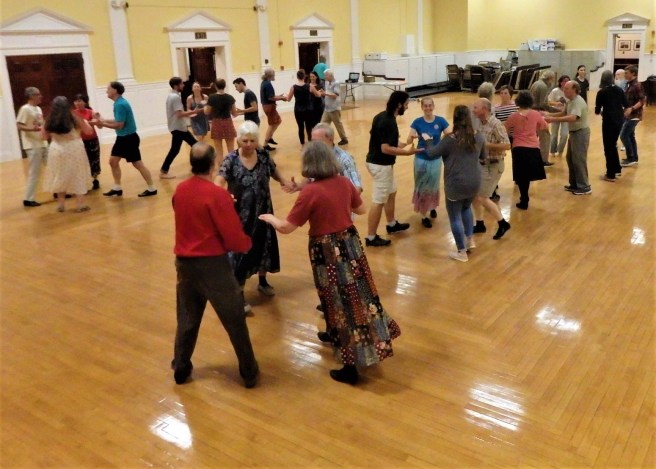
They’re balancing the ring in Petronella

A style of community dance popular in New England since Colonial times, contras start out as two lines of partners facing each other and then the next couple on each side. There’s a live band and callers, and we walk through the sequence of steps before the music begins. The whole point is to have fun, and you wind up dancing with everyone in the line before the piece is finished. This example is from the  Lamprey River Band’s dance series in Dover’s city hall before the monthly event moved to a Unitarian-Universalist church in neighboring Durham. This particular dance is named Petronella.

A different paradigm of family

My novel What’s Left was precipitated by the structure of a book I’d just read – four sections of four chapters each. Somehow, I just knew this was what I needed for the material already floating around in my head, even though at this point I hadn’t been thinking of writing another novel. But this triggered it.

I’d been reflecting on the ending of my newly recast Freakin’ Free Spirits narrative, where the protagonist lands in a circle of bohemian siblings who have inherited a restaurant. At the time, with only a general acquaintance of a few individuals in the tradition, I intuitively identified them as Greek-American, in part, I recall, as an attempt to suggest a bridging of two ancient wisdoms – the Buddhism from the East and ancient Greek teaching in the West – and in part as a vague awareness of the prevalence of this ethnic group’s ownership of restaurants across the country, possibly including the one that provided a foundation for the one in my story.

In revisiting that ending, though, I felt a need for an understanding of how the siblings turned to Tibetan Buddhism in the first place and why they were now actively hippie, which in turn needed a clearer presentation. Viz, as I’ve been arguing, hippies came (and still come) in many varieties, and no one probably ever fit in the mass-media stereotype.

What became clear to me as I considered the issues was that I needed a backstory, one that winds up going back two generations rather than one. This, in turn, presents another challenge: how many named characters can a reader follow? Since my new novel is told by the daughter of the earlier protagonist, this could get very messy. Remember, the restaurant was inherited by a circle of siblings.

I do employ several turns in the plot to keep maintain a focus, but in doing so, I’m reminded of an insight I had my genealogy research when I noted four Hodgin brothers marrying four Ozbun sisters (or some such, it’s the concept that counts here). What I saw here somehow goes beyond our modern isolated, small nuclear family household in which a husband is expected to fulfill all of a set of expectations and the wife, another. Instead, I’ve wondered how much of those expectations could be spread across the siblings. Not that I go quite that far in my newest novel or at least that blatantly. But the daughter is quite aware of how different her extended family is from those of her classmates.

Does a family that meditates together glow together?

The first decade of her father’s presence in the family was one of great growth and deepening personal awareness for every member – especially before all of the children, including Cassia, come along.

For one thing, her parents’ generation is still working on its Buddhist studies together. As I noted in an earlier draft of my novel What’s Left:

You know, Baba will say one night after our family meditation, most of these enterprises wouldn’t stand a chance if it weren’t for one thing.

What’s that?

Rinpoche, the Tibetan master.

Then the room will fall into a profound reverie.

Well, it was all no doubt pretty exotic to all of them.

And then the vision got even heavier:

It’s the concept of living as a people of the Holy One, however we phrase it. A peaceable people. A peaceable kingdom. The great wisdom or enlightenment.

There was even a question of how much diversity they could manage:

Religions? Say the way a piano is a world apart from a trombone or a double bass or a clarinet, even if they rely on the same kind of musical notation? And that was before your Manoula weighed in on some wildly divergent ethnic musics based on entirely conflicting theoretical foundations.

Well, that got too esoteric, even for me! Play it as you will.

Still, not everybody in the family was so high on the Buddhist excitement:

The Temple Room relocates to the first-floor parlor next to Yiayia Athina before moving altogether to a more public location, one having chambers for our anticipated Rinpoche’s full-time residency. Yiayia Athina makes no secret of being glad to see them go. The chanting was getting on her nerves.

Oh, I’m so glad Cassia stopped talking like this! In the final version, she’s pretty snippy.

~*~

Cassia’s family obviously takes all this seriously.

What spiritual practice or source of inspiration is meaningful to you?

Ten perspectives on yoga in America

My novel Yoga Bootcamp stirs up more curiosity. Here are ten facts.

  1. Number of yoga teachers in U.S.: 52,746 registered with Yoga Alliance in 2015.
  2. Number of centers: 18,000.
  3. Number of yoga practitioners in U.S.: 37 million.
  4. Number over age 40: 14 million.
  5. Percentage of women and men practicing yoga in U.S.: 72 percent versus 28 percent.
  6. Amount spent on yoga classes, clothing, and gear: $16.8 billion.
  7. Most popular reasons for practicing yoga: flexibility (61 percent); stress relief (56 percent); general fitness (49 percent); overall health (49 percent); physical fitness (44 percent).
  8. The highest percentages of yoga practitioners: Found on the West Coast and Mid-Atlantic states (New York, New Jersey, and Pennsylvania). The lowest percentages are in New England, the Upper Midwest and Plains states, and the East South.
  9. Circulation of Yoga Journal magazine: 375,000.
  10. Turnover: Only 25 percent have been doing yoga for more than five years.