On the waterfront itself

The bluff has been carved back to make room for a riverfront park by moving a road back.

After leaving the waterfall, the Cocheco River makes a sharp loop around the Washington Mill. Henry Law Park borders part of that sweep, but its public frontage is about to become three times longer.

Environmental cleanup of the river itself gave the city one more reason to move the public works department’s yard, which was around the bend, to another site, opening a choice piece of real estate at the Knuckle, where the river turns again. A marina sits on the opposite bank. Get the idea? You can sail to the ocean from here.

However, until the Tommy Makem traffic bridge was built a few years ago (any Irish music fans reading this?), the site was pretty isolated, connected by a narrow lane at the foot of a wooded bluff. The new bridge has allowed a bypass around a stretch of busy Central Avenue, but the sidewalk along the river feels pinched. That’s about to change.

The bluff has been removed. Yup. It’s been carved away to allow the street to be moved back away from the river to make room for a more pedestrian-friendly Waterfront Park at Dover Landing. Think of casually strolling or walking your dog or taking a stroller and a toddler for a walk. Maybe even just going out to sit with a book or catch a few rays on a blanket.

At the far end, down by the Knuckle, a mostly residential development will go in – behind the end of the new riverfront park. Say hi to your neighbors, that kind of thing.

The project has an additional touch. Our 29-acre Maglaras Park sits atop the slope, but getting there has required a circuitous route. That will change with the extension of Washington Street, directly linking that park to the waterfront and downtown across the river.

It will all redefine the city. Think what Central Park is for Manhattan or, closer to us, Piscataqua Park is for Portsmouth.

I’m impressed. What does your location have to offer?

Washington Street passes between two large mill buildings on its way to the new park. The stone building, upper center, is on Lower Square, where the Foster’s Place and Orpheum are rising.

Chapel Street

Corner view toward downtown. The windows are a common style in my town.

Two blocks east of the waterfalls, more residential units are going in on a hilltop site overlooking the river, at least from the rear units. This project does fill in the skyline as seen from the river and eliminates an eyesore.

Again, the emphasis is on pedestrian-friendly and the look is traditional New England. Note the “two-over-two” windows so common in my part of the state.

The development opens out at the back, where apartments will have views of the river below.

Busy bees

My wife couldn’t resist getting up close to the entrance to our new beehive and using her cell phone camera to record this. The portal is getting a lot of action during the day as the honeybees are take off in search of food and return. The one with the fat yellow legs is carrying a load of pollen home. The colony itself seems to be thriving. 

Ten perspectives on subway systems around the globe

I’ve long looked at subway systems as a measure of a great metropolis. Not its only one, mind you, or even the defining one, but among the criteria to consider.

Here are ten items to put that in perspective.

  1. About 160 underground public transportation systems operate in 55 countries around the world – more than 40 percent of them new in the 21st century, starting a decade after my novel Subway Hitchhikers was first published.
  2. The London Underground opened in 1863 and operated its first electrified line in 1890, making it the oldest.
  3. The longest route is the Shanghai Metro.
  4. The busiest system is the Beijing Subway.
  5. New York City has the most stations.
  6. The Paris Metro opened in 1900. It has some great art deco design and a certain funky romantic air.
  7. Budapest opened in 1896, beating Paris. As did Boston, 1897.
  8. China has 32.
  9. Africa has three: Algiers (2011), Cairo (1987), Mecca (2010).
  10. The Moscow subway, with some truly impressively beautiful stations, opened in 1935 and claims the world’s highest daily ridership – nearly seven million. Tokyo, opened in 1927, has 8.7 million daily riders – more than Moscow’s – but the footnote is that subways account for only a fraction of the daily passengers. As for Beijing, 10.3 million riders daily? Go figure. Tokyo’s punctually efficient system still hires oshya to push commuters like sardines into the tin. Err, car, at peak hours.

From daily news to daily views


The old Foster’s Daily News newspaper plant on Central Avenue is getting quite a makeover, now that the paper’s published elsewhere.

Just a block south from the waterfalls, the former Foster’s Daily Democrat newspaper plant is becoming mostly apartments. The newspaper office and printing press moved out to an industrial park a few years ago, leaving the triangular site vacant. One side is on busy Central Avenue, where the original building sprawled out onto some curious additions. The other side, on Henry Law Drive, was an uninviting cement-block wall, which in effect turned its back on the neighbors.

That backside is being opened up with doors and windows facing Henry Law Park and the river itself.

For added excitement, the park now includes a state-of-the-art playground as well as the New Hampshire Children’s Museum and a band shell for summer concerts.

In becoming Foster Place, the redesign includes new construction atop the old, rambling building. I’m curious to see how it plays out.

The repurposing has a parallel in my novel What’s Left, where Cassia’s family transforms a nondescript building into their expanded restaurant complex. I didn’t picture hers quite like this, but opening the wall and building more on top are part of the story. Much of the new design hinges on windows and doors carved out of the earlier walls.

Facing the park.


Requiem for hippie

In revising the novel that has been recast as Daffodil Uprising, I began grieving. It wasn’t the feeling I had expected. This was supposed to be a celebration of a remarkable time in world history. Some things really did change as a result.

Not all of them for the better, alas. And many of the lessons arising from Vietnam, especially, still haven’t been learned in realms of political power. And while much of the environment has been cleaned up, the global climate is still headed for disaster.

Repeatedly, I felt this was a requiem.

Part of that must have been a consequence of my long effort of drafting and revising What’s Left, which picks up on the central character a generation later. Or, more accurately, his daughter, Cassia.

But moving on with his story, in what’s now released as Pit-a-Pat High Jinks, I’m feeling wounded. Not by the novels, mind you – I think you’ll find them entertaining, enlightening, and delightful. No, the wounds are from, well, all kinds of losses, many of them my own fault.

I have heard that in the retreat from the outburst of the Quaker movement in the radical uprisings of mid-1600s Britain, many of them had a something of a shellshock look for years after. They had come so close to truly revolutionary societal change and lost that to the Restoration. Well, some of those ideals did come to flower in the American Revolution – the Bill of Rights, especially – but even there, we’ll still falling short.

As the liturgical chanters sing out in accompaniment to prayers in Christian Orthodox worship, Kyrie eleison – Lord have mercy.

Yes, mercy. And hope. And grant us peace.

New to the family

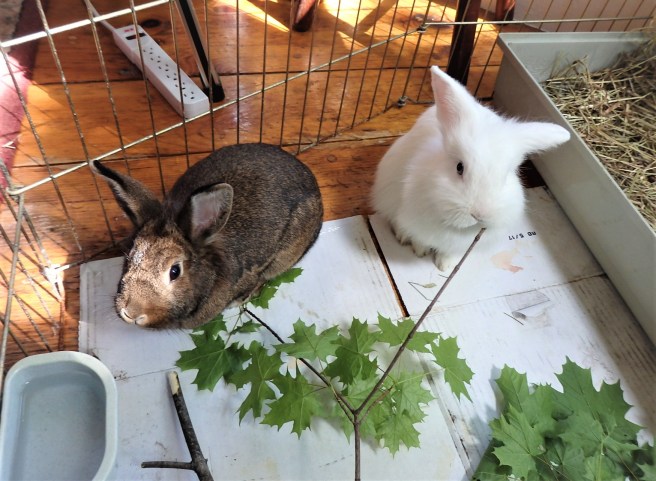
This pair of year-old sisters is getting adjusted to living with us. Originally named Maya and Elena by the daughter of their previous owner, we’ve been calling them Pepper and Sal … or even Salty. The are quite lively, entertaining, and enthusiastically devouring many of the weeds and branches gleaned from our gardening. And, yes, they are quite cuddly.

What’s below the pavement in Manhattan?

A compact and congested city center sits atop a spaghetti pile of underground pipes and wires and more.

Here are ten things you might find below the pavement in Manhattan:

  1. Con Edison’s 105 miles of steam pipes heating nearly 2,000 buildings. (Take care – it’s 350 degree heat!)
  2. Water mains. Many lead to buildings. Others to fire hydrants or drinking fountains.
  3. Electrical conduits and telecommunications infrastructure.
  4. Natural gas mains. Beware of the pressure.
  5. Sewage pipes. These have to run downhill in the end.
  6. Storm drainage. Ditto.
  7. Underground storage tanks containing things like Freon or fuel oil or industrial chemicals. Who knows what else.
  8. History, from cobblestones and Colonial foundations to bottles and bones.
  9. Passenger and freight train tunnels. Think PATH, Metro North, and the Long Island Rail Road when they roll into Penn and Grand Central stations.
  10. Subway tubes and stations and the air vents that support them. The city has 275 fully underground stations.

What’s actually down there often remains a mystery, even to public and utility officials. What happens when a corroded pipe bursts?