While looking for a positive male authority figure

Among her mother’s male ancestors in my new novel, What’s Left, my personal favorite is clearly Ilias the Cypriot, even if I might hope to be less obvious in my telling. Ari, Perry, and Stavros all have their better qualities, but I doubt I’d get along with any of them for long. There are reasons, though, that Ilias is also known as the Philosopher, even when he’s become a successful construction contractor in Chicago before he and his wife relocate in what they erroneously assume will be semi-retirement.

He’s gentle, curious, generous, and instills in grandson Dimitri and granddaughter Nita, at least, qualities they ride to success in their own fields.

If only he’d been present to comfort Cassia in her grief after her father vanishes in an avalanche halfway around the globe – we would have had a different novel. Is there a point where the elderly are simply too weak to lend comfort or guidance, even when they’re still breathing? In the novel, unlike some of the more dramatic deaths, Ilias and Maria simply fade into a past. I imagine them going off arm in arm, smiling, but leave that to the reader’s discretion.

~*~

Think of the circles around you. Who do you look to as your favorite male authority figure?

~*~

A large Queen Anne-style house with a distinctive witch’s hat tower something like this is the headquarters for Cassia’s extended family in my new novel, What’s Left. If only this one were pink, like hers. (Manchester, New Hampshire.)

Ten favorite restaurants in my experience

Some of these no longer exist, other than in my memory. And while some are expensive, others are quite the affordable but deserve kudos for skillful preparation and good ingredients.

  1. Big Night, Dover. Anything Chris and Linda did here or in their later incarnations in South Berwick, Maine, was always masterful, often with a French or Mediterranean base. Small-scale, as in a two-person operation, can truly be beautiful. They’re the standard by which we now measure all others.
  2. Fore Street, Portland, Maine. On a larger scale and an industrial style room, this is simply great food. We had a sauvignon blanc that was delivered with very little markup from retail simply because the owners thought this would be perfect for our meals – and we’re still searching for another bottle that comes close. My wife will rattle off the details of our meal and why we were so thoroughly impressed.
  3. North, Providence, Rhode Island. Another small setting – 18 seats, plus a small bar – this Asian fusion laboratory was a revelation with tastes I didn’t know even existed.
  4. Gasperetti’s, Yakima, Washington. A small setting – about 48 seats at the time – this was considered by many to be the best Italian restaurant in the Pacific Northwest when we lived there.
  5. A tiny Japanese restaurant near Golden Gate Park, San Francisco. Four tables, as I recall on my first and only visit to the city. My introduction to raw fish (shashimi), sake, and plum wine. Heavenly.
  6. PB Boulangerie, Wellfleet, Cape Cod. Wonderful French with a chef proprietor from Lyons.
  7. Little Saigon, Worcester, Massachusetts. I love Vietnamese, and this one most of all.
  8. Lobster in the Rough, York, Maine. Many fine Sunday afternoons here with a cover duo and families playing bocce. They knew how to make fine onion rings and French fries, in addition to haddock and lobster. And don’t overlook the slaw. Straight-forward fare like this can be a tough test for many restaurants. We really admire the ones that pass with flying colors.
  9. Wonderland Café, Watertown, Massachusetts. Unpretentious Chinese cuisine that demonstrated the importance of fresh ingredients. This was takeout that was welcome a two-hour drive away a day later. ’Nuff said?
  10. Ta-boo, Palm Beach, Florida. My first truly upscale restaurant experience, thanks to my girlfriend’s parents. Had my first raw oysters and first orange flambe while being entertained by a Yale glee club. After that, everything’s a delirious swirl.

~*~

So how about your favorites? And what makes them stand out?

~*~

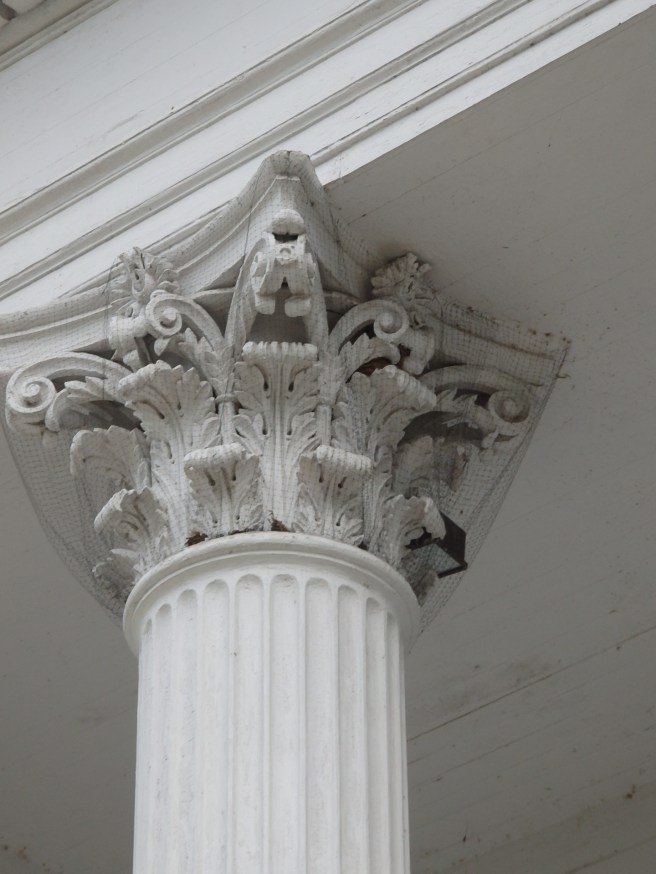
A Corinthian column on the exterior of the Bradford Congregational Church in Haverhill, Massachusetts, is a classic touch. The screening is to keep birds at bay.

Of course, this is totally unrelated to the theme. Just another thing on my mind.

Sometimes the story goes its own way

Considering his love of mountains, I am surprised that I didn’t have Kenzie heading off on mountainous trails on more of his days off work. He was certainly living close enough, if he wanted to drive a few hours each way.

Instead, it’s swimming at the secluded lake those two summers as well as riding the underground rails of Gotham one weekend of each month.

Sometimes, then, what happens all depends on the people you’re with or are meeting.

That’s how it worked for me, in a situation similar to Pit-a-Pat High Jinks.

Maybe Kenzie just thought he’d get the mountaintop opportunities later? Or maybe just not quite where he planned?

Allowing for a fairy-tale dimension

Admittedly, in my new novel, What’s Left, her family has a lot of good luck – accompanied by enough bad things for balance.

In the early drafts, I liked the fairy-tale, larger-than-life tone – as befits the “best movie ever” or “best novel ever” lists of upwards of ten thousands of listings that I hear from younger voices around me. Still, I’m a bit too Aristotelian to allow more than one as the best of anything, and I’m not referring to Cassia’s great-grandfather Ari here, either.

No, I’m thinking of the fact she’s in a close-knit extended family that’s prospered. In this case we have three brothers who’ve worked tightly together. A more common example in today’s society would be the three brothers who will never again speak to each other after their mother’s estate is settled. And that’s before we get to their children, the cousins who barely know each other, unlike Cassia’s.

There’s her aunt Nita, who’s negotiated a contract to assure she owns her daily newspaper column.

The adults who’ve joined in the family get along well together, something that’s never a given.

And Cassia herself lays claim to a rare happy childhood, up to the point when tragedy strikes when she’s 11.

I never intended this optimism when starting out on this work – it’s just where the narrative wanted to go. If the novel originated, as I think it did, in revisiting the aspirations of the hippie experience, what follows fits well as a foil to directions American society has since taken.

By the way, I do love fairy tales, especially in their more ominous, early, unrefined versions. The kind where Rapunzel’s pregnant or Cinderella’s stepsisters lose their feet.

There are a few of those touches in Cassia’s tale, too, just in case you wonder.

~*~

Put yourself in the story. Or have Cassia stop in your neighborhood for a visit. Where would you want to dine with her? Create something imaginary, if you want, or simply take her (and us) to one of your favorites. (For some of our neighbor girls, it would definitely be the Creperie.)

~*~

A large Queen Anne-style house with a distinctive witch’s hat tower something like this is the headquarters for Cassia’s extended family in my new novel, What’s Left. If only this one were pink, like hers. (Dover, New Hampshire.)

Ten ways ‘High Jinks’ is new and improved

My newest book, Pit-a-Pat High Jinks, is a thorough reworking of my earlier Hippie Drum and Hippie Love novels.

Here are ten ways the result is new and improved.

  1. These events are now seen a generation later by the protagonist’s daughter, Cassia, even if she has to pinch her nostrils closed while admitting some of the love scenes. She’s not as vocal here or as perceptible as she is in Daffodil Uprising, but she nevertheless instills a critical distance. There are good reasons so much of this era still puzzles her.
  2. Many of the characters are renamed, starting with our hippie boy, Kenzie, and they’re now more fully developed. The backstory for Shoshanna, especially, emotionally blew me away while revising her part of the plot.
  3. Drummer has evolved. He’s now Kenzie’s best friend and an integral counterpoint to the happenings, as is his pit-a-pat on his very private collection of drumheads.
  4. This is the ’70s rather than a blend with the ’60s. Woodstock has happened, and the movement is heading off in many new directions. One of them is what’s supposed to be a hassle-free back-to-the-earth lifestyle like the one Kenzie’s landed in.
  5. The two earlier novels are woven together. Originally, in the first one, Kenzie usually fails to land himself in bed – a reflection of the reality that in the hippie era, not everyone was getting laid all the time. That version focused more on his housemates and friends in town. In the other story, he’s far more successful sexually, though the events still lead to the same ending. In the new blended novel, he’s one hot dude, though it’s not always obvious how much of the action is a consequence of his imagination or dreaming and how much matches reality.
  6. The blending instills a clearer plot line. His farmhouse and his social circle around campus are given balance, and his sequence of lovers advances his wisdom.
  7. Kenzie’s attraction to Buddhism is more fully explained. The Tibetan practices transform him, inside and out.
  8. The playful, even dizzying thrust of the original two novels is now countered by meaningful times of loneliness and brooding. Being hippie, after all, was no guarantee of always being happy. Quite the opposite. It often involved extremes of feeling.
  9. This novel is now character-driven, rather than running along the surfaces of its actions. The actions grow largely from their individual emotions.
  10. It’s all about connections. The people Kenzie meets lead to new adventures and first-hand discoveries.

Be among the first to read my newest novel.

Pit-a-Pat High Jinks


Defined by faith, especially

Many Americans participate in a congregation close to their homes – a neighborhood church, as it’s often called.

For others, though, the decision is more selective and may require travel to gather for worship, communal action, and other events.

Frequently, these members define their personal identity strongly by these religious circles – I certainly do as a Quaker. Still others, like Jews or Greeks, find their identity further enhanced by the use of a foreign language, such as Hebrew or Greek, in worship and possibly also at home, as well as unique holidays on dates the wider public doesn’t celebrate.

I am fascinated by the intensity of this identification for some people or its relative weakness in others. I rarely hear individuals define themselves as, say, Methodist or Presbyterian or even Baptist with the sense of intense core identity I hear in Quaker, Greek, Mennonite, or even “nonobservant Jew.”

Think about the Amish, with their German dialect accompanied by distinctive dress and horse-and-carriage transportation. Or Ultra-Orthodox Jews who also observe the dress restrictions and likely add Yiddish to the mix.

Let’s assume we’ll find similar patterns in new ethnic populations appearing in the nation – Islam, especially. Anyone else feeling some empathy?

What’s your experience of religion and personal identity?

Facing strands of my remaining male vanity

As a little kid, I hated going to the barber. Was it really that painful?

I don’t know when my mother took over, but I doubt it added any style. This was the ’50s, remember, and then the early ’60s.

Looking at those photos, I see a vast improvement when my girlfriends took over.

And then the hippie movement hit. I let mine grow out. It was wild, felt free, and even attracted chicks. One, who’d known me in high school, kept voicing her disbelief, “You’re so cool now.” Like what happened?

Looking at the photos, though, I should have had it styled. Really. It’s embarrassing, even with the headband.

Sketch of me by the late Douglas Dorph,, 1971 or ’72.

Once I moved to the ashram, it started getting shorter. Not all at once, but by degrees. We were cleaning up our act, as Swami said.

By the time I was back out “in the world,” mine was mostly about sideburns, and then my locks were in the hands of my first wife, the artist.

Flash ahead a decade, right after the divorce, and I was visiting the Big Apple for a job interview. A good friend who always looked great in a new ‘do arranged for me to visit her hair stylist in Brooklyn. The session was quite the revelation, even after he ran his fingers through my mane and declared with disgust, “Dis hair wasn’t cut in New York.” I mumbled a dumb apology akin to groveling.

Well, whatever he did worked. I landed the job.

A second current was running through many of those years. It started at the temples, the receding hairline. Invisible to me was what was happening at the crown. Shortly after I relocated to New England, I was starting to look like a medieval monk there.

Well, when I was walking with a good friend who’s a family physician, he quipped that a popularly advertised shampoo or daily pill wouldn’t do any good in my case. I had the wrong patterning or some such for it to address. Alas.

And then, once I’d remarried, my daughters warned me of dire consequences if I ever grew my ponytail back. So the thinning continued.

After the younger one had gone off to college, my roommate from my own first year after came up for a visit. I was in shock. His eyes were still the sparkling blue and his voice and laughter were as musical as ever but – gasp – that naturally blond Afro he had sported was totally gone, leaving a shiny dome in its place. Something was off, seriously wrong.

Continue reading “Facing strands of my remaining male vanity”