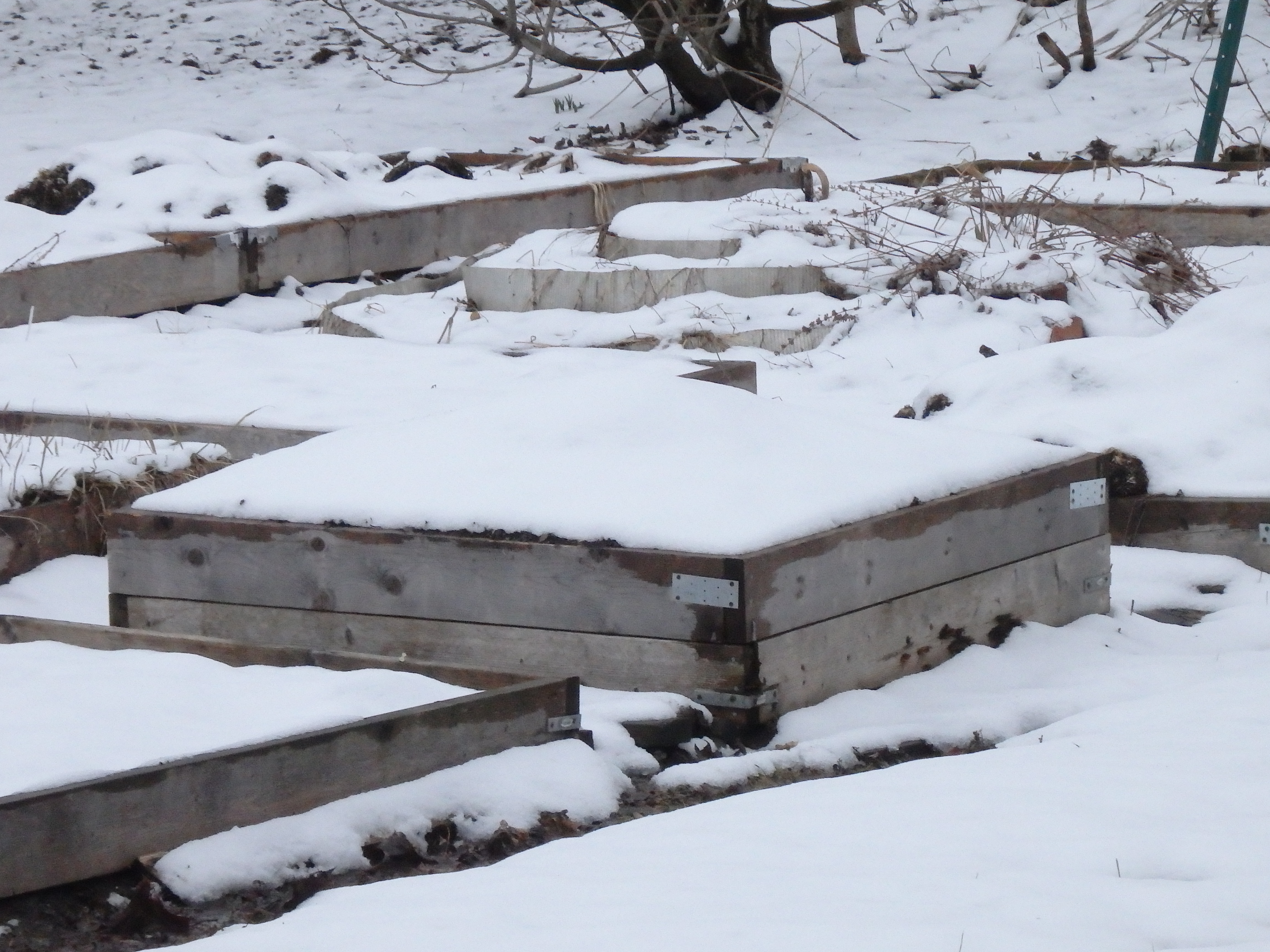
GARDEN AT REST
You never know what we'll churn up in cleaning a stall
I dream of a kind of writing that approaches, well, dreaming. A narrative of free-floating, widely associative surrealism that’s richly informed by fomenting emotions.
So the other morning I was somewhere in the vicinity of what I report in my novella, With a Passing Freight Train of 119 Cars and Twin Cabooses, and having coffee with an ex-boss, maybe even at the same cafe frequented by John Wycliffe and Hieronymus Bosch in my book. We were too far from the ocean to be considering his sailboat, so we must have been discussing a story in the works. Or maybe politics or updating him on office gossip, now that he’s moved on.
Next thing I knew, we were joined by Jerry Seinfeld – as he was on the show, who knows what he looks like now – and an invisible stranger. Jerry started telling me that’s not how he would have constructed the scene under consideration in my new story.
“When it comes to going to the dentist,” he said, “I would make it as awful as I could. Everything has to go wrong.”
But that’s not how it happened, I want to reply. It’s not true – not true to the facts.
“So?” I can hear from his end. “Wouldn’t it be true to the dream? And much funnier?”
He’d have a point. I’m still thinking about it.
For the record, let me say – there are no scenes with dentists in my novels. And maybe just two or three poems with the hygienist.
 ~*~
~*~
For this volume and more, click here.
Just as the first snowstorm of the season has finally hit New Hampshire, the state’s first-in-the-nation presidential primary is beginning to show some flickering flames. The kind that produce both heat and light. Up till now, it’s been only smoke, mostly on the Republican side. (The Democrats have been politely, though passionately, lined up behind Hillary or Bernie, recognizing the battle they’ll share together after the national convention.) The Granite State’s winnowing function has worked best when some unanticipated turn reveals a candidate’s true character for the public to see, either with devastating consequences for the campaign or its big breakthrough moment.
To be candid, I’m surprised we got through the autumn without seeing one or two of these. Yes, Trump came close when he attacked a St. Anselm college student as a “Bush plant” after she asked him a question, but the story never gained traction. The rest of the pack of candidates never picked up on the theme or any other, for that matter. The race to date has been pretty bland, all too predictable, little to set one apart from the other. Where’s the genuine courage or bold intelligence been? Talk all you want about the Trump-Carson-Fiorina outsider role, the pros in the lineup have been notable mostly in their failure to connect as seasoned campaigners rather than slick packaging alone. We’ll probably see some fascinating postmortems when it’s all over, but for now the scene’s been pretty befuddling.
We did awaken to an unexpected surprise November 28 when Joseph W. McQuaid, publisher of the state’s largest newspaper, endorsed Chris Christie. While the Union Leader and its New Hampshire Sunday News hold staunchly conservative editorial pages, there are Republicans in the state who insist these are liberal media. Ahem. True, McQuaid has often marched out of step with many of the state’s right-wing voters – anyone remember Malcom Forbes, for instance? – but you can assume Joe’s never, ever voted for a Democrat.
Yesterday morning, though, came the startling headline across the top of the front page: “Trump campaign insults NH voters’ intelligence,” an editorial by McQuaid noting Trump’s resemblance to bully “Biff” in the “Back to the Future” series. As McQuaid wrote, “Trump has shown himself to be a crude blowhard with no clear philosophy and no deeper understanding of the important and serious role of President of the United States than one of the goons he lets rough up protesters in his crowds.”
You get the idea.
And Trump’s response?
As this morning’s top of the front page headline announces, “Trump calls McQuaid ‘lowlife.'”
Of the many things you might accuse the publisher, “lowlife” is not one that springs to my mind, especially when coming from the lips of someone like Trump. The inaccurate retort carries the air of desperation – and flailing.
We’re still six weeks away from the voting booths, and Trump’s starting to show his central weakness. Am I wrong in seeing him as thin-skinned, someone who can’t take criticism or a well-aimed insult? Who can’t take what he routinely dishes out? Is this a wakeup call to his rivals to get their punches in, too, now that they see he’s not invincible? For that matter, what will their responses reveal about them?
Sure looks like it’s about to get interesting. Maybe even exciting. But first, I need to shovel some snow.
From the rails, the landscape threads together quite differently than it does from a highway or water passage.
The tracks pass sidings, graffiti-tagged warehouses and low factories, storage yards of all varieties, rundown housing, apartment clusters – and once out into the farmlands, grain elevators as well.
Clicking along, you can’t help but wonder how many of the enterprises are legit or how many, in their decrepitude, cover questionable activities.
For a maverick intellectual gone incognito, they might even be an ideal location to go underground for a while – a place to work uninterrupted.
In my novella With a passing freight train of 119 cars and twin cabooses, English Bible translator John Wycliffe shows up in a railroad crossing on the American Great Plains, where he’s soon joined by Hieronymus Bosch.
As they discover, once you’re lost in time and space, anything just might happen.
~*~
For more of the fantasy, click here.
Looking at a volume and realizing it’s one of my “keepers,” meaning the ones I keep close at hand, had me wondering if I could name a Top Ten list of books.
Nope, definitely not.
How about Top Hundred?
I turned to my mostly Quaker bookshelf and realized it has more than that alone.
So nope, definitely not.
Five hundred? Maybe, but it would be tough.
 A woodpile needs time to season if it’s going to do any good in heating the house. It’s a relief knowing this is ready. This is how it looks in a typical year, unlike this uncommonly warm December. Last time we looked at the forecast, though, snow was finally around the corner. We’re hoping. This is, after all, New England.
Taking the bus to and from Boston for my choir’s caroling performances was far more civilized than trying to fight traffic and find parking. I should add that this is a commuter bus that makes only two stops before hitting Logan airport and then South Station. It’s clean, quiet, and comfortable, with free coffee and newspapers at the terminal. By the time you factor in tolls, gasoline, parking fees, and subway fares, it’s probably cheaper, too, at least for just one person.
Freed from driving and then sitting high above the auto traffic, I found myself observing much that’s normally out of sight, and for parts of the route, I’m afraid to report the cluttered landscape was rather dismal. For one thing, I was surprised by how much of the development in the suburbs we traversed was cleaved from rock. Nothing natural, much less harmonious – brute force, mostly. And then there was the jumble of retail boxes along busy highways, leading to the question of just who really patronizes the enterprises, much less whether there’s enough revenue to meet the bills. How many discount mattresses do Americans buy, anyway, or how many palm readings? A winter coat outlet I can understand, but, well, memory fails.
Perhaps if these were along pedestrian byways I’d be more sympathetic. Having to drive from one to another to browse or buy just eludes my understanding. For once, I’d even give Internet shopping the edge.
I also felt a pang in recalling a reply I made to a comment that remarked on the beauty of the town where I live. As I recall, I said that beauty can be cultivated anywhere, but that’s not what I was seeing along this route with its oil-tank farms, treeless suburban housing tracts, and construction machinery garages.
And then, to my amazement, as I looked down to the level below the overpass we were ascending, I saw a green park set gently on the earth. Here was a pocket of relief in spite of the noisy traffic overhead. Children from nearby houses could play, adults could stroll or sit. I’m still in awe of the designers who advanced this – and those who brought it to fruition.
Just thinking along the way. If you’re traveling over the holidays, here’s wishing you safe and comforting journeys. And keep an eye open for those unexpected beauties, too, wherever you land.
With my plunge into yoga discipline early in my adult years, I came to an appreciation of non-Western ways of perceiving the world around us. For someone rooted in scientific, empirical , Aristotelian logical thought, this came as a jolt. Or, as Gary Snyder has argued, every poet must have an appreciation of some archaic system of awareness, be it astrology, I Ching, tarot, palmistry, well, you get the picture. Just listen and look.
What I’ve come to appreciate is the alternative wisdom carried by Native American elders, gurus of all sorts, and the range of those labeled shamans, East and West.
And so, at last summer’s sessions of New England Yearly Meeting of Friends, I was intrigued by an opportunity to view a movie on Mongolian shamans. It’s a remarkable work, by a registered nurse who has worked for two decades with nomadic reindeer herders in Mongolia. Having earned their trust and respect, and realizing their own vulnerability in the face of global changes, the shamans allowed her to film their healing ceremonies.
As I viewed the documentary, I was struck by how much of what she observed leads into Tibetan Buddhism, too.
This is remarkable work. What is healing, anyway? From a Christian point of view, I can say healing can differ from a cure. So just what happens in a shaman ceremony? And where can Eastern and Western health care interact? How much of our physical state is a reflection of our emotional and spiritual conditions.
We might wonder, too, how the Nativity stories would appear from the world view of the herders, how much their insights would inform us about shepherds and angels. Would a stable be that much different from the homes where the shamans enact their rites? As for the Magi? Or the heavenly wonder? Or even an oppressive political and economic presence? As the Gospel message insists, the world needs healing, no doubt about it.
To learn more of the reindeer herder perspective, go to Nomadicare.

Look at all that folded paper!
We know someone who ordered a book online but was confused when a much different volume was delivered. Not the right title or shape at all, much less the anticipated title. The seller was quite perplexed, too.
So the order was placed again, with another supplier, only to produce the same mistake in delivery. The very same wrong title, in fact.
Only after checking the ISBN (International Standard Book Number) did anyone notice the two titles – the one ordered and the one delivered – had identical numbers. I thought this was supposed to be a fool-proof system. How often does this happen?
As for the warehouse, I’m left wondering: Doesn’t anybody read the title anymore? A double-check for accuracy. And that was well before the Christmas rush. For the sellers, this was a costly error.
 Jnana's Red Barn