ALONG THE ISINGLASS

Quaker4 085

As I said at the time …

After dropping the kid off at school for a rare Saturday session (costume design class), noon, I stop off at Mount Isinglass for a short hike, in part to eat up a bit of time before our customary Saturday afternoon wine tasting and opera broadcast.

While most of our snow has melted, the woods are still covered, even in Gonic. The trail’s quite icy, with a few bare spots for relief.

Amazing how many people rely on their dogs as an excuse to take a walk – as the droppings in the snow attest.

Still, a good exercise, this trek before the snowpack is completely gone, at least if I don’t slip, fall, and injure myself.

Coming down near the river and former bridge, I view a black pool of stilled water brimming slightly over the usual banks, a complete contrast to the two snowy forest hillsides it cleaves. The utter beauty is timeless, and yet totally of the moment. While the water is quiescent, the air resounds with the ferocious chords of the cataract just out of sight.

I approach the top of the falls, the water gaining inevitable velocity and muscle, some of it careening into rockface and then pushing across the current. The narrow, sloping trail down to the base of the cascade, however, remains ice covered, and the places I would normally cross to the river are now mid-stream anyway. I back off, and head back, rather than attempting to scale the cliff to a possible overlook from above.

The temptation becomes too much, and I venture off the return trail, my feet crashing through snowpack that still comes to my knees, until I come to a place where the falls are in view off to the side below me. Rather than the miniature Niagara I’d expected, however, the water’s not rounding off to drop vertically, as I’d seen it in high water here the previous autumn. Rather, it shoots straight out – sometimes into a sheer wall of rock.

All of this wild power – untamed, exuberant, destructive or even cleansing, hissing like strong wind with drumming somewhere deep within. Anyone pulled into the current would be broken by the weight, crushed on the rock, torn by the crossfire. The mill that once channeled this energy has long been swept away by such outbursts, with only a few foundation stones remaining. Downstream, this water will be used at least twice to generate electrical power, but here it explodes for its own glory.

What is it that attracts us to cataracts? The description that comes to mind is “awe,” an acknowledgment of natural, inexplicable power far greater than our own mortal existence. Or maybe the seemingly inexhaustible stream of profusion that outlasts our own span of concentration and observation.

Even so, as the Psalmist noted, “He leads me beside the still waters,” not down to the base of the torrent. I think of two Plain meetinghouses in Ohio, both named Stillwater – one Quaker, the other Old Order German Baptist Brethren. The still water as a place of clarification, the sediment dropping away, a clear drink or safe place to water livestock and wildlife. Waterfowl, too, take refuge. Here the energy is latent and gathering, ready for release. In the meetinghouses, the worshipers gather, still themselves, become clear, preparing for the channel of the week ahead.

The contrast within one stream couldn’t be sharper, one as the other face of its complement.

On the walk back to the car, an icy beech leaf turns translucent on the snowy trail.

a beech leaf
translucent with ice

floating on snow

January 094

PAPER-FREE DIGITAL ANXIETIES

Do we read less closely online than we do on paper?

Do pieces get lost in the email and social media deluge of new material? (With paper, are we more likely to revisit a piece and ponder it? More likely to use it a springboard for response or action?)

Do we keep things in our inbox or mailbox folders? Or do we delete most of them once they’re read? (Or do we scan them, rather than reading?) Or just save them, “for later”?

I don’t know about you, but I’m feeling flooded. There seems to be way too little time to keep up, and my mind is feeling like a sieve. Now, we’re all on to the next …

FORGET THE ROBINS

Yeah, I know that seeing the first robin of the year is supposed to be a harbinger of spring, but the reality is that it’s possible to see them all winter, even where we live.

Just consider the day we looked out the window in the middle of February and saw 10 flocking together in our driveway – and believe me, we were a long way from the end of winter. There were more on the snow on the other side of the house, too.

The true bird of spring tidings is the buzzard. That’s right, the one more properly called a turkey vulture, back from wintering in Florida. (I happen to think there’s a lot of symbolism there. And they call the senior citizens “snow birds”? Maybe a better term would be “bait.”)

Yes, you can observe the stray vulture around here in the middle of winter, but they arrive in numbers just as the air’s turning from the depths. Sometimes it’s just as the last snow of the year is melting, in years like this when we’ve had a heavy and sustained pack build. Doesn’t matter, really. Somehow, they know.

Unlike the robins.

GLIMPSED FROM THE FREEWAY

When I grew up in the heavily farmed Midwest, a beaver dam or lodge was a rarity, an awe-inspiring emblem of wilderness.

But if you pay attention while driving the freeways around here – including those near Boston – you’ll catch a glimpse of a beaver lodge and then recognize the surrounding pond, frequently soon followed by another.

The sight reminds me of a wonderful documentary I once watched on public television. The program followed the life of a beaver colony through an entire year, and then, at the very end of the hour, the camera pulled back from the dam and lodge to reveal a busy limited access highway at the edge of the pond.

It’s enough to make me appreciate both kinds of engineering.

This beaver lodge appears to sit securely in remote wilderness ...
This beaver lodge appears to sit securely in remote wilderness …
... until you turn around to see it's built right at the side of a busy freeway.
… until you turn around to see it’s built right at the side of a busy freeway.
Further back in the pond is the large lodge that first invited me to pull over to the side of the road.


WHAT IF THERE HAD BEEN NO VIETNAM ENGAGEMENT?

Oh, if John Lennon had only penned this one! Just imagine, what if there had been no Vietnam engagement?

What if John Kennedy had not been assassinated and had been free to curtail or even dismantle the CIA?

What if the military-industrial complex President Eisenhower had warned of just a few years earlier had not been called into high gear for yet another round of (highly profitable) business? Would it have been brought under control and reduced greatly, with all of the investment directed elsewhere?

What if the Red-baiting bluff had been called and we’d instead seen Vietnam as a civil war rather than a Communist intrusion into the “free world”?

There would have been no lingering black cloud over America like the one that continues to fester. Even without the antiwar movement, I suspect, the nation would have been bitterly divided by the fiasco that ensued in Southeast Asia.

Would our economy have been unencumbered to grow the way Japan’s did at the time we were saddled with the costs of fighting or the accompanying steep inflation? Or the costs we’re continuing to pay in debt interest and veterans’ benefits?

And, oh yes, maybe there would have been no Hippie Trails novels, either.

Just imagine. And then add a comment on your vision. Music optional.

GOING PAPERLESS, TO SOME DEGREE

It’s been a little over a year since I went largely paperless, as the high-tech crowd would put it. Not entirely by choice, but rather because my printer died and the one we have for the household no longer interacts with any of our three laptops. So much for technology. Alas.

Yes, it can be an annoyance, especially when I have a choral score to print out or my wife’s found some great coupons. But we’ve found ways to cope.

When my printer went kaput, I was already finding that most poetry journals were accepting submissions only online, and that included the printed quarterlies. Keeping duplicate files of online and printout versions was troublesome and led to several embarrassing duplicate acceptances. So I decided to go to online-submissions only, and had only a few instances where I had to decline an opportunity.

Blogging, of course, has allowed me to move many pieces straight to the Internet without using paper, so that’s cleaned up a corner of my studio.

The big breakthrough was the ebook publishing with Smashwords. There’s no more need for multiple printed manuscript copies or files of postal correspondence to cope with. It’s so clean!

Not that the piles of paper don’t continue. Rather, they’re smaller these days. I’ll still pay my bills with a check, thank you, and there are always paper notes for consideration. Admittedly, I used to jest that sorting papers was one of my hobbies. In a way, it still is.

The fact is I love the feel and look of paper when it’s used well – fine stock and good typography, especially, along with masterful photography or illustration. And I still have a lot of that to sort through, to say nothing of all my years of journaling, which I’ve done with fountain pens for nearly two decades now. The old-fashioned fountain pens I ordered the same time I bought a PC that’s long been out of commission. The pens that dance in my hands, unlike this keyboard.

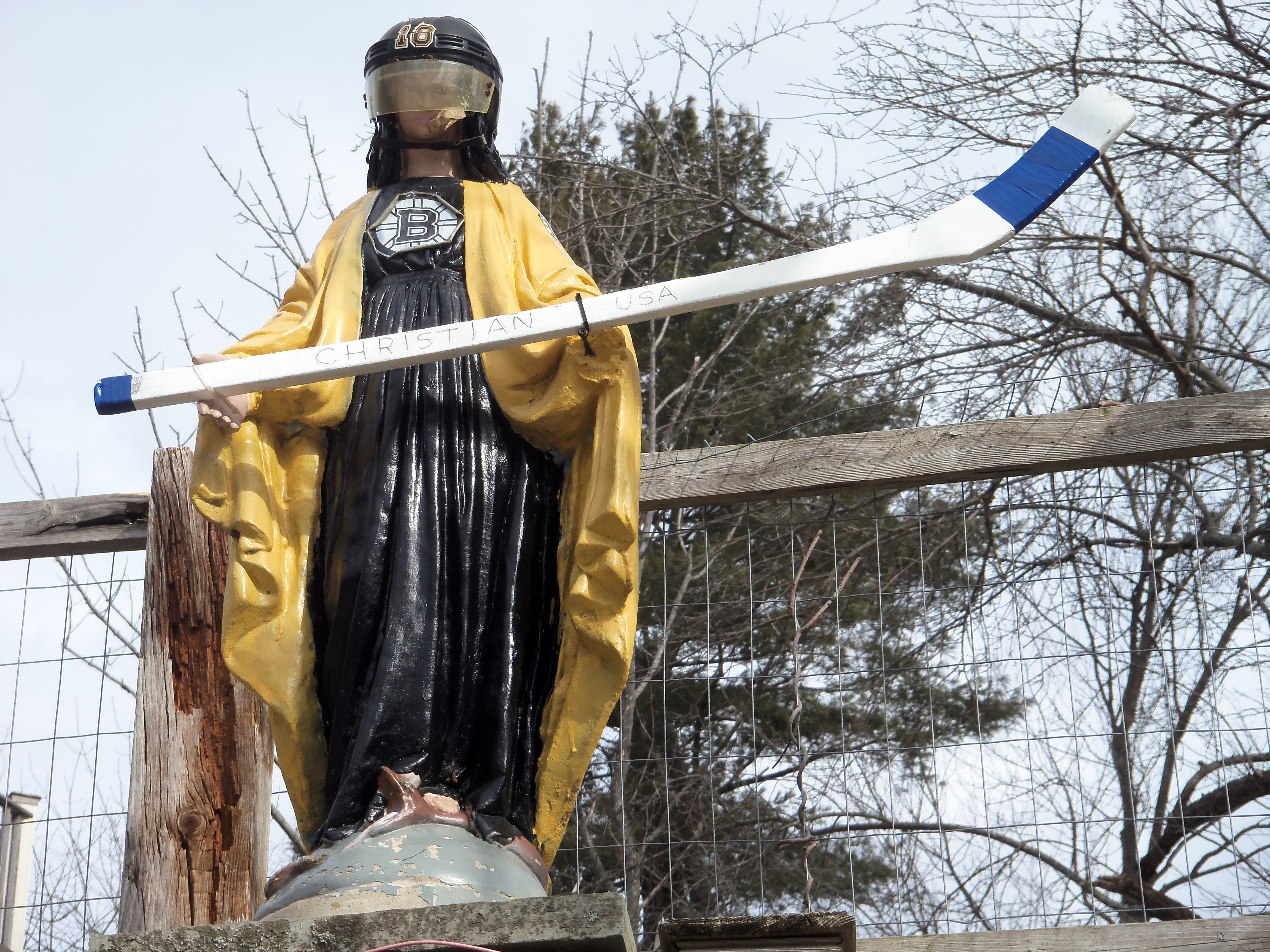
OUR LADY OF THE ICE

Always ready for a miracle.

Or is it Our Lady of the Puck?

New England is hockey country, and Boston Bruins fans are legion. Rest assured, Bobby Orr would no doubt lead their pantheon of saints.

While statues of Mary are common across the country, I know of no others like this. Behind the mask, the face looks feminine. This repurposed icon icon overlooks Chauncey Creek Road in Kittery, Maine.

HUNTER-GATHERER DIMENSIONS

As I told them: 

Although Jnana does not hunt, he observes points at which ancient traditions – including hunting and gathering – influence modern religious practices, meditation high among them. Jnana also acknowledges the role organized sportsmen have performed in restoring populations of wildlife, and has learned from hunters eminently adept at reading animals’ ways in the field. These days, living in New Hampshire, he keeps an eye open for moose rather than elk along the highway.

IN THE PERSPECTIVE OF TIME

As a writer, I love taking a phrase and rolling it around, substituting one word or thought and seeing what happens.

With the Grimms’ fairy tale opening, “A long time ago, when wishes came true,” I began substituting “prayers” for “wishes” and realized many people seem to assume that prayers really did have more effect a long time ago – say back in the time of Moses or King David – than these days.

But that also has me wondering about the depth of our wishes today. Are we too directed by advertising and material possessions to seek what’s truly desirable? The fairy tales and Holy Scripture, as I recall, have a lot to say on that account.

THIS SECRET SOCIETY OF READERS

One of the more baffling questions for just about any author, I suspect, is the one that asks, “Who are your readers?”

Yes, I know about genres and their core audiences – Chick Lit, aimed at unmarried females in their 20s; Romance, middle-age women; Sci-Fi, geeky males; Young Adult, well, it’s self-explanatory. I even know that commercial radio programmers could target their listenership to hit an average, say, of 24.7-year-old women in the office.

For a poet, though, or the novelist working outside common genres, this question becomes more problematic. I can imagine those I hope will find the work appealing, but the reactions often turn up elsewhere. I’m thinking of a writer who hoped her work would speak to her friends, only to hear them say, “I don’t read books,” as if it’s a badge of honor. (Oh, for shame!)

What that suggests is that rather than expecting a boffo bestseller, we writers might envision a much smaller-scale enterprise – connecting with readers one-on-one, as an underground understanding. Let it be private and personal, then. Our own quiet conversation.

Whether my Hippie Trails novels find their appeal more for those who lived through the era or among younger readers undergoing similar searching is still taking shape. I would hope both. But I am enjoying the feedback I’m receiving, from wherever.

It’s not the big-business Manhattan operation I once dreamed of or the San Francisco counterculture success, either. But here we are, connecting, in our own little underground society. Little do the others know what they’re missing now, do they?