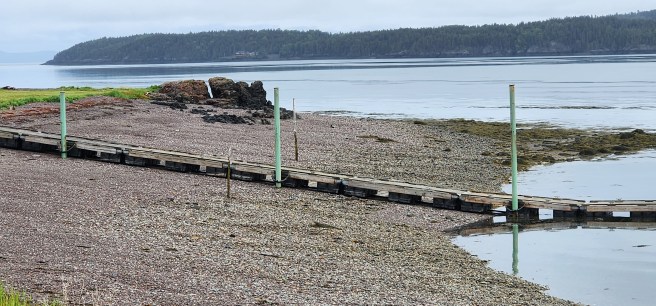
Reclaiming Passamaquoddy

Living adjacent to the tribe’s Sipayik reservation opens new perspectives in my awareness. It’s not quite osmosis, but perhaps a willingness to listen.

One of the big breakthroughs for the tribe has involved access to 36 wax cylinders from 1890, the first field recordings ever made, when anthropologist Walter Jesse Fewkes came to Maine to test the Edison equipment before he headed off to Navajo and Hopi lands.

For decades, the recordings were kept in museum vaults, unknown to the tribe. And then, slowly, they came into consciousness, first through taped copies full of scratchy static and more recently cleaned up into digitalized files that tribe historians are carefully gleaning.

As a writer, I believe in the power of stories and the importance of language itself.

Here are some of the insights I’m hearing from my neighbors.

  1. Dwayne Tomah’s reaction on hearing the recordings the first time: “I wept. These were my ancestors speaking and singing to me.”
  2. The language has only two genders – animate and inanimate.
  3. Its wider family, Algonquian, features prenouns, a form shared only with Japanese and Korean.
  4. Translations from a tribal side, rather than a nontribal institution, can be revealing. For instance, rather than “Trading Song,” it’s more accurately “Let’s Trade.”
  5. The recordings preserve more than the language itself. There are also the stories, songs, and advices, sometimes with context.
  6. The Tides Institute’s latest map of our region portion of Maine and New Brunswick includes the Passamaquoddy place names. Tribal historian Donald Soctomah has used that to explain hard-to-translate subtleties, such as those describing qualities of water encountered in canoeing in a specific location.
  7. A Passamaquoddy-English dictionary, still growing, is available online. It has a range of expressions for anger that are totally missing in English.
  8. The language is being taught in elementary schools. (For generations, it was banned, even in homes.)
  9. The recordings are helping the tribe’s branch in neighboring Canada in its quest to gain First Nations status. One song, for instance, refers to what’s now the location of Saint Andrews.
  10. Even a few commonly understood words spoken among the tribe are rebuilding identity and pride, even when the rest of us watch on.

What’s love got to do with it?

In research for my novel What’s Left, I wound up learning about the people we now call Roma. I won’t say how it applied, but it was an eyeful.

For instance.

  1. All Roma are expected to marry – and to another Roma, not an outsider.
  2. In many tribes, the parents arrange the marriage.
  3. Rejection of a formal proposal is considered a disgrace.
  4. Acceptance leads to the negotiation of a bride price to compensate her parents for their loss.
  5. A festive ceremony may follow a few days later, signifying the engagement.
  6. No formal ritual is required as a wedding itself, though some tribes turn the occasion into a multiday celebration.
  7. Wedding gifts almost always consist of money.
  8. After the wedding, the bride is never seen in public without wearing her headscarf.
  9. They settled into the groom’s parents’ home, and cannot move to a place of their own until after the birth of their first child.
  10. The couple cannot refer to each other as husband and wife until their first child is born. Up to that point, it’s only their first names when speaking to each other or about the other in public.

Gee, we haven’t even touched on the death customs and rituals.

Drawn from Gypsy at larp.com.


Take up a new activity means learning words that go with it

My week on a schooner enlarged my vocabulary.

For instance.

  1. A quarterboard proclaims the name of the ship at the bow.
  2. Quarterdeck, the little raised house behind the main mast, where the wheel is. The forecastle is the one at the other end, up by the bow.
  3. Dropping the hook, meaning anchor.
  4. Gaff, the more or less horizontal spar at the top of the mainsail and foresail. It makes those sheets irregular quadrilaterals in shape rather than triangular.
  5. Beam, the width. Crown, the roll of the deck for water to roll off. Sheer is the cut of the profile, usually voiced with aesthetic appreciation or disproval.
  6. Hatch, with the ladders down into the hold.
  7. Stern, the back, where we steer.
  8. Transom, the flat back of the boat , or, as you know now, at the stern.
  9. Yawl. It can be a kind of auxiliary sail, but in a schooner’s case, usually refers to the yawl boat riding at the stern when it’s not off somewhere on its own.
  10. Windward, meaning the direction the wind’s coming from, and leeward, the direction the wind’s headed. In a heavy wind, the windward side of the ship’s higher, while the leeward one dips toward the water. (When it’s really touching the water, the ship’s “running the rail,” meaning ripping along.)

I also like the term “running on one screw,” meaning propeller, except we didn’t have one.

We won’t even start talking tonnage, which seems to mean a lot for insiders.

Balkan voices

Eastern European music features low bass notes prominently. I listened to this group with envy. They were doing an all-Ukraine program.
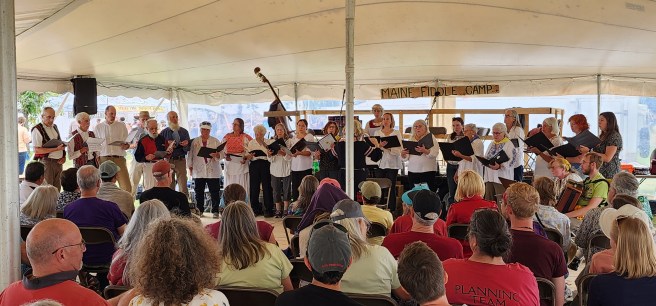
The Maine Balkan Choir international music and dance ensemble performs at the annual Common Ground Fair during hour-long breaks in the big contradance tent. The choir rehearses in three subgroups across the state and then comes together for events like this.

Their closest location to me is Ellsworth, two -and-a-half hours away.

Eliot burial ground

On what was the Asa Austin farm, the oldest part contains unmarked graves of Quakers, in contrast to the newer headstones.

For more, go to my book Quaking Dover, available in both paperback and ebook editions online or at your favorite bricks-and-mortar bookstore. Or ask your local library.
Some things ‘Quaking Dover’ has in common with my novels

Not that I really noticed the parallels until now.

  1. Counterculture is central, leading to an awareness of an underground community or at least kindred spirits.
  2. Both have meant learning to write differently than my neutral third-person journalism. Emotion, for instance, over fact, is the rule in the fiction. And the history opened a similar vein as creative nonfiction.
  3. The role of a narrator in both. In the history, that meant developing the gently laughing curmudgeon as he pored over historical data. In four of the hippie novels, it was the snarky daughter reviewing her late daddy’s hippie experiences.
  4. Both veins are self-published, falling under the shadow of being “not commercially viable” by publishing houses. That places an additional burden on the author.
  5. Marketing is a huge challenge. Apart from Subway Visions, none of my stories take place in a big city or address a big audience. How many hippie novels can you name, anyway. As for Quakers?
  6. Spirituality and religion run through all of them. In the novels, it’s often yoga, though Hometown News runs up against a puzzling array of churches. In Quaking Dover, though, it’s often the clash between the upstart Friends and what I first saw as rigid Puritans before both traditions begin to, uh, mellow.
  7. There’s a strong sense of place, even if these locations are far from the mass-media spotlight.
  8. I go for the big picture. I really would like to have a simple book – something, as Steven King advises, having only one big idea – but that’s not how my mind works.
  9. They’ve all undergone deep revision. Much of the fiction actually got new titles and new characters after their original publication.
  10. They were all labors of love.