Greed, hatred, and illusion.
Leading to 84,000 kinds of defilement.
I didn’t mean to get political. Take it as Buddhist fact.
You never know what we'll churn up in cleaning a stall
Greed, hatred, and illusion.
Leading to 84,000 kinds of defilement.
I didn’t mean to get political. Take it as Buddhist fact.
When we sit silently in worship, clouds that separate us may evaporate, allowing us closer to oneness, our own fullness, which is the essence of God.
The closer we get to Truth, the more tolerant and understanding we become of others. There can be no lasting revolution in the world until we’ve changed ourselves, as in reborn or liberated or enlightened, even self-realized.
The varying teachings “were provided to suit the different needs and temperaments of various people … If there were no human beings, there would be no Dharmas; hence we know that all Dharmas are made for men …” The Sixth Patriarch again, I presume.
“Learned Audience, those who recite the word ‘prajana’ the whole day long do not seem to know that prajna is inherent in their own nature. But merely talking on food will not appease hunger, and this is exactly the case with these people. … Talking alone will not enable us to realize the Essence of the Mind, and it serves no purpose in the end.” – Hui Heng, the Sixth Patriarch of Zen, “having taken his seat and asked the assembly to purify their minds collectively.”
The Patriarch again: “Do not talk about the ‘Void’ all day without practicing it in the mind. One who does this may be likened to a self-styled king who is really a commoner. Prajna can never be attained this way. ….”
How I feel listening to so many sermons or radio-evangelist preachers.
“Prajna [Truth] does not vary with different persons; what makes the difference is whether one’s mind is enlightened or deluded.”
At the small-town paper, Marcy made all the difference. She was also a future Pulitzer Prize winner.
With her camera she cut through all the crap to find something of real value in the people.
Her signature touch often blended humor and compassion while giving a glow to black-and-white images of daily life. What she found added up into a larger statement over time.
Photographer Burt Stern was one of her inspirations of the hard work to strip an event down to a simple, direct image and underlying message, albeit his were often of commercial intent.
In those days, please remember, ours were mostly black and white shots, though her darkroom technique did wonders with the grays.
I noted her remark about a coworker’s husband who had no concept of aesthetics – a photographic silhouette, to him, meant something went wrong. He saw everything as “good” or “bad” reduced to a scale of “I like” or “don’t like.”
Yes, “good people” (like us) versus “bad people,” who may simply be different rather than evil.
It’s been a problem across much of humanity, though consumerism cashes in on it.
Sticking to what you like means taking the easy way out, rather than aiming for greatness or achievement. Many of the things I value in my own life started out as dislikes – opera, contemporary classical music, asparagus, lamb, meditation, beer …
I suspect she was the inspiration to make the protagonist in the novels that became Subway Visions, Daffodil Uprising, Pit-a-Pat High Jinks, and What’s Left a photographer rather than a writer. It was a step away from glorifying the writing trade. Besides, I had seriously considered becoming a visual artist but settled on writing instead.
“The camera itself creates and destroys illusion.” (Source long since lost.)
Reporter Tom: “I was building a cabinet several nights ago and everything kept falling into place, everything fit, I cut the wood just right and there was such a good feeling of simply working that in a way I didn’t want to finish the thing. They never taught us to work that way. It’s always to get the thing done.”
Nowadays, no sense of craftsmanship. No unity of elements or workers. Just things, not creation.
For Esquimaux artists, objects do not have to be seen but treasures to be unwrapped and felt on special occasions.
~*~
As I reacted somewhere recently, Endless Prairie, broken into what? Ghosts?
Most of my journals along these lines simply broke off.
Maybe I’ll revisit what I had and issue it later as a chapbook at Thistle Finch. There are limits to everything, after all.
Please stay tuned to see what else I turn up in this review of my past.
When it comes to mass media, the real power brokers are the big advertising agencies that foot the bills or at least allocate the payments. Forget “liberal media,” the rig of the game is elsewhere.
Here are some of my early journal entries along the topic.
“I used to think I had some control, but I’m finding out more and more that I have no control over the film. The film is gonna come out the same way,” depending on the performers, scriptwriters, prevailing moods, and other factors. “The material is being filtered through me, so it’s gonna wind up having my shape. And for me to think I can unshape it is crazy.” – Robert Altman, producer and director
My feelings after “having my own paper” on the prairie
“I hate to admit it, but everybody’s got the same news.” – Chicago Tribune Managing Editor Maxwell McCrohen on promoting features and columnists. He broadened the definition of “news.”
Reporter Tom: “I can remember my dad arguing with his mother till he was red in the face: ‘You think they’ve got a separate heaven!’ It wasn’t until I was older that I found out the colored people we shared our pew with every Sunday in the Presbyterian church were different. I’d always thought of Negroes as the National Geographic.”
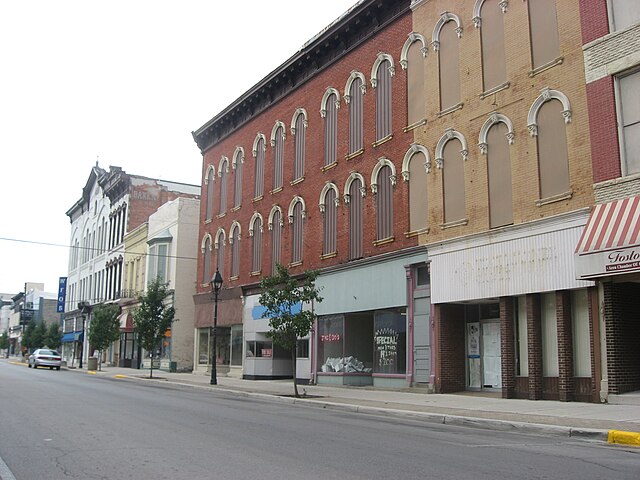
A few asides on the small town where I was dwelling.
John Quinn, who grew up in Fostoria: “Small, flat, uninteresting. Platt-Deutsch. Smelly. Thick-skulled Catholic diluted with third-removed Yankee.”
B.L. Reid: “An ethnic polyglot with many Germans and a sprinkling of Irish and one unusual strain, a tribe of Belgians. To the time of the First World War, three out of four sermons a month in the Catholic church were preached in German. The Belgians were the glassworkers and conducted the local industry. A small opera house was visited by traveling musicians and players. Pretty public parks were much frequented by the Germans and Belgians, often observing their transplanted holidays in their native costumes. The Belgians formed a fine concert band and Belgian funerals, led by the band and followed by mourners on foot, were a familiar and impressive sight.”
Radio “newsman” Mel Murray, in his own voice, used my newspaper column as his “editorial” this morning on WFOB, two days after the concert I had reviewed. Obviously, he wasn’t there.
The people of this town gossip and bitch to each other but when it comes time to stand up, run away. They all want somebody else to stand up for their view, yet are afraid of anything different or new. They seem to be sleeping on their feet.
“Findlay’s only got nickel millionaires, but here, shit, these pishers may got money but they stick it up their ass.”
Nickel millionaires, sez the trashy town’s foot doctor.
[Findlay was headquarters of Marathan Oil and Cooper Tire & Rubber; Fostoria had none.]
~*~

~*~
This piss-hole of a city! So much negativity, jealousy, and hatred it’s a struggle for anyone to remain alive long – negativity that could kill a horse
This place is still a swamp, not even an idea to look up to.
Everything’s got to be good or bad. Their minds can’t handle anything more. Their minds don’t work anywhere near as fast as their hatreds do.
They keep electing crooks just like themselves.
Reporter Tom, a West Virginian, observing how these Midwestern towns build statues of their founders and then live in the shadows: They think they’re friendly, chattering all day, cutting down each other, not a good word to say, a whole damned town of gossips, women and men …
As I saw it, the thing about this place is there’s nothing to look at, no lofty ambitions like a mountaintop, not even a holy man with a begging bowl.
There wasn’t even a river running through it or a lovely lake or pond to ponder. Just the railroad tracks and truck traffic.

