A few prime strolls around here

Visitors on the street sometimes ask me about good places to hike around here, and looking at them, I don’t always want to recommend anything too strenuous. On my part, I do miss the old carriage road up Garrison Hill back in Dover, New Hampshire, but you can’t beat some of these.

  1. Quoddy Head State Park in Lubec. The parking lot is close to an iconic lighthouse, spectacular bluffs, and an Arctic peat bog. Not a bad combo as an introduction.
  2. Shackford State Park in Eastport. It almost became an oil refinery. The central trail leads to an incredible panorama of Cobscook Bay and a high probability of seeing bald eagles.
  3. Matthews Island. Also in Eastport, this Maine Coastal Heritage Trust site can be reached only at low tide. Getting there will give definitely give you a sense of mudflats. MCHT also has nearby Treat Island, which we intend to explore by renting a water taxi to get us there and back.
  4. MCHT includes other personal favorites, starting with Boot Cove in Lubec. If you like Acadia National Park, you’ll love these lesser known opportunities. Nose around in this Red Barn blog, you’ll find photographic evidence why.
  5. The Bold Coast public lands in Cutler. This is for the serious hiker, one willing to walk 1½ miles to get to the rugged ocean. From there, though, there’s a six-mile breathtaking clifftop trail along the restless ocean, and even primitive camping on a limited first-come, first-served basis at the end. The trailhead parking lot can be overflowing in prime season.
  6. Cobscook Shores. Thanks to a newer family trust, 15 small waterfront sites provide public opportunities for investigation. Most have outhouse or indoor plumbing facilities as well as picnicking, sometimes in screened-in pavilions around a single table. My favorite to date is Morang Cove.
  7. Moosehorn National Wildlife Refuge. So far, I’ve sampled trails at its Baring and Calais district but there is more in Edmunds township. Former roads, now used only for ranger access, make for broad, easy pathways through a variety of ecosystems. My big caveat for inland trails is to be prepared for black flies from late April into July. They can definitely spoil and outing.
  8. Downeast Sunrise Trail, atop an abandoned rail line. I see it primarily as ATV and snowmobiling in season, but it does offer insights in inland ecologies. Again, note the black fly warning.
  9. Mowry Beach in Lubec and Roque Bluffs State Park south of Machias. Sandy beaches in Downeast Maine are rare. Here are two wonderful exceptions for those who want to indulge in a long barefoot walk.
  10. Back in Eastport, the Hillside Cemetery is worth nosing about. It’s newer than many classic New England burial grounds, but the engraved stones add up to some fascinating stories.

With the Canadian border now reopened, I’m looking forward to some treks on Campobello Island, both at the Roosevelt international park and a few other sites.


I’m really looking forward to tonight’s reading

If you’re a musician or writer or some other kind of performance-potential artist, you probably find being part of an open mic event invigorating. Not just because you get to air your own work and see how it fares on exposure, but also because you’re amid so many kindred spirits.

Tonight has a kind of hybrid version — six featured published writers at the wine bar downtown — and it is creating a buzz in our small community. Each of us gets about 15 minutes in the spotlight, as well as a book-signing and chat time afterward.

I’ll be reading a chapter from my new book, Quaking Dover, one that details a remarkable but often overlooked outburst in early New England, the bohemian colony called Merrymount. I had settled on that excerpt, a side I hadn’t yet presented in my presentations, before realizing how appropriate it is for this weekend’s ArtWalk festivities, many of them reflecting Pride awareness.

So, here we go … just as the summer season is beginning in our oceanside setting.

Flowage


Streams passing through Maine forests often open out into a wetland known as a flowage, a flooding typically caused by beaver dams or other impoundments. The resulting broad habit is crucial to waterfowl production, and also provides for excellent kayaking, canoeing, and fishing.

These shots are all from one spot. Note the beaver lodge in the last one.


When the fog rolls in

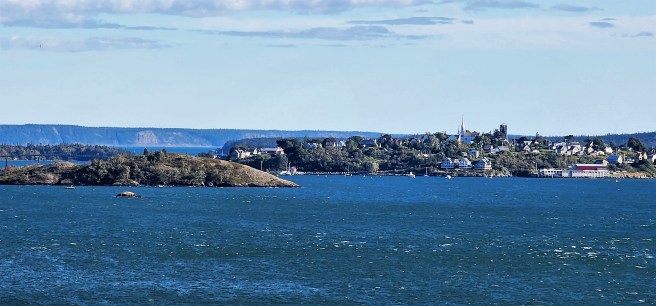
We can watch it roll in over the neighboring town of Lubec and move up the channel. Treat Island is about to be engulfed. 


It often rides in on the tide, this time from the Canadian islands.


I’m getting used to hearing the foghorn, too.

“Another crappy day in Paradise,” as one wit has been heard to say on a gray, chilly, wet morning here.

How to end a most memorable summer

When last summer ended, I proclaimed it my best one ever – in part because there were no complications from an employer or romantic upheavals. Instead, it was filled with new adventures, explorations along the Bold Coast and out on the waters, introductions to fascinating characters and geezers (both positive terms, in my estimation) who live here at least a goodly part of the year, plus a sequence of fascinating artists in residence combined with local painters and photographers and their galleries as well as a world-class chamber music series by mostly resident performers. Whew! And, oh yes, I had plenty of time to devote to a new book and setting up posts for this blog. I even got a new laptop, which meant importing and tweaking everything.

This time around has simply amplified everything.

The temperatures are generally cool on the island – often ten degrees less than what’s happening on the mainland even just seven miles to the west – so I rarely suffered from sweltering. On the downside, heritage tomatoes are rarely found here. Remember, in Dover I lived on tomato-and-mayo sandwiches from the beginning of August into October, some years, though in no small part due to global warming. Even so, the ocean temps here are too cold and the currents too treacherous, for any swimming, though inland lakes and streams provide a welcome alternative.

Well, that’s only half of it. Summer is when Eastport comes into its full glory. The streets are swarming, like a big party. To think, I’m experiencing the ideal of summering on a Maine island, combined with a lively artistic dimension! Never, in my wildest dreams, would I have expected that.

But all good things must come to an end.

Three-quarters of the Eastport’s population is what Mainers call Summer People. Now they’re mostly going-going-gone and we’re on the verge of getting back to our more essential state, something akin to a ghost town.

Not that we go down that easily.

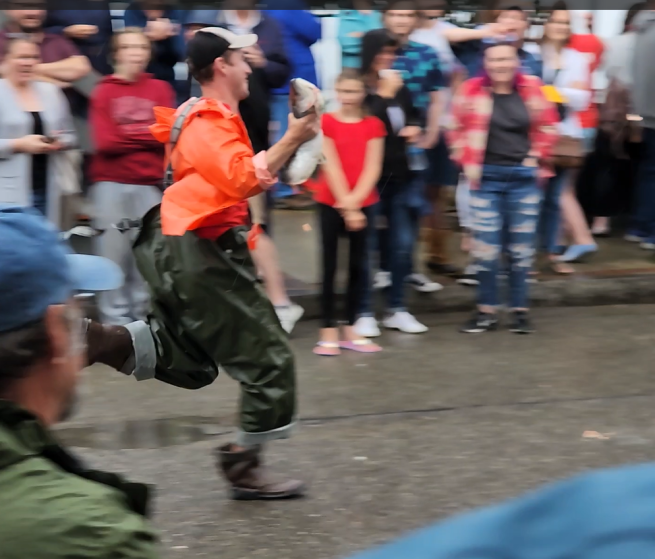
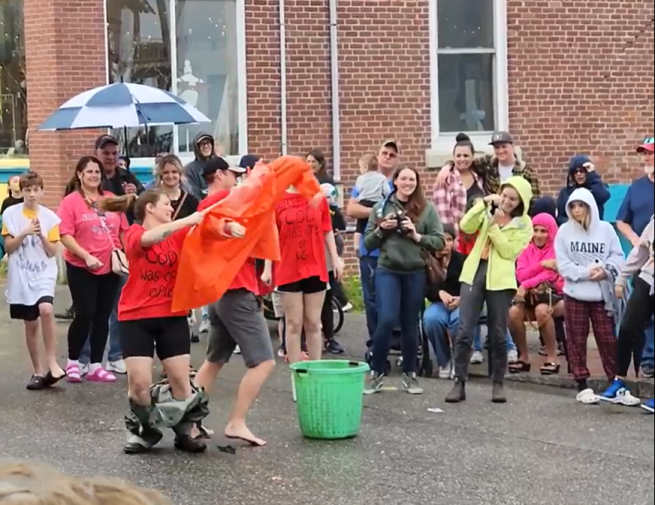
This weekend featured the annual Salmon Festival, a delightfully low-key event highlighting local musicians, galleries, and crab rolls served by the senior center and Episcopal Church on Saturday and salmon dinners on Sunday, as well as tours of the salmon farms at Broad Cove.

The Salmon Festival is a low-key event, centered on the waterfront..
Historian Joe Clabby tells a circle at the amphitheater about the region’s rich past. One local wag calls this our “NPR festival,” in contrast to what’s coming next weekend.
Celebrating local seafood, there are crab rolls on Saturday and a big salmon dinner on Sunday.
And, of course, live music.

The event honors what was once the Sardine Capital of the World in its current incarnation as a center of aquaculture in the form of salmon.

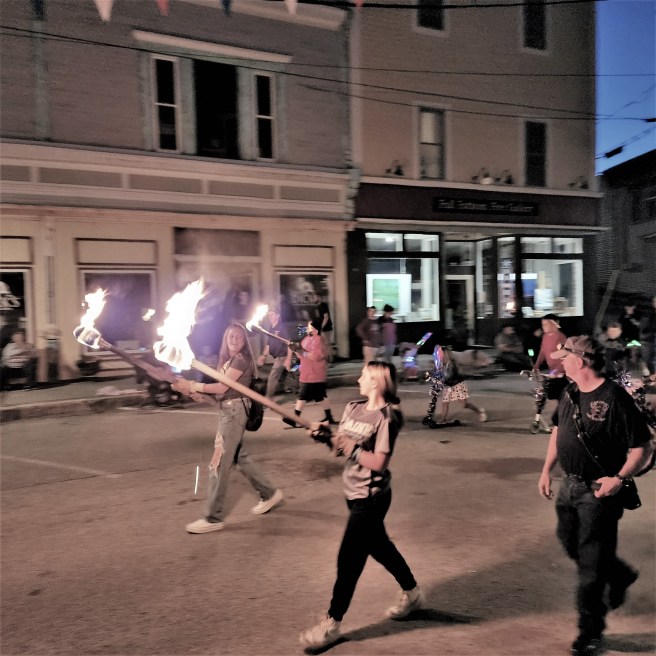
But it’s also a prelude to next weekend’s blowout, the Pirate Festival.

On Saturday, a mini-flotilla, armed with water balloons and squirt guns, sailed down to invade neighboring Lubec. Next week, they’re expected to return the favor, all in good spirits.


What’s made your summer special?