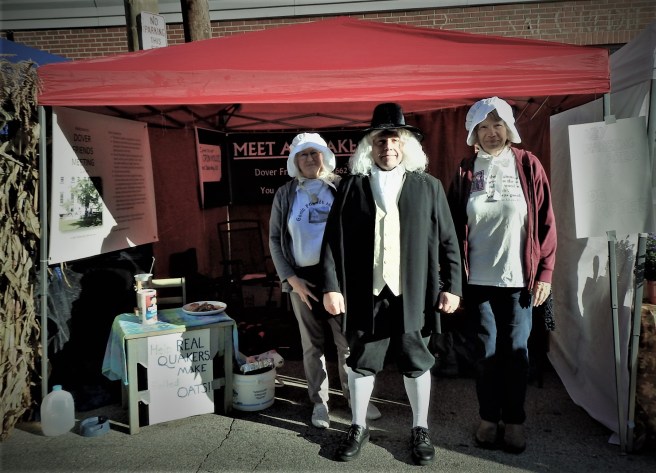
Meet a Quaker
You never know what we'll churn up in cleaning a stall
When I was growing up, cheese in our household was almost exclusively of the processed variety. Some even came out of a jar, like yellow glue. Grandma and Grandpa would have the real stuff – Colby longhorn or a bitter Swiss, mostly. It wasn’t until I was off on my own after college – and in the ashram, especially – that I discovered how marvelous natural cheese could be.
Here are ten favorites.
What would you add to the list?

Let me confess, as an author, this was an impulse purchase for me. Have you ever driven through an old residential neighborhood and noticed an old church just plunked down in the middle of the block?
The one in my novel What’s Left sits next to the family manse. Here’s an early description of the site, one I decided not to include in the final version:
One thing that hadn’t been discussed when he left was the use of the old white church. We bought it just because we could. Thea Nita has joked it was the missing lot on our Monopoly board, and you could agree that she’s right. Yes, it was a great indoor playground for us kids but, as I’ve learned, that hardly justified the expense. Early uses included folk dancing, especially square dances and New England contras – events that included live music and callers, along with instruction. And there were a few weddings. It wasn’t a particularly big church, though – the pews held maybe a hundred people? Well, we promptly put those into storage.
Oh, I’m so glad she stopped talking like this! In the final version, she’s pretty snippy. You get the idea.
~*~
I’m ready to up that capacity number somewhat, anyway. Wouldn’t 200 be more fitting?
If you’re like me, music’s an essential part of life. I’m in a community choir that rehearses in the social hall of a church that rents out space for our offices, too – we do a big Christmas production at Harvard every year. I could imagine something similar working out of this space.
Where do you go for live music or dancing? Do you prefer a small club setting? An auditorium? A big arena? Or just somebody’s garage or basement? What kind of neighborhood is it in?
What, me as a Mixmaster?
Just look at the topics percolating in Yoga Bootcamp.

Here are ten:
Be among the first to read it!


Kittery, Maine, is a few miles downstream from where I live. It’s also across the Piscataqua River from Portsmouth, which is loaded with eateries – maybe as many per capita as Manhattan.
For much of its existence, Kittery has been pretty blue-collar. It’s home to the Portsmouth Naval Shipyard – the U.S. Navy’s oldest continuously operating yard – and now tasked with the upkeep of nuclear submarines. It’s also home to a lot of lobstermen.
When I first came to New Hampshire, the Kittery Grange Hall was the scene of a monthly contradance – both the grange and the event now ancient history.
Oh, yes, and its strip of discount outlet stores along U.S. 1 is a major tourist attraction. Seriously. As is the adjacent sprawling Kittery Trading Post.
But with Portsmouth booming and the cost of its retail space skyrocketing, Kittery has been undergoing a transformation. Nowhere is that more apparent than in Wallingford Square, which used to be a gritty cluster of bars around one of the shipyard’s two gates. Today it’s been rechristened Kittery Foreside and is the center of some enterprising fine dining and food sellers.
Here’s what you’ll find.

~*~
Nearby is the Beach Pea bakery, the best baguettes around, and Loco Coco’s Tacos, with its wonderful fine Mexican cuisine.

My newest novel takes place in a Yoga Bootcamp. It’s run by an unorthodox American swami who’s also known as Elvis or Big Pumpkin, for good reasons. His followers think he’s divine, and they’re out to spread the word as yoga itself is first becoming popular across the nation.
Each of them has moved to his farm to intensify their practice. What they find has as much to do with cleaning toilets or weeding the garden as does standing on their heads in exercise class. Even a single day can embrace eternity as well as a cosmic sense of humor.
Mysticism? It’s largely quite down-to-earth, as you’ll see.
The novel is being published and released today at Smashwords.com. And that certainly has me levitating.
Be among the first to read it!
Since these are transcribed from the Hellenic alphabet, their spellings in Latin script can vary.
Here are ten.
I’ll leave the swear words to Cassia in my novel What’s Left. Especially the ones she learned at church camp.
I know where I’m getting the candy rocks and gummy fish to decorate my gingerbread lighthouse this Christmas. And it’s also a great place for guys to find great little gifts for the significant other in their life, something that usually confounds us. It’s even a fun place to take her on a stroll around town. (Think cheap date.) You can sit in air-conditioned comfort while savoring the yummy ice cream. Or even keep a bunch of kids happy.
We’re hoping Lickees & Chewies Candies & Creamery catches on. It seems to have its act together, blending several types of economically marginal stores into one.
Key to everything is its location, across from the Children’s Museum of New Hampshire and above Noggin’s toys on the ground floor of the historic Cocheco Millworks downtown. The one drawback is that the entry is on the other side of the building, away from those two kid magnets.
But once you’re inside, you’ve entered a whole different world. It smells richly mysterious, largely from the chocolate bakery. There are maps with pushpins where customers indicate where they’ve visited from, and there are metal rings on strings you can swing toward hooks in the wall if you’re feeling playful.
There are more classic games in the sitting area, which includes a large round table suitable for a birthday party, actually. Or just resting or looking at the views out the window.
So one part of the operation is the ice cream counter, with an emphasis on creamery. But remember, this place is loaded with candy, as in toppings.
Then there’s the old-fashioned candy store itself, with about every brand you can imagine. The entrepreneurs don’t proclaim their organization or knowledge of the field, but it’s there – Southern candies in this part, German in that – even before you get to the saltwater taffies. Many of the smaller wrapped bits haven’t been a penny apiece for sometime, but that’s its groove anyway. After all, the idea is to fill your own bag.
Yet another part is the fine chocolatier. This is where to find a gift to impress, maybe even a new client. And there’s plenty of room to grow to the side.
They make the most of the historic textile mill space. The ceilings are tall, with bare wood posts. The lighting is warm, tasteful, with some German Black Forest kinds of surprises befitting a fairy-tale atmosphere in the evening.
It’s been here a year already, but I’ve just discovered it. I’m definitely anticipating getting back before Christmas.


Brooklyn has long been overshadowed by its more commanding neighbor, but it is undergoing a renaissance among trendsetters.
Here are ten random bits about the borough also known as Kings County.

