
Be sure to carry a raincoat in the Olympic Peninsula

The Olympic Peninsula, set off in the northwest corner of the continental U.S., is a unique place. My longpoem American Olympus is a travelogue of one week we spent camping there.

Here are ten things to consider.

~*~

  1. Size: About 3,600 square miles, it’s a large arm with the Pacific Ocean on the west, the Strait of Juan de Fuca on the north, and Puget Sound on the east. You can’t drive straight through it, by the way – only around the perimeter.
  2. Distinctive features: The Olympic mountain range fills the center. It’s dominated by 7,980 foot elevation Mount Olympus, which has seven notable glaciers. The peninsula’s Pacific coastline (including 73 miles inside the national park) has impressive sea stacks and dense old-growth rainforests.
  3. Precipitation: The Hoh Rainforest receives 12 to 14 feet of rain a year – that is, up to 170 inches. In contrast, the eastern half of the peninsula, facing Seattle, is in a rain shadow, where lawns and gardens may require irrigation. The mountains, as you may have guessed, get buried in snow.
  4. Public lands: The peninsula includes Olympic National Park and national forest, plus designated wilderness areas and state parks. The national park itself covers nearly a million acres.
  5. Rangers: The national park has 139 full-time rangers. Seasonal support pushes that to 256 in season, assisting nearly three million visitors a year.
  6. Natives: It’s home to eight contemporary tribes of Native Americans and ten reservations.
  7. Population: 104,000 people. The largest city is Port Angeles, 20,000 residents.
  8. Wildlife: Cougars, bear, elk, bobcats, eagles, salmon.
  9. Freshwater attractions: Glacier-carved and crystal-clear, 12-mile-long Lake Crescent is up to 624-feet deep. Average depth is 300 feet. The peninsula also touts 13 significant salmon-bearing rivers, most of them wild, plunging from the mountains to the sea.
  10. Who was Juan de Fuca? The band of seawater between the peninsula and Canada is named for a Greek maritime pilot who lived from 1536 to 1602. Though we know him by his name in Spanish, he was Ioannis Phokas, sailing in service of King Philip II of Spain. He claimed to have discovered the strait on a voyage in 1592, and though much of his report departs from reality, a few details make it possible that he was just a lousy recordkeeper.  

~*~

What’s the wildest place you’ve explored?

Sea stacks are shown at Ruby Beach. The Olympic Peninsula coastline is often strewn with tangles of fallen trees like this.

On the road to satori

Like Zen, my mind works in strange ways, and this is how I too often see things.
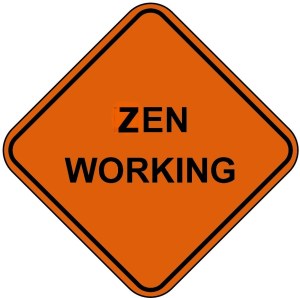
How I often see or hear life around me.

I can imagine a Buddhist sutra in which two monks observe the sign. They’re walking, of course, rather than driving.

The first says something pithy asking how Zen, being nothing, can do anything, much less work.

And the second replies that work’s nothing, too. But it’s not lazy.

Better, I suppose, than “ZZZ Working,” which many assume while passing the usual sign and seeing the crew standing by idly.

If you like this, please clap with one hand.

Takin’ the ferry in New England

Washington state isn’t the only part of the country where ferry service is important. The Staten Island ferry makes appearances in my Subway Visions novel, strange as that sounds. Check it out.

A bit further to the northeast, here in New England the boat service can also be impressive. Most of my trips here, I should add, have been as a walk-on passenger.

Now for a look.

~*~

  1. Casco Bay. Portland (as in Maine, not Ory-gone) overlooks Casco Bay and some of its neighborhoods are on islands. A state-created ferry service makes daily stops on four islands within the city limits plus two in towns beyond. The little yellow-and-white boats are rather picturesque, truth be told, and the fares are quite reasonable. We’ve become quite fond of the mail run, which has six stops on five islands out and then back.
  2. Portland to Nova Scotia: Also out of Casco Bay is a catamaran ferry that zips to Nova Scotia in half the driving time. (Looks like there’s one stop en route, at Bar Harbor.) Back when it was a conventional boat, much of the appeal was in overnight gambling, once you were out in international waters.
  3. Nantucket. There are several routes, mostly from Cape Cod. The island likes to think of itself as a world all its own.
  4. Martha’s Vineyard. Like Nantucket, but maybe more exclusive.
  5. Boston to Provincetown. The catamaran zips from downtown Boston to the Cape in just 90 minutes, half of the time of driving in good conditions. I might mention some Boston Harbor commutes for shorter ventures.
  6. Block Island. Out from commercial fishing Port Judith in Rhode Island, it’s a fine daytrip. Rent a motor scooter when you land for a quick tour.
  7. Isles of Shoals. Just downstream from us, there are several services linking Portsmouth and the Isles of Shoals. The small islands split by the New Hampshire-Maine boundary include the Star Island summer retreat run by a Unitarian-Congregational church arrangement.
  8. Mohegan Island. Penobscot Bay in Maine has several ferry trip choices available. Mohegan Island is a prime destination served from several points onshore.
  9. Lake Champlain. Several crossings connect Vermont to New York State. Of the ferry trips on this list, these are the only ones on freshwater, not saline. One even follows a cable from one shore to the other.
  10. Campobello Island. OK, that’s in New Brunswick, Canada, but it’s once again served by a small ferry from Eastport, Maine. Sometimes the boat goes further, too, out on the world’s biggest tides.

~*~

Ever been on a ferry or whale watch? What’s your experience?

A Casco Bay ferry passes one of several historic harbor fortifications in Portland, Maine.

Made my own sashimi!

We’ve once more subscribed to the community fishery’s summer season weekly catch selection, which we pick up every Friday at our natural foods grocery. Often, what’s offered is a sustainable variety not often even sold at the supermarket, but this time, it was tuna. A beautiful, fresh, one-pound sirloin, which indeed looked like a steak.

Yes, sirloin is the term I found used in the recipes.

So far, I’ve never attempted homemade sushi, but looking at our tuna and then the recipes, I took the leap into sashimi, which I first encountered in a four-table Japanese restaurant in San Francisco back in the ’70s and maybe two times since. And yes, that first time remains memorable, even the plum wine accompaniment.

In a restaurant, it appears so daunting. As one recipe said, though, nothing could be further from the truth. Sashimi is a staple dish in Japanese homes.

I had no idea this would be so simple. Using a very sharp chef’s knife, you firmly cut long strips across the grain – no sawing. One swipe! And, by definition, no cooking. Sashimi is raw fish from the ocean, not fresh water.

It just happened that we’re growing daikon radishes for the first time, as an experiment, so I went out to the garden and pulled one, which turned out to be larger than we were expecting. No problem. Came in, sliced it, put those rounds into a ramiken, and covered them in rice vinegar as my side dish.

The dipping sauce was a ramiken of soy sauce mixed with the juice from half a lemon.

That was it. Easier than making a salad, actually.

Accompanied by a cup of sake (which we also chanced to have in the cabinet), this made for one of the most heavenly meals ever, at least from my hand. And this wasn’t even sushi-grade fish, which gets flown immediately to Japan for a much higher price. I can only imagine.

Still, this was fresh, and that’s much of the secret.

Great cuisine is about respecting the ingredients.

Sorry I didn’t take pictures.