Unabashedly, I am a snob when it comes to putting big fireworks together in an aesthetic whole, rather than something that resembles an action movie big car smashup.
A smart design team can use the entire sky as a canvas of evolving colors, combined with the timing of a sharp comedian.
That said, here’s some perspective.
A show like Boston’s on the Charles River Esplanade fires off 5,000 pounds of explosives in its half-hour glory. That performance requires a computerized launch system for five barges floating on the water.
Macy’s, the nation’s biggest, goes for an average 1,600 shells a minute – more than three times as many as a typical town display uses for the entire night. That show has more than 40,000 shells fired from six barges in the Hudson River.
China produces 85 percent of the world’s fireworks.
Many of the styles are named for flowers such as peony, chrysanthemum, or dahlia. Others, after trees, as in willow and palm tree.
Prices vary wildly, especially when you’re looking for some serious color intensity and blending rather than honky-tonk garish.
Shells are sold by tube diameter, commonly six-, eight-, and ten-inches, with each additional inch typically adding another 100 feet of elevation to the shot. Are some of those bursts really a thousand feet overhead?
An aerial shell contains six parts. Or more, depending on what bells and whistles are added on.
Larger shells cost average around $336 apiece and may require an 840-foot display radius.
Even a small-town show will run between $7,500 to $15,000 to produce, just for the fireworks. Add to that set-up and clean-up labor, sanitation, musicians, and public safety expenses. The average municipal show costs $25,000. In contrast, a wedding show is tabbed for $1,500 to $3,000. But don’t hold me to those figures. Other estimates I’ve seen simply soar.
Injuries send about 10,000 Americans to the emergency room every year, two-thirds of them males, and many of the injuries are to children. That’s in addition to 7.9 fatalities. As another safety consideration, more fires are reported on July 4 than any other day of the year – some 19,000.
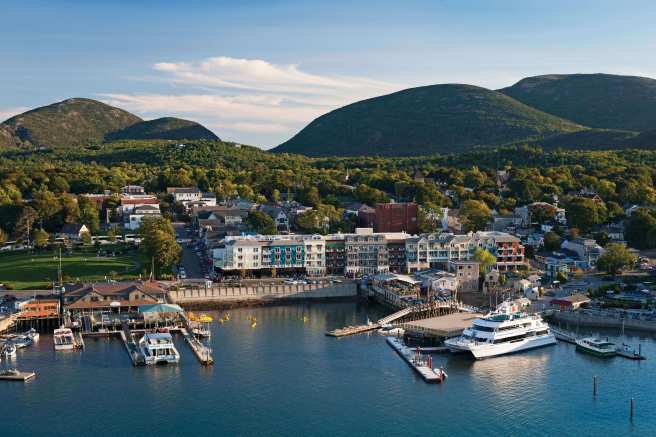
Maine likes to tout itself as Vacationland, and Acadia National Park is definitely a star attraction. I know people who gush that it’s their favorite place ever. Not that I’d go that far.
Still, let’s consider:
With four million visitors a year, it’s among the 10 most popular national parks. Most of them crowd in during the prime summer months.
The official version has the park being named after Arcadia, a region of Greece that it supposedly resembles. New France, however, referred to eastern Maine as Acadia before being expelled by the English in 1763. In their migration, some of those Acadians became known as Cajuns down in Louisiana. I’m siding with the French here, despite my fondness for Greek culture.
It was the first national park established east of the Mississippi and encompasses 47,000 acres, mostly on Mount Desert Island. Not that there’s any desert, it’s just wild. Additional, less well-known tracts are on Schoodic Peninsula (my favorite) and Isle au Haut as well as smaller islands. And a fourth of the land total is privately owned but under easements and similar arrangements.
With 108 square miles, Mount Desert Island is the biggest island in Maine and the sixth largest in the contiguous United States.
The park has 158 miles of maintained hiking trails spanning mountainous terrain, panoramic views, rocky Atlantic shoreline, mixed forests, and lakes. Former carriage roads are also popular with bicyclists.
There’s a private trolley service for those who’d prefer to view the scenery more than the traffic jam.
Backcountry camping and overnight parking are not permitted, but there are campgrounds and lean-tos for those who plan well ahead.
French explorer Samuel de Champlain gets the creds as the first European. He encountered the place in September 1604 when his boat ran aground on a rock. He applied the name Isles des Monts Deserts, or island of barren mountains, to the bigger scene. Well, some are pure rockface.
In the 1880s, the island became a summer retreat for Rockefellers, Morgans, Fords, Vanderbilts, Carnegies, and Astors who built elaborate vacation dwellings they called “cottages.” Many of those were destroyed by a vast wildfire in October 1947.
Its principal gateway is Bar Harbor, a city of 5,000 full-time residents that swells with summer people and their second homes, tourists, and often a big cruise ship or two that add several thousand more people to the crowd. Be warned that parking is at a premium in high summer.
For more adventurous souls, let me suggest exploring two hours to the east, to the Bold Coast, for a less spoiled alternative.
While Edward Hilton is hailed as the father of New Hampshire and was early on joined by his older brother William, both drifted away from my history Quaking Dover. Still, some points of interest remain.
Among them:
His son, Edward Hilton Junior, married Anne Dudley, daughter of Puritan minister Samuel Dudley, allying his line with a prominent early New England family in Exeter. I sense there’s much more to this union that is presented.
Edward’s grandson, Colonel Winthrop Hilton, was slain by Natives in 1710 while harvesting mast trees in Epping. He had succeeded Richard Waldron as head of the New Hampshire militia. His other grandfather was Massachusetts governor John Winthrop. So much for high connections.
Winthrop Hilton’s brother Dudley was carried off in the attack and never heard from again.
Edward’s nephew Captain William Hilton mapped an island in South Carolina in 1663, naming the location Hilton Head Island. He also mapped Cape Fear that year. He sailed out of Charlestown on Boston Harbor but acknowledged finishing the maps in the home of Nicholas Shapley in Maine – that is Shapleigh, a major figure in my book. Just look at Billy’s uncle’s second wife.
That is, the elder Edward’s second wife, the widow Katherine Shapleigh Treworgy, who had a daughter marry into the equally prominent Gilman family.
Into the late 1900s, one line continued to live on the farm settled in Newmarket around 1630. In fact, they claimed it was the oldest homestead in the state.
Descendant Daniel Hilton, born in 1794, removed from Newmarket to Meredith, where he had 18 children and left an estate of 80,000 acres by the time of his death in 1867. His ancestry also included Thomas Wiggin, who had brought many of the first wave to settle in Dover after the Hiltons.
Daniel’s son Charles became chief engineer of the New York Central railway, in charge of the building of bridges over the Hudson River and a viaduct in Albany in addition to Grand Central Station and grain elevators in New York City. So much for humble Granite State beginnings. He was also a high-ranking Free Mason.
The Hilton family burial ground along State Route 108 in Newfields, just across the town line from Newmarket, rather thickens the plot.
There’s no connection to Conrad Hilton and his hotel chain.