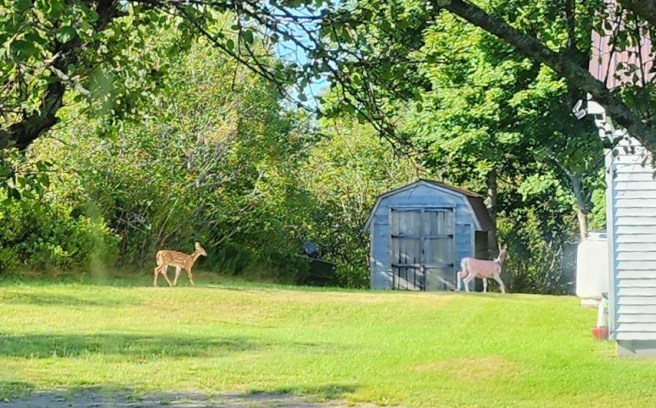
Our white deer and a fawn

Eastport, as you may have gleaned from this blog, can be overrun with deer. They do make gardening a challenge.

The encounters become more lively when mention of an albino deer arises. We’re discovering that Moose Island, where we live, has had a series of white deer, including fawns with the gene.

For the record, they’re probably not albino but leucistic, and as I saw in this case, mostly pink. Defining piebald has its own set of technicalities.

This encounter was on a Sunday morning while I was heading out of town on my way to Quaker Meeting for worship. I passed what I thought was lawn decoration and then realized it wasn’t. When I whipped back, this was the best I could capture before lowering the car’s window, and by then they had slipped behind the house. Wily critters they can be.

The deer in question, by the way, is on the right in the photo.

Memories of places in the town I grew up in

I’ve mentioned a few others, such as the art museum, in other posts here. Now, to add a few more, in no particular order. Again, I’m looking at Greater Dayton rather than strictly inside the city limits.

  1. NCR: The National Cash Register Company’s world headquarters looked more like an open college campus with linden trees and pristine lawns than an industrial jumble behind barbed wire and hurricane fencing. It even had a fine auditorium and pipe organ, used for its gatherings of salesmen but also the concerts of the Civic Music Association – I heard a number of famed musicians there. And I was awarded my Eagle Scout badge and later my high school diploma on its stage. And, oh yes, I can’t overlook Old River, the employee park with the lagoon and boating, a fine miniature golf course, and a huge outdoor swimming pool – when one of my buddies whose father worked at NCR and thus had a pass to the park asked if I wanted to go, there was only one possible answer. Please!
  2. The corner display windows at Rikes department store: The pioneering retailer was the place to shop in town, and anytime we took the bus, say to the library or a movie, we’d wind up checking the latest display – especially at Christmas. During my senior year, some of my art work was used in the background of the featured fashion.
  3. The YMCA: I learned to swim at the indoor pool and sometimes applied my allowance to a grilled cheese sandwich later, over on the men’s side. And then, little kid that I was, I enjoyed the freedom of taking the bus home on my own.
  4. Frigidaire employee park: Thanks to my best friend’s father’s employee pass, we spent many summer nights enjoying free Starlight movies. My dad worked for another General Motors division in town, one that had no such benefits.
  5. Troop trails: My Boy Scout troop had a long hike one Sunday a month, in addition to a primitive camping weekend. Our routes often followed a river or crossed farmlands or even trekked along railroad tracks. I remember especially a few that traced the abandoned Miami-Erie Canal with its mule bank and its eerie remains of limestone locks left in vines and trees.
  6. Suicide Hill: A decent snowfall (quite modest by what I’ve experienced since) meant sledding at Hills and Dales Park. How insignificant the slope looks now, but there were some serious injuries. I had a near call.
  7. Memorial Hall: It really wasn’t designed for concerts, but it’s where the Philharmonic performed, and since my dad had access to tickets, I heard many top soloists. Hard to believe now, actually.
  8. Our big ugly high school: built in the 1960s and long since torn down. In my memory, I recall it more than the older but equally ugly elementary school.
  9. Yellow Springs: Once I got my driver’s license, the bohemian town in Greene County, home of Antioch College, became a welcome retreat. Its funky stores, before funky was a word in my consciousness, were mind-expanding. Nowhere else could we find Earl Grey or gunpowder tea or sticks of incense or perfumed soaps. Then there was the professional summer theater series at the amphitheater, itself a revelation. By that time, I was in love, at last. And that leads to mention of a covered bridge by moonlight: Yes, making out afterward in the moonlight at a covered bridge that’s no longer existent down an unpaved road.
  10. The Art Theater: Where I first saw foreign films, black-and-white alternatives to Hollywood’s commercial concoctions. And then there was the Lemon Tree coffee house next door with its folk music and blues.

My, all that was a world ago in my life.


Think of it as an ‘advance reading copy,’ after the fact

Many of the books in my personal library arrived in the newsroom as advance reading copies, intended for reviews or perhaps mention in a column, except that we rarely printed one of those. Instead, the freebies went out on a shelf for first-come to be first-served.

For the book publishers and authors, it was a huge waste of money.

In addition to the two books I’m offering for free at Smashword’s big July-long sale, you can pick up a copy of my new Hamlet: A Village of Gargoyles poetry collection at just half-price.

It really is worth a visit.

The Appalachian Trail is the grandaddy of a hiking marathon

Other parts of the world have long had their pilgrimages, but in the United States, when it comes to doing that on foot rather than by car, I’d say the Appalachian Trail tops the list.

The public pathway was conceived in 1921, built by private citizens, and competed in 1937. It officially became the Appalachian National Scenic Trail in 1968.

Here are some other perspectives.

  1. Length: Almost 2,200 miles involving 14 states from Georgia to Maine. Parts of the path get rerouted over time, a consequence of urban development pressures, loss of access across private lands, or other factors. It’s touted as the longest hiker-only trail in the world. Pack animals and wheeled things are shunted to other options.
  2. Heavenly heights: The trail ascends many of the tallest peaks in the Appalachian Mountain system, including the Great Smokeys of North Carolina and Tennessee, the Green Mountains of Vermont, the Presidentials of New Hampshire, and Maine’s Longfellows, many of them rising above the tree line. Most of the trail is forests or other wildlands, although some sections, especially in the valleys, pass farmlands, follow roadways, cross bridges, or run into small towns.
  3. Backpackers: Sections traversing roadways often have trailheads that give day hikers or overnighters access for short treks, the AT is celebrated for its backpackers, carrying all of their food, clothing, and gear and camping each night somewhere in the wilds. Some, like my Boy Scout troop when I was 12, venture out for a week or two, but the truly serious folks are the ones who trek from one end to the other in a single season. They’re known as thru-hikers, and those who return to hike the AT from the other direction the next year are considered a “yo-yo.” An estimated 3,000 people set out each year to hike the entire length, with a fourth of them actually succeeding. In 2017, 715 northbound and 133 southbound thru-hikers were recorded.
  4. Weather factors: Winter weather in effect shuts down many sections of the AT, at least for thru-hikers. Since the weather warms earlier in Georgia than in Maine is the reason most of the thru-hikers start at the south end and head north, hoping the snow and ice have melted from northern New England sections by the time they arrive that far. Some veterans argue that the trail is easier in that direction, too.
  5. Self-discovery: As one gets a distance away from a road or peopled location, the terrain becomes more pristine. There’s less litter and debris and less noise, too. The hiker encounters not only nature, on gorgeous days and raw ones, but also personal challenges and inner resources.
  6. Dedicated organization: The AT is maintained by 31 trail clubs of volunteers and other partnerships and managed jointly by the National Park Service, U.S. Forest Service, and nonprofit Appalachian Trail Conservancy.
  7. Angels along the way: Thru-hikers tell of remarkable locals who routinely come to the aid of the travelers. Need a bath or shower? A lift into town for groceries? A phone call, back in the day before cell phones? (Maybe today that’s a recharge?) They’re there.
  8. Memories: Many of the experiences are unforgettable. The scenery, especially. But there can also be downsides: Rattlesnakes, copperheads, bears, as well as ticks, mosquitoes, and black flies. Or some brutal weather, even in the height of summer.
  9. Mostly protected now: Passage of the National Trails System Act of 1968 allowed the Park System to purchase most of the lands still in private hands, assuring the AT of a permanent route.
  10. It’s not necessarily free: Portions of the trail require payment for backcountry permits or park entry as well as for shelters and campsites. Otherwise, access it free. Your gear, foodstuffs, and getting there are, of course, expenses to consider.  

 The AT is no longer the only long trail system in America, but it’s still the oldest. To achieve its length combined with Continental Divide Trail (2,700 to 3,150 miles, depending) and Pacific Crest Trail (2,653 miles) is considered the Triple Crown of Hiking in the United States.