Dover was on the frontier of Friends

For much of its first century of settlement, Dover was on the frontier of English settlement. Tenuous outposts clung to the coastline as far as Pemaquid and Monhegan Island in Maine, but after hostilities broke out in 1689, European settlement was pushed down to Wells, just beyond Dover.

During this time, Dover Friends were both the furthest north and furthest east Quakers in the New World. Did they feel isolated or vulnerable? They did get some strong visiting ministry during those years.

Only when Casco Bay, or today’s Greater Portland, was resettled around 1740 did that begin to change.

The number of Dover Friends relocating to new Maine lands by 1800 continues to astound me. After all, the traditional historical focus tends to look south, to Boston and to the west beyond.

I’m sensing that there’s a much richer story looking in the other direction, involving Dover families of all stripes.

A few key provisions made all the difference

I had initially dismissed them as inconsequential, but when Massachusetts annexed New Hampshire, it allowed two crucial exemptions in the Live Free or Die province.

The first let all free males vote in town affairs, not just those in good standing in the tax-supported church. And it let them hold land.

What that meant for those joining the Quaker and Baptist movements was that they wouldn’t be disenfranchised for their faith.

That wasn’t the case in the Puritan colonies of Massachusetts and Connecticut.


White supremacy was there all along

Maintaining a unique group identity can be perilous, no matter how necessary.

The necessity side, at its best, has to do with trying to make progress, improve justice and physical comfort, live healthier, counter the corrosive forces of status quo and lethargy, be smarter, and so on. Put it any way you want, things in general could be better, and even thinking something like that will set you apart from the status quo of broader society.

On the other hand, humans are social animals. We need others as family, friends, colleagues, cohorts. We even need them to share our stories, histories, songs, and place on this earth. Relax, right?

It’s a complex calculus, then, around the world.

What I started to see in researching my book on a Quaker community in New England, though, was a blatant arrogance within the Puritan wave of immigration. I suspect similar sides are apparent in the Spanish settlers to the south or the French to the north, or, well, back in the Old World, all the way to China. Even one tribe over another.

I’m trying to look at this clearly.

The English, of course, knew they were superior to the French, who I gather saw it the other way around. (Insert proper expletive and spit appropriately.) And they were both superior to the Spanish or Portuguese or Italians, according to this scenario.

Germans? Not really on the scene in earliest settlement in America, far as I can tell, though the Dutch of New Netherlands add their own twist.

Remember, the English also looked down on the Scots and Irish, as well as the Welsh and Cornish.

Sounds to me like the old game, King of the Hill.

The comedian Eddie Izzard has an insightful riff on this where he says it all comes down to a flag. If you have no flag, you have no claim to your country or land. So, here, I’ll stick mine in the ground and this place is mine.

That does make for a short ride on the papal Doctrine of Discovery. Look it up, if you must.

What I’ve seen in my research is how this air of superiority made equitable dealings between the Europeans and the Indigenous peoples impossible. There was no eye-to-eye even exchange. Even the concept of farming was viewed as more productive, and thus superior, than the Native hunting and gathering use of a piece of land.

Well, I could argue that God preferred a wild-game offering over grain in Cain vs. Abel, Genesis chapter 4.

You know, quality over quantity.

As for equality? We have our guns and Bibles.

Which points to another distinction: written language. I’m a writer and a reader. You expect me to not take sides here?

Still, in the New England story, the English weren’t shy about labeling the Natives as “barbarians,” “savages,” and “heathens.” Never mind many of the practices of the English and French, who not only offered bounties on scalps – Native and the other side’s European – but also indulged in the practice themselves. As for heathen? For the Puritans, with their Calvinist inclination of proclaiming themselves God’s Elect, most other Christians were also lumped in that group, perhaps at a slightly lesser degree.

Many of the consequences, however, have been tragic, for all sides.

In some theology, pride is a sin, right? Ahem. (Hopefully, in contrast to justifiable self-esteem.)

Well, as some among us might note, I’m proud to be a humble Quaker. Not that we didn’t fall into that trap of feeling superior, too.

There’s plenty of work for all to do on this issue. I’ll leave my end of the discussion at that, for now.

Some related history books I’d like to see

Assuming they’re well written.

  1. A biography of Sir Ferdinando Gorges. He was the godfather of New England, after all, but failed to fulfill his dream.
  2. Ditto for father and son Alexander and Nicholas Shapleigh (especially the trials of being royalists as the Puritans and their commonwealth emerged).
  3. Especially a bio of Major Richard Waldron in all of his shenanigans. He made much of Dover a personal fiefdom and ignited decades of warfare that followed his death.
  4. How early colonial economics really worked. Start with the charter holders who “owned” the province but not the land.
  5. A clearer understanding of Puritans, Unitarians, and Baptists, especially as they evolved within New England.
  6. A closer examination of the Dover Meeting minutes, especially the Revolutionary War disciplinary actions as well as more on the recorded ministers and elders.
  7. Hampton Meeting and Salem Meeting … and a comprehensive history of New England Yearly Meeting and its Friends.
  8. Devonshire folkways and ways its Puritans may have deviated from those …
  9. How the four towns differed, then and now.
  10. Dover in its textile mill glory days.

For my own contributions to the field, see Quaking Dover. Order your copy at your favorite bookstore. Or request it at your public library.

More on the early Scots around Dover

The Scottish prisoners of war who had been deported in chains to New England and sold into indentured servitude were becoming free men about the time the Quaker movement came to the New World. It must have added to the volatile social, economic, political, and religious mix.

My book Quaking Dover examines the tensions between the traditions and values of the settlers from Devonshire and those of the Puritans originating from East Anglia. In the Piscataqua watershed, the Scots no doubt added another dimension to that culture clash.

Their number in a sparsely populated area is impressive – more than 50 men in Berwick, Maine, plus Oyster River, Exeter, and Hampton in New Hampshire. In short, they were a significant part of the inhabitants, even before many of them scooted off to places like York, Maine, or Boston.

~*~

A historical marker on Sligo Road in Rollinsford, opposite Berwick along the Salmon Falls river, summarizes the life of one as thus:

Near this place lived David Hamilton of Westburn born in the parish of Cambuslang, Scotland, in October, 1620; captured by Oliver Cromwell at the Battle of Worcester, England. September 3, 1651 brought to America as a prisoner in chains on the “John and Sarah” in the same year; settled near here and married Annah Jaxson of Lanark, Scotland; killed by Indians on September 28, 1691.

The marriage to Anna Jackson took place in 1662 in either Dover or Saco, Maine. She is believed to be the daughter of Richard Jackson, another Scottish POW. We are left wondering whether she had somehow managed to rejoin her father in New England or whether Hamilton knew her in Scotland and arranged for her passage. I’ve found little more about her father and nothing about her mother, although the fact that he died in 1691 in Berwick has me wondering if he, like Hamilton, fell in an attack by Natives.

David and Anna settled in Rollinsford and had seven sons.

He was slain in 1691 while working on his farm. His wife presumably predeceased him.

Today, Hamilton House can be seen across the river from the site of their farm.

That house gets its name from their great-grandson Jonathan, a wealthy merchant who built a manor overlooking a broad cove of the Salmon Falls. There, he had ships unloaded and repacked.

The site, with a classic Georgian house erected by later residents, is now maintained as a museum by Historic New England and open to the public.

~*~

The Oyster River connection brings into the picture an early settler who bought seven of the prisoners. He was Valentine Hill, who arrived in Oyster River in 1643 and established a large farm and saw mill at the falls. His 1649 house, now part of the Three Chimneys Inn, is one of the oldest structures in New Hampshire. His prominence is reflected in his construction of a meetinghouse in 1655 for the village, which was still part of Dover. Or should we say the Scots laboring for him did? The Puritan minister at First Parish held services there as well as at the Fort Meetinghouse on Dover Neck.

Through his first wife, Hill was distantly related to William Hutchinson, whose wife Ann had been banished from Massachusetts in a religious controversy and resettled in Rhode Island, where many of her followers later joined in the Quaker movement.

Valentine appears to have been thoroughly Puritan, but not so his likely nephew John, who settled in Oyster River in 1656; many of his descendants were active Friends in Dover. I’m assuming that John was the son of a John Hill who settled in Dover by 1639.

~*~

One Scottish POW who definitely had a line of Quaker descendants was John Bean, who settled in Exeter. As I describe in my book, Joel and James Bean and their two sisters left Dover to assist the growth of Friends Meetings in Iowa and then the West Coast, including roles in the founding of two colleges.

Their great-great-grandfather Bean was a recorded Quaker minister in Brentwood, New Hampshire, but stubbornly refused to submit to eldering from New England Yearly Meeting colleagues and was ultimately “disowned,” or removed from membership. Even so, he then led a splinter Quaker body in town. Was that the Scottish heritage at work?


There’s much more than one big story to touch on

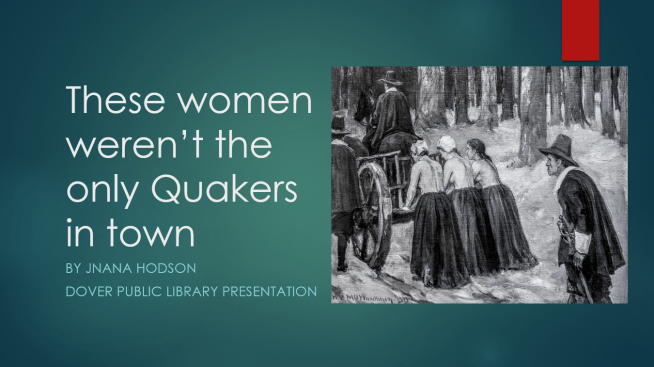
There’s more to the origin of Dover Friends Meeting than the three women who were whipped out of town in December 1662 in what would have been a death sentence, had it been carried out to the letter.

Still, it’s a big story, one that occupies a central place in my new book, Quaking Dover. The horrific incident is also the most frequently visited page at the public library’s online history site, and it’s the subject of one of Greenleaf Whittier’s most famous poems.

I’ll be using that to introduce other examples of courage and faith from the town’s Quaker experience when the Dover Public Library features me in a book reading in front of a live audience this coming Wednesday. I hope you can join me, perhaps even posing a question or insight.

The appearance will also be streamed live, but preregistration is required.

That’s 6:30 pm this Wednesday (March 22).

If it’s anything like the Dover400 new authors presentation earlier in the month, I can assure you it will be a blast.


What revelations will turn up in Dover’s early public records?

In preparation for Dover’s 400th anniversary, dedicated volunteers have been poring over early records. In many cases, these served both the town and its tax-supported church, back to the 1600s. Many of these have been digitized and posted on the City of Dover website, but they can be very hard to read.

Even so, they’re being transcribed for release as part of this year’s big celebrations.

Moreover, in the light of scholarly advances, these hold the potential of drastically revising an understanding of our legacy.

I think it will be exciting.

I’m having fun preparing PowerPoint presentations

In general, when it comes to new tech, I’m pretty much of a neo-Luddite. I prefer to stick to the tried-and-true rather than chasing after every new twist and trying to master it before it’s obsolete by the next wave.

I still haven’t stepped up to host a Zoom session, for heaven’s sake. And we’re definitely not E-Zpass users when it comes to highway tolls, either.

Preparing visuals to accompany my public presentations related to my new book, Quaking Dover, however, has me beaming.

The first leap was in learning to connect a laptop to a slide projector – you know, so folks could watch a slide show on a big white screen or a wall.

From that experience, I realized the shots really needed to be all of one size. Some pictures I was discussing ran off the screen, while others were too small. That led to the PowerPoint format.

My initial outing with PowerPoint was with the Whittier Birthplace Museum’s virtual lecture series back in January. There, I was amazed to discover how much I could enlarge a detail from a photo without having it pixilate. Individual signatures from a Quaker marriage document, for instance, could be displayed prominently. The size of the photo in hand wasn’t an issue, either. Up we go!

I’ve been at it again, this time for presentations at the Dover Public Library on March 22 and the Pembroke (Maine) Historical Society on April 18, as well as a third in July via the Falmouth Friends Meeting on Cape Cod. All will be streamed, by the way, if you’re interested in participating. (Do mark your calendars.)

It’s getting easier with each round, and I’m learning how to easily copy a PP slide from one production to another. Yay!

Fun? I’m finding it downright exciting. Hope you do, too.

Town meeting and grassroots democracy

New England’s annual town meetings are often hailed as an epitome of participatory democracy, but I have yet to hear an examination of how they mutated from the original Congregational churches’ model of self-governance, back when the town and Puritan parish were one.

As long as voting on town affairs was limited only to males in good standing with the local congregation, up to two-thirds of a town’s households were excluded from the deliberations.

In New Hampshire, that wasn’t the case, even after Massachusetts annexed the colony. What happened then, I’ll venture, is that the Quakers and Baptists tempered the deliberations in the future Granite State in ways that eventually seeped elsewhere.

Quakers, or more formally Friends, served as a loyal opposition, one that wouldn’t take up arms in its cause but that would nonetheless hold firm to its convictions. Like the Baptists, they also believed in a separation of church and state.

The Quaker practice of conducting community business in a monthly session meant seeking unity on an issue without ever taking a vote. A vote, after all, would create a minority. Instead, when differences arose, due consideration might produce a synthesis – not a compromise. The former would be superior to either of the earlier positions. The latter would mean settling on the lowest common denominator.

Crucial to this process was the Meeting’s clerk, carefully listening to all involved.

A skillful town moderator, so I’ve heard, needs similar abilities.

I’m curious to hear how this played out in Rhode Island and on the Cape, where Friends and Baptists were also an influence.

Do note, the Puritan colonies had none of the toleration of Maryland, New Jersey, Pennsylvania, or New York to the south and west, yet they lacked the town meeting heritage.

I do want to hear more.