As for Underground Railroad connections?

While Quakers were active in the Underground Railroad for fugitive slaves, the practice wasn’t universally embraced within the Society of Friends. In fact, much of the illegal action across the North was undertaken by evangelical Protestants who even created the altar call at revivals to enlist fellow workers.

Yes, it’s one more story in the American experience that needs to be better known, in all of its gritty reality.

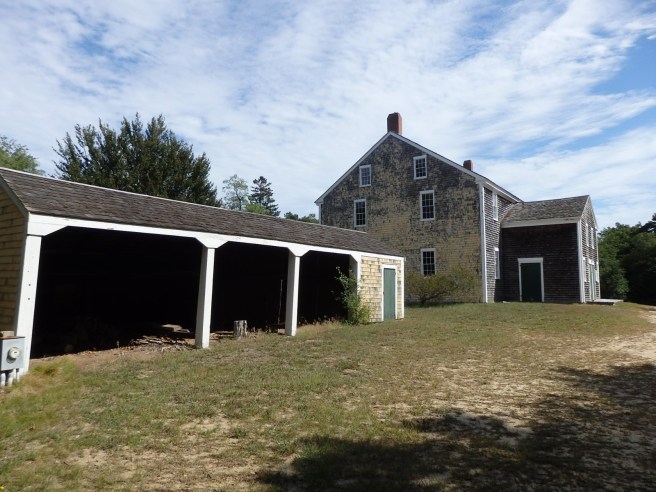
As I describe in Quaking Dover, the Cartland family farm in Lee is believed to have been a stop on one of those lines to freedom. While documentation of such participation is rare, escaped slaved turned abolitionist Frederick Douglass was a frequent visitor to the farm, and like also its small Quaker meetinghouse and school.

The bigger question would be how did the fugitives get that far and where did the route head from there? Not everyone along the way was sympathetic, after all. Newburyport, Massachusetts, for one, was downright hostile and thus an unlikely place to jump ship. As for Portsmouth or Dover?

Establishing reliable yet invisible connections every ten or 20 miles would have been quite an accomplishment. What prompted households to risk everything to the moral cause? They were, after all, a threat to a vast economic system and its wealth.

It’s one more another interesting twist to develop in future research through New Hampshire.

Of note across the street from Dover’s Quaker meetinghouse

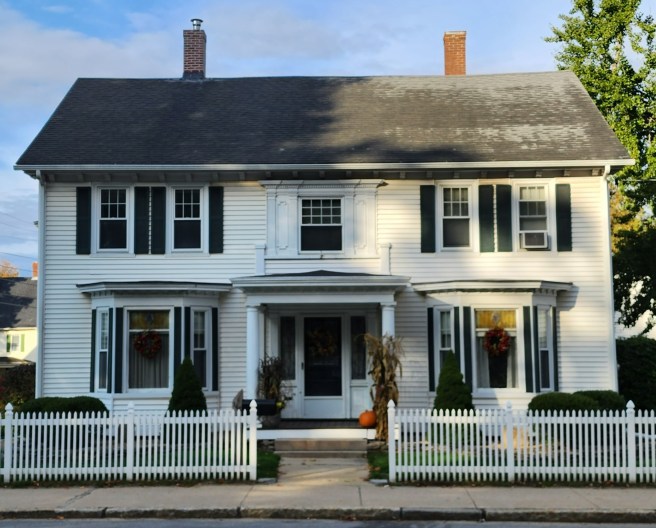
The home Isaac Wendell built by 1827 sits across Central Avenue from the Quaker meetinghouse.

I often parked next to it on the side street and admired the bird boxes and woodworking details on the ample barn and house additions.

He’s most noted as the cofounder with John Williams of the Dover Cotton Factory, the forerunner of the big mills downtown, but of interest to my story, he had married Anna Whittier, a close cousin of the celebrated poet John Greenleaf Whittier.

We can assume Greenleaf was a welcome guest there on his many visits to Dover.

Let me add, the relatively humane working conditions in the mills deteriorated drastically after Williams and Wendell lost control to new investors, leading to the first labor strike by women in America in 1828.

Wendell also shows up in the founding of the Sawyer Mills, which I discussed a week ago, as well as a foundry.

One commute I can’t complain about

Some Sunday mornings, my drive to and from the Quaker meetinghouse a half-hour from my home is a meditation in its own right.

Even in fog or snow, it can be refreshing.

Much of the road is through forest, plus stretches along Passamaquoddy and Cobscook bays and their tributaries. The route also passes through a tribal reservation and a national wildlife preserve, which does sound a bit exotic though I take it as routine.

Eagle sightings are common, and I have had to stop for deer or turkeys in the middle of U.S. 1. Once I even spotted a moose far ahead on the pavement.

A radio program of classical choral music on a CBC station that comes in quite clearly is often also an element, depending on my mood.

Do you remember the freedom you felt when you first learned to drive? Some mornings, especially when there’s no other traffic, that elation returns.

While I’m tempted to proclaim “What could be more glorious than this!” I will also note many of the scattered homes I pass resemble junkyards – poverty in Washington County is a constant – so there’s a reminder of that reality, too. I suspect there are more dead cars and trucks here than people.

As an added touch, there are no traffic lights, either.

Sawyer Mills usually get overlooked

The town’s textile mills don’t get a lot of attention in my book Quaking Dover, in part because I haven’t found a lot of interaction between the emerging industry and the town’s Friends. Indeed, the Quaker Meeting was seriously aging about the same time the thriving mills transformed the town into an industrial power.

Dover’s conventional histories, on the other hand, have good reason to focus on the big brick mills along the Cochecho River, world famous for the quality of their calico and their stunning print designs and execution.

You might be surprised to learn, though, that they were in operation much earlier than the legendary cotton mills at Lowell, Lawrence, and Manchester on the mighty Merrimac River.

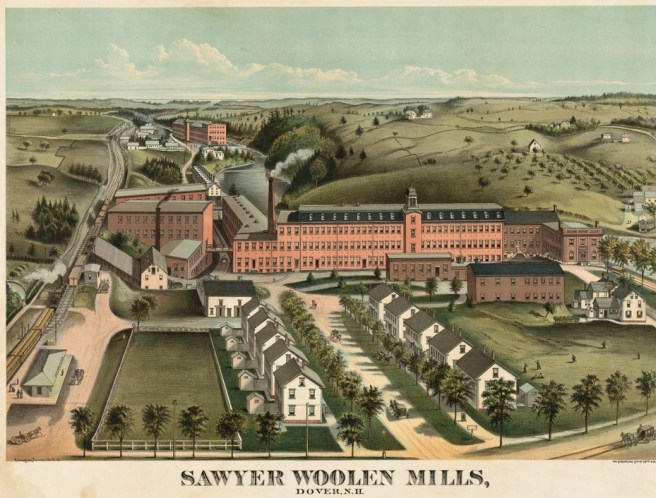
Largely overlooked, as one Friend reminds me, are the woolen mills on the Bellamy River south of Dover’s downtown and only a few blocks from the Quaker meetinghouse. These operated from 1824 to 1899 and were often innovative, employing up to 600 workers before being sold and continuing till 1954.

They were renowned especially for their flannel and were, at stretch, the largest woolen mills in the Granite State.

Today the mills and their historic housing have emerged as a charming residential district.

While there were some Sawyers in the Meeting, I’ve not yet found any connection to those owning the mills.

Based on the naming of some of their children, those were apparently Methodist.

I’ve been meditating for more than 50 years now

Well, I haven’t been living as a monk in a Himalayan-mountain cave any of that time, but it does sound more impressive that being a “meditator” or someone who practices in a contemplative religious tradition that long even when it’s only once or twice a week.

The thought came to me in Quaker worship the other Sunday morning, the center of what has remained my spiritual discipline and community after the yoga-based version faded away over the years – even my rising before dawn to sit cross-legged in front of a small altar and its candle before I tackled poetry and then took off for the paying job for the rest of the day.

~*~

While I can no longer park myself on a cushion on the floor in the Asian style but rather settle in much more loosely on an old meetinghouse bench – do not call it a pew – the bigger change has been in the focus of my sitting.

The goal of the yoga exercise was to transcend, leaving behind mundane awareness altogether. Somewhere you might encounter your past lives, even. If not that, then a natural high, as an advanced version of a drug trip. At least an awareness of an altered state of consciousness that might even address authentic ethereal reality.

Instead, in the Quaker vein, what I’ve found is a time of being mentally and emotionally renewed and even gaining clarity into my daily engagements.

Or, as one quip goes, some of the best barns in New England were designed during Quaker Meeting. In this case, meaning the hour of shared and mostly silent worship.

~*~

The half-century mark also takes me back to my first Summer of Love, detailed my novel Pit-a-Pat High Jinks, a book that has scenes triggering the erotica filter, should you try to order a copy.

While I was preparing to live in the yoga ashram to our south back then, I experienced my first summer with a daily exposure to the outdoors, including swimming in mountain lakes, often naked, Upstate New York. It was a time of great struggle, discovery, growth, and redirection for me.

And at the end of all this, at the closure of our hour of silent worship here in Maine, one Friend (aka Quaker) voiced an insight from a Native perspective that when it comes to time, the focus is on the past – it’s the only one we can know. The future is the one behind us, rather than ahead. Not that there’s that much ahead for me in this lifetime.

~*~

Still, it’s was a kind of day that had me wondering, can life be any better than this? (Even with those aches et cetera of aging.)

My range didn’t expand to the whole state

Statehood for New Hampshire was accompanied by growth in the Merrimac Valley and western side of the state, including Quaker Meetings.

Weare, especially, became a Friends center, with two large meetinghouses in town and another in neighboring Henniker. There was also the Clinton Grove academy.

Much of that growth, however, came from Massachusetts, not Dover, and so it fell outside the focus of my Quaking Dover story. They were even in a different Quarterly Meeting than the one encompassing the communities emanating from Dover.

Just in case anyone was wondering.

If you missed my latest Zoom presentation

You can catch up with my insights on “Quaker Meeting as a nest for social justness” via YouTube, thanks to West Falmouth Friends on Cape Cod.

The event, the latest of the special presentations based on my book, Quaking Dover and the New Hampshire city’s 400th anniversary, was recorded and is now available.

Many thanks to all involved.

To see what transpired during the hour, click here.

As for a broad history of New England Quakers?

It would be an ambitious project, and I’m not sure quite how one would structure it, spanning six states and many subjects as it would from early colonial times to today.

Dover Friend Silas Weeks’ book of meetinghouses and burial grounds remains my go-to volume, but it’s mostly about buildings rather than people.

I’m still surprised to hear Rhode Island Yearly Meeting as the body’s early name, rather than New England Yearly Meeting. When did it change officially?

Well, I have seen some genealogies that get impossible to follow after, say, the third generation.

I even feel something like that in Dover, once the textile mills take over.

Still, the conventional histories of Quakers in America focus on Philadelphia, overlooking or slighting the unique challenges and characters of New England, North Carolina, Ohio, and more.

For now, my Quaking Dover is a microcosm of the bigger picture. I’m hoping it will prompt more.

Welcome to Cobscook Friends

As a small, rural Quaker fellowship, we’re especially happy to be worshipping together in one space every Sunday again, at least through the summer and early autumn.

Covid, of course, had us connected only by Zoom through much of the Covid onslaught and after that, coming together in a physical space on alternative weeks only. We do live at distances from the meetinghouse, so winter weather can often be a challenge.

Not so summer. We’d love to have others join us in our hour of mostly silent centering, beginning at 9:30 on Sunday mornings. The meetinghouse is in the woods along Maine Route 189 in Whiting – on the way to Lubec and many great outdoors trails.

If you meditate in some practice, you’ll fit right in – and if that seems foreign, it’s still a great time for personal reflection. I always find it renewing.

As for Happy Hampton?

In New Hampshire, Hampton is often touted as Happy Hampton, at least in summer, reflecting its long, broad, honky-tonk ocean beach and the rock concerts at the casino. Let me warn you it can be pretty crowded this time of year. Inland a bit, it’s also known for the Hampton Tolls on Interstate 95, which can be a major travel delay.

In the colonial era, Hampton was renowned for its saltmarsh hay and related agriculture.

It was also the center of the colony’s other Quaker Meeting, one at least as old as Dover’s, as far as I can tell.

As I was researching my book, Quaking Dover, I kept wondering what happened to the Hampton Friends over time. And then I discovered that, like Dover, Hampton had small, neighborhood worship groups, or “preparative meetings,” that came together once a month to address their joint affairs and personal conduct. The monthly sessions rotated among the meetinghouses under the Monthly Meeting’s care, in Hampton’s case including Amesbury, Massachusetts, which became home to the celebrated poet John Greenleaf Whittier.

Amesbury continues, while Hampton fell away long ago.

Since the boundary line between New Hampshire and Massachusetts kept shifting in the colonial era, sometimes reaching down to the Merrimack River – or Merrimac, as Massachusetts insisted – I feel safe in saying New Hampshire had two Monthly Meetings, while the Bay colony had only one, at Salem.

Either way, it could be a rich story in the telling.