When Edward Hilton settles on Dover Point, his brother William is dwelling in the Plymouth Bay colony. It’s one more suggestion, in fact, that Edward knew about the Piscataqua watershed before setting forth himself.
William arrives on the second ship to the Pilgrim plantation, followed by his wife and family on the next. They definitely aren’t Pilgrims (the term wasn’t even in use then – Separatists was more accurate). And, for that matter, despite sharing a basic Calvinist theology, the Separatists hold some sharp differences from the Puritans who show up later.
Critically, roughly half of the settlers at new Plymouth aren’t members of the Separatist faith. And that includes the only ordained minister in the colony.
Thus, when William and his wife arrange for a secret Anglican (that is, Episcopal) baptism for their infant, a scandal erupts that sends them scurrying northward and brings to light the sordid background of the now disgraced minister who is promptly banished. (No spoiler here – but you’ll still have to read the book.) These events do present a grittier alternative to the Thanksgiving scenario we usually trot out about the Pilgrim experience.
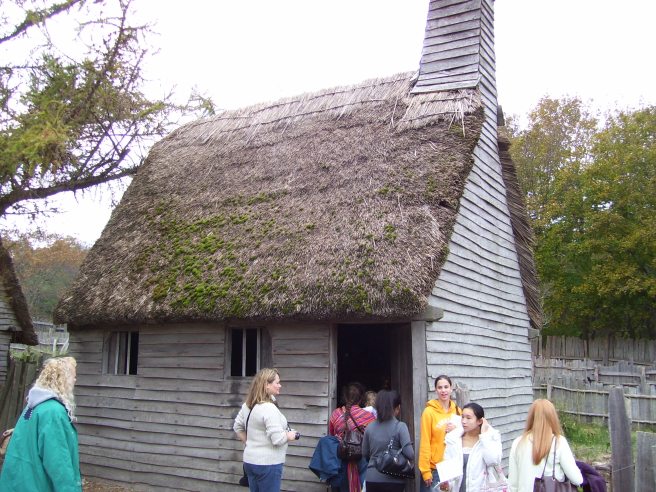
I wonder how much early Dover resembled the 1630 village at the Pilmoth Plantation living history museum. These houses were dark and drafty, at best. Photo by Swampyank via Wikimedia Commons.
William winds up in New Hampshire, settling at the Pannaway plantation at the mouth of the Piscataqua River, where he’s soon making salt to be used for preserving fish for shipment.
And then, in the demise of Pannaway, he’s finally at Dover Point.
This isn’t the way his arrival in Dover is commonly painted. Quite simply, he isn’t one of the first two settlers. Thomas Roberts, Edward’s apprentice, earns that honor.
Still, like his brother, William is both a member of the powerful fishmonger guild in London and literate. And things get a bit rowdy when he moves on from Dover to live on the Maine side of the river.
Yeah, if you’re looking for gossip, there’s some juicy stuff on his part, especially when we meet his last wife. She’s definitely not holier-than-thou.
The mystics and traditions I’ve encountered are anything but airy-fairy. In fact, they can be pretty down-to-earth and practical, based on personal experience and testing rather than empty speculation or dogma.
As George Fox said at the beginning of the Quaker movement, “This I knew experimentally.” That is, by first-hand experience including trial and error. Or as was said a few years later, “Some of the best barns in Rhode Island were designed during Quaker Meeting,” during quiet meditation.
Never underestimate the importance of the disciplined circle of fellow practitioners, either. Anyone who says “I’m spiritual, not religious,” but lacks that communal base is headed for trouble.
I learned that 50 years ago in a yoga ashram – see my novel Yoga Bootcamp for unorthodox examples of how it works – and have seen it in other traditions since, especially my Quaker circles.
One of my favorite stories comes via fellow blogger Tru-Queer, who relayed the incident this way:
A Tibetan lama and a famous Korean Zen master in the Rinzai school were to have a debate.
The Tibetan lama sat meditating, counting his mala. The Zen master produced an orange from his robes and asked the lama, “What is this?” It was a famous koan. Waiting for a response, the lama continued meditating. The Zen master asked again, “What is this?”
The Tibetan lama spoke with his translator for a moment, who said, “Do they not have oranges where he is from?”
~*~
I suppose I should explain that a koan is a kind of mental puzzle intended to push a student beyond rational thought. Zen is essentially black-and-white ascetic, while Tibetan Buddhism is full of colorful esoteric teaching and drama. Yet here the roles are reversed, in a great joke.
But it doesn’t end there. When’s the last time you really looked at an orange? How many varieties can you identify, much less their differences in uses or subtle flavors? Does your recognition that it’s “an orange” put a stop to regarding it fully? That is, when’s the last time you had an “OH WOW!” moment with something so seemingly commonplace.
Gertrude Stein was aiming at something similar with her “A rose is a rose is a rose,” which blows open when you learn she was also speaking of a friend named Rose and not just the metaphors associated with a specific flower that somehow too often gets lost in the entire equation.
So just how do we live full of wonder – a state a Friend hailed as the Holy Now?
I’d say having dear ones who share it with you does help. Even if they’re Zen Buddhists.
I stepped out of my journalism career three times in my life before retiring for good. The first was when I decided to move to the ashram where I could immerse myself in yoga philosophy and practice. Responding to Swami’s invitation to settle into her rural setup was something I did slowly and deliberately, with a large degree of trepidation. As I relate in my Yoga Bootcamp novel, the daily life was intense and evolving. Leaving the ashram was a different matter, with others largely resolving the outcome – out you go. For weeks afterward, I felt myself falling helplessly through space. Eventually, I reestablished my feet on the ground and then headed off for a new life in a town I call Prairie Depot.
The paperback cover …
What happened for me during my residency was life-changing. I regard it as my master’s degree and my introduction to psychotherapy of an amateur sort. Among other things, it led me to the Society of Friends, or Quakers, which turned out to be the faith of my Hodgson ancestors from the 1660s down through my great-grandfather.
In the novel, I chose to confine the structure to a single day, in part because I had so many lingering questions I could not answer. Yes, within that day individuals could look back on their previous history, but the focus was on the NOW. And a lot could happen there in a 24-hour span. Besides, as I later learned through some candid discussions with a former Episcopal nun, monastic life has some commonalities of its own. As she said, some of the most intense interactions came in trying to choose the flavor of ice cream when the rare opportunity arose. I’ll argue you’re the most human under such rarified circumstances.
On top of everything, when I was drafting the book, I was out of contact with the place and its people. Critically, I had refused an order to return to the ashram after I’d married and moved to Washington state and a follow-up stipulation of heavy financial support was out of the question. A half-dozen years later, back on the East Coast, I had an opportunity to stop by but was not admitted into the house. I did learn that Swami had died and I sat by her grave. So much for making amends.
… and the back cover.
Since then, I’ve reconnected through social media with some of the key players and had a few assumptions, not in the story, deflated. In addition, Devan Malore’s “The Churning” reflects life there a few years after I’d moved on.
The story itself could have gone another way, if I hadn’t wanted to present the ideals that drew us together and kept us going. Especially the humor and playfulness.
More compelling for many readers would have been a more sordid tale of just one more “new religion” outfit run into scandal of a sexual or financial sort, preferably both. There were enough elements for that, as I’ve since learned.
The story first came out as a pioneering ebook in PDF format only and was later updated to Smashwords and its affiliated partners. A more recent, quite thorough recasting (again, blame the influence of Cassia in “What’s Left”) changed Swami from female to male and introduced Jaya as one of the eight resident yogis, thus linking her to the heftier Nearly Canaan novel. Besides, the transformation made Swami more acceptable to the expectations of many readers and allowed the Big Pumpkin and Elvis dimensions. The role was already unconventional enough, and this was more fun.
Am I still doing yoga? If you mean hatha, the physical exercises, let me say rarely and embarrassingly, at that. As exercise, I’ll substitute my daily laps in the swimming pool, and as meditation, my weekly Quaker meeting for worship. And no, I’m no longer vegetarian, other than when I voluntarily follow the Greek Orthodox “fasting” of Advent and Great Lent (again, blame Cassia), though I also eat much less flesh than most Americans. Actually, in these seasons, the Eastern Orthodox Christians are stricter than we yogis were.
I do wish there were a similar haven for youth today, one freed from the burden of student college debt. I’ll let “Yoga Bootcamp” stand where it does.
It’s hard for modern Americans to understand a basic reality of European colonies in the New World.
None of the players in the story own the land they’re dealing with.
Not the settlers, even though they’re clearing it and building on it.
Nor the proprietors or investors, either. They’re more like developers who offer leasing opportunities. Think of rental agents.
Nor the Indigenous tribes, surprisingly, even though many of the settlers also negotiate a payment to them for their land. The use of their land, more accurately. Admittedly, the payments are largely symbolic – a bushel of corn a year, for example.
No, quite simply, all land “belongs” to the king, and he allocates the privilege of using it as a means of leveraging his own prestige and power.
Under the feudal system, that would mean grants to barons and other lords in return for their fealty.
They, in turn, could dole some out to knights, who then become wealthy, as well.
Add to that the gentlemen farmers, living off the rents to their estates.
And then yeomen, who are still free on their own tenants, as their small holdings were called.
And husbandmen.
And, somewhere below that, the serfs who are bound to the land and its holder. Well, by this point in time, they’d been freed but were still at the bottom of the ladder.
King James I
~*~
THIS IS THE MODEL OF LANDHOLDING – not landownership – up through the American Revolution.
Its assumptions are quite different from those of modern Americans. What do you mean? I don’t own the ground under my house and barn?
No, you don’t. And you still have to pay rent on it.
~*~
AS A FURTHER COMPLICATION, charters could be revoked or rewritten.
Falling out of the king’s favor would have costly and dire consequences.
As my upcoming book describes, this land arrangement affected Dover and the rest of New England through a series of realignments and controversies and attempted evictions.
In fact, it almost leads to a rebellion in Boston Harbor against the king a century-and-a-half before Paul Revere’s midnight ride. Well, that’s one aside I don’t develop. There’s too much else going on along the Piscataqua.
From the git-go, there’s been a rivalry between Portsmouth and Dover, though a closer look reveals it’s more nuanced than what we usually think.
The 1622 contract for developing the Piscataqua watershed allows for more than one vessel to arrive and more than one settlement to be planted along the river.
Scotsman David Thomson is the head of the operation. He sets forth in the Jonathan and establishes his fortified Pannaway plantation at the mouth of the river in today’s Rye – not Portsmouth, contrary to the Port City’s claims of founding. He’s highly placed politically, somehow having the ear of King James I. And specifically, he’s the only one named in the grant.
Pannaway faces the open Atlantic, with salt marsh to its back.
As the scene stands today. The landscape has changed but not the waterways.
~*~
IN CONTRAST, when the Providence arrives a month later, she apparently sails straight up the river to today’s Hilton Point aka Dover Point, where Edward Hilton and Thomas Roberts then set up operations. They disembark at Pomeroy Cove, which they name for Leonard Pomeroy, one of the three principal backers of the project. He’s also Lord Mayor of Plymouth, England, home of the company, and co-owner of the ship that’s brought them this far.
As I detail in my upcoming book, Hilton likely knew of the site even before setting sail. It was far enough inland to be sheltered from violent storms. Vast forests extended from the riverbanks, with timber for shipbuilding, piers, and barrels as well as homes and bridges and wild game for the taking. Best of all, the point was a confluence of rich tidal waters, with the Great Bay estuary on one side along with its tributary streams and, on the other side, the Piscataqua and its Cochecho and Salmon Falls rivers. Cod, salmon, sturgeon, eels, herring, oysters, clams, and lobsters are bountiful. Why go out to sea when the fish come right up to you?
While Pannaway is thoroughly documented, in part through its stream of visitors, its existence is short-lived, and the site’s abandoned by 1626, when Thomson relocates to an island in Boston Harbor and disappears soon after. His widow then promptly marries Samuel Maverick – yes, the source of that word. It’s a rough-and-tumble world.
~*~
OUT OF THE SPOTLIGHT of documentation, Hilton and Roberts continue on, in time joined by Edward’s brother William and their sister or possibly cousin Rebecca along with more family.
Either way, Roberts and Rebecca soon marry and start a farm about a mile from the point – they later move it another mile-and-half – but theirs will still be the oldest family-owned farm in the future United States well into the 20th century.
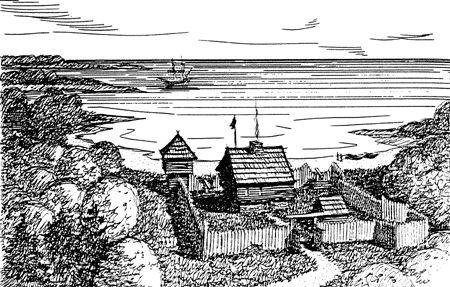
The Hilton Point settlement as it’s commonly been envisioned.
It must have been lonely through much of that first decade. The Hilton-Roberts clan was definitely on the frontier, and ongoing war in Europe cut off much ship traffic.
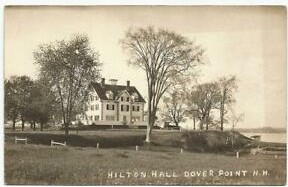
How much, if anything, did Hilton Hall originate in the early settlement at Dover Point? If the house was anywhere near this size, my perspective changes completely.
Edward Hilton is, however, definitively rewarded for his six years of habitation and hard labor by a charter giving him clear control at Dover Point. And they must be prospering, as seen in assessments placed on their province or his brief return to England for the legal document, perhaps a fish delivery, and definitely a marriage.
While Thomas and Rebecca Roberts remain in Dover for the rest of their lives, her brothers eventually move on – Edward to Exeter and William, by degrees along the Maine side of the Piscataqua. All of their lives take colorful turns along the way, which I relate in the book.
Even though Portsmouth baldly claims 1623 as its founding date, it had no European settlement until the Laconia Company chose to set up operations there in 1629 or 1630, calling their site Strawbery Banke. Yes, that was one more convolution of investors.
~*~
AND THAT’S THE BARE-BONES VERSION. There’s plenty in my upcoming book to flesh it out, some of it rather earthy – especially when we get to the contemporaneous and scandalous Merrymount plantation down on Plymouth Bay.
Fact: New Hampshire is the second-oldest state to be settled in New England. Older than Connecticut, Rhode Island, Maine, or Vermont.
To understand why a third of Dover became Quaker in the mid-1600s, we need to go back to the very founding of the colony.
The whirlpool in Sir Ferdinando Gorges’ coat of arms eerily reflects his role in New England’s early settlement.
The common presentation of history has New England settlement being prompted by a quest for religious liberty – you know, the Pilgrims and then the Puritans – but close examination finds that’s not the full story.
For instance, the first permanent English habitation, Plymouth in southern Massachusetts, is only half Pilgrims – the other half is diverse individuals looking for economic opportunity. The colony is also heavily in debt to investors in London who dictate much of its operation. Religion isn’t on their radar.
There’s nothing altruistic in the investors’ role. They’re looking for quick returns on their money. Their eye is on gold and silver or at least a shortcut to the Far East and its lucrative spices. Trade for furs could also be lewdly profitable. And then there’s the possibility of creating landed estates in the New World, where they could live at ease as gentlemen farmers supported by the rents paid by their tenants once the time’s ripe.
All of that puts the investors at odds with settlers who are out to establish homes, livelihoods, and security.
~*~
AS A FURTHER COMPLICATION, the investors come in layers. One company holds rights to the development of all of New England and then enters agreements with others interested in specific tracts, sometimes within a specified timeframe.
Sir Ferdinando Gorges is the godfather of all this and plays a crucial role in the birth of Maine, which emerged largely on its border with Dover. Quite simply, the Maine side of the Piscataqua River is a big part of early Dover’s community.
Sir Ferdinando’s business associate, Captain John Mason, emerges more directly as the proprietor of New Hampshire itself.
Together, only two years after the Pilgrim venture, they negotiate with a band of Devonshire merchants to settle on the Piscataqua River, today’s border between New Hampshire and Maine.
~*~
THEIR AGREEMENT SPECIFIES seven settlers – and, as we will see, that implies their families, servants, and laborers – intent on commercial opportunity. Forget religion.
Captain John Mason may have owned the province of New Hampshire, but fate intervened before he could set foot in it.
The Puritans, pointedly, are nowhere to be found. They’re still seven or eight years off in the future. Their arrival to the south of New Hampshire will, however, spark a culture clash and ongoing power struggle that will include Maine. As you’ll see, the plot thickens.
In the meantime, the odds are greatly against the survival of the Piscataqua enterprise.
Other attempts in New England have failed, some without a trace, as would others. The Plymouth colony is faltering.
Remember, nobody finds gold or silver or that shortcut to China.
Even so, Gorges and Mason leave a deep imprint on the future Dover.
As do Edward Hilton, a member of the powerful fishmongers’ guild in London, and his apprentice, Thomas Roberts. Their outpost at Dover Point is the start of the seventh oldest permanent European settlement in the United States – and the third oldest in New England.
Edward has been recognized as the Father of New Hampshire.
Thomas, however, is generally neglected, even though he has a more central role in its continuing development. He even becomes Quaker, for all intents and purposes. And though an apprentice, he’s not a disadvantaged youth looking for a step upward. He comes from a privileged family, and his father, by some accounts, is about to become a baron.
~*~
ALL OF THAT’S PART of what we’ll be celebrating next year – 400 years after their arrival. And my new big book tackles some of the story.
Dover Friends have long relied on the story of the three Quaker missionaries who came to town in 1662 as the origin of Dover Friends Meeting. They were severely persecuted and whipped, the subject of a well-known John Greenleaf Whittier protest poem, yet they were promptly followed by more itinerant ministers and soon a third of the population was Quaker.
The Puritan authorities had enacted harsh anti-Quaker laws. Anyone who even listened to a Quaker for an hour or owned a Friends book or tract could be imprisoned, fined, have an ear loped off, or have the flesh mutilated with a red-glowing branding iron. By the time the three women – accompanied by two men – came to Dover, four Quakers had been hanged in Boston. Yet in some places, a few people listened and even hosted them.
Dover, obviously, was one – and, as I find, had welcomed Friends even earlier than we’d thought. In 1659, some residents were fined for neglecting public worship, meaning the Puritans’ services, and attending Quaker Meeting instead.
My central question keeps asking what made Dover, of all places, so responsive to the controversial Friends message? What made some residents so willing to defy the prohibitions and risk the consequences?
My upcoming book delves into the findings, but quite simply, the town had been rocked by divisions for much of its then-short existence. At one point there had even been an armed skirmish between rival ministers for the town’s tax-funded pulpit.
~*~
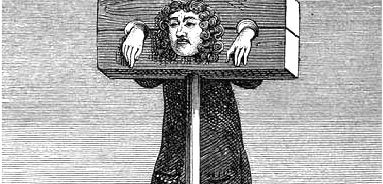
Merely listening to a Quaker could lead to this. Hours hanging in the town stocks.
Some grudges are harbored a long time, awaiting the right opportunity to flare up again.
Or, for repeated offenses, even being branded.
Another factor to consider is the ways that Dover’s settlers differed from the majority of the Puritans to the south. Dover’s came overwhelmingly from Devon, a large shire in South West England, while the Puritans were rooted in East Anglia, to the other side of London. Culturally, they differed strongly, from accents and cuisines to courting and marriage patterns to superstitions and social customs. It’s something Dover shared with two Quaker hotbeds nearby – Salem, in Massachusetts, and Hampton, down the coast of New Hampshire.
Frankly, I’ve been surprised by the degree to which Dover was a center of controversy and scandal in the mid-1630s and a bit on, all so early in New England’s history.
Much of the Atlantic coastline hadn’t yet been settled. What happened in Dover fuels a big part of my big book and definitely sets the stage for what follows.
I thought we Dover Quakers – or more formally Friends – had our long history covered. I had even helped Silas Weeks, way back, in some of his research for his definitive volume on New England Quaker meetinghouses and burial grounds.
Frankly, after revising and republishing seven novels after the appearance of my eighth, I wanted a break.
A big break.
These are supposed to be my retirement years, OK? Admittedly, I had long imagined devoting myself to the writing as a big part of that dream, but really!
But then a casual request for an overview of Dover Friends history changed everything. It came indirectly, through someone in another denomination who was active in our Sanctuary movement. But then, going back through my filing drawers, I came up empty – couldn’t even find my folders of notes. What we did have was mostly about our three meetinghouses over the years – especially the structure where we’ve worshiped since 1768 – along with a few prominent events.
This left me unsettled.
Unlike many other denominations, the Society of Friends, or Quakers, is first and foremost about its members. Our definition of church is the body of believers – not the building or the polity and definitely not the ordained clergy. It’s why we call our building a meetinghouse and why we organize as Meetings, reflecting the times and ways our church-people come together. Church can happen whenever and wherever we are, even over dinner in our homes or chance encounters on the street or in the midst of social activism. And vitally it’s not just us – we’re meeting God, too.
I spent a lot of time at my impromptu workstation in Eastport, Maine, last year working on a history of Quakers in Dover, New Hampshire. And I arrived with what I thought was a largely finished manuscript. I was mistaken.
~*~
WHAT NEEDED TO BE TOLD was the lives of the individuals and families who were the essence of one of the oldest Quaker Meetings in the world.
I resisted as long as I could but finally succumbed. Who were they? Why were they so willing to risk severe punishment and persecution imposed by the Puritan authorities? And in the face of that, how and why did a third of Dover’s population quickly become Quaker? And several generations later, start fading away?
With the 400th anniversary of the settling of Dover – and thus New Hampshire, too – coming up next year, the timing for our side of the history felt right.
Now that the book’s written and revised, I’ll be sharing some of my findings with you as well as news of publication itself as that nears.
~*~
WHAT EMERGED IS A PARTIAL HISTORY, as in partisan, with my focus on a radical religious subculture that thrived in a unique, out-of-the-way, locale. Partial, as well, to the independent streak of New Hampshire against more powerful Massachusetts authorities to the south. Partial even in being incomplete as well as lacking footnotes, and not even the work of a professionally trained historian.
The story is also partial in being biased toward a sequence of unusual, sometimes roughhewn, figures and their families – not all of them Quaker – and inclined especially toward the narrative they shape.
The roots, as you’ll see, arise in the very beginning of English settlement. Forget what you’ve assumed about New England before Paul Revere and Sam Adams and the American Revolution and Boston as the Hub of the Universe.
A lot had already happened before the first Puritans sailed into Boston Harbor. Let’s look instead to Dover, which lays claim to being the seventh-oldest continually inhabited European settlement in the United States.
In the standard telling of the founding of today’s city of Dover, New Hampshire, two brothers arrived from England in the spring of 1623 and settled at the mouth of Great Bay on the Piscataqua River, upstream from the Atlantic Ocean. The brothers were fishmongers, members of one of the oldest and wealthiest guilds, or great companies, of London.
Except, as it turns out, one of the brothers didn’t arrive until a few years later.
Instead, the cofounder of the new settlement was a fishmonger apprentice who would be an important figure in the early years of the colony.
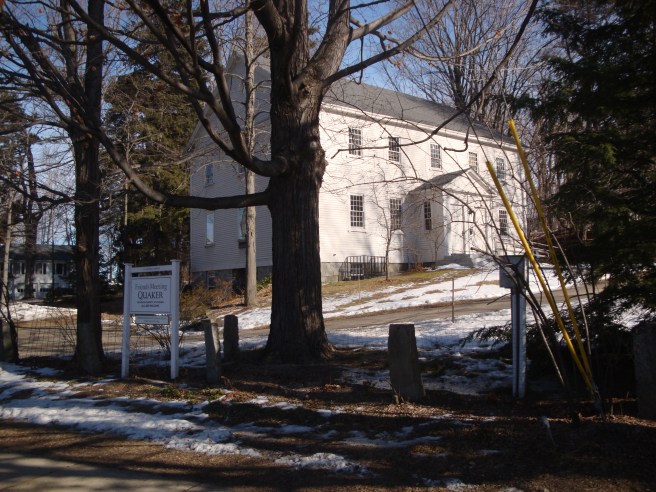
The meetinghouse, Dover Friends’ third, is home to the faith community today. It was erected in a single day in 1768.
~*~
YOU’LL PROBABLY BY AS SURPRISED by this alternative take on New England history as I’ve been. It’s not just Quakers. There’s much more to New England’s past than a Thanksgiving dinner and a riotous tea party followed by a midnight ride and the shot heard ’round the world or even the notorious witch trials.
Here at the Barn, you’ll definitely be hearing a lot more about this big project through the coming year. Believe me, some of the findings will be startling.
The probing question by seminal Quaker George Fox, in a setting totally foreign to his comprehension, leads to the mystery of what makes something constantly new after any so many encounters.
Say a route you retrace daily. What do you discover for the first time today?
No book was more of a struggle for me – or ultimately more transformative. Not that any of them came easily or quickly.
Each of them would have been much simpler if I had only hewed to a specific genre and with a particular reader in mind, but my goal was to explore a theme and see where it led rather than fill in a blueprint and hope that others would be fascinated by the discoveries. That put me in the “pantsers” end of writers, meaning seat-of-the-pants, rather than the “outliner” side, which can be paint-by-numbers rather than “painterly,” layer upon layer added or scraped away for intrigue, depth, and motion.
My earlier novels were grounded in people, places, and events I had experienced directly, which I then abstracted, of course, for a more inclusive understanding. When needed, I could turn to my journals for details and to my correspondence for dialogue or even make a few phone calls.
The paperback cover …
What’s Left, though, took me far beyond that. Yes, I was starting from the finale of my first published novel and trying to advance the scene by as much as a half-century, but I had no experience in a family-owned business. (I had skirted marrying into one, but I didn’t know how it would feel growing up in that situation – this was totally unlike my grandpa’s plumbing outfit, anyway.) Nor had I really worked in a restaurant. As for being part of a tight-knit extended family? Much less Greek-American? The adage, “Write about what you know,” now became, “Write about what you want to know.” More pointedly, that led me more and more into my daughters’ generation and its struggle for survival. As if anyone has answers to the big questions.
I set out thinking the story would take up the ongoing issues of the counterculture movement one by one – peace and non-violence, sexual and racial equality, the environment and ecology, natural foods and fitness, alternative education, spirituality, boho lifestyles, and so on. I had plenty of extended outtakes from the earlier books plus a set of essays that could be woven into the narrative.
But my upbeat, idealistic outlook started ringing hollow. Yes, the issues remain, even thrive, in spite of the entrenched opposition, and they need to be taken up by a younger generation. What hit me was the debris of broken dreams and promises, much of it caused by our own petite shortcomings. Yes, some of them mine as well. Broken families, too – just what is a family, anyway, especially when you examine the evidence closely, as the novel does? Where was the tight community we envisioned, much less that sense of tribe? As I looked around, I saw those who most continued in the hippie image were either bikers or what my kids would call losers. I have to say substance use or abuse has taken a heavy toll.
… and the back cover.
It’s too much to pack into a single novel, though one can touch on them. My focus slowly shifted on trying to pick up from the wreckage. That is, the place where Cassia found herself.
I was still mulling my approach when I chanced upon Jonathan Lethem’s “Dissident Garden” and was taken by its unique structure of 16 mosaic panels that could be moved about, if one wants, within its developing chronology. Lethem also had me realizing how much I needed to develop Cassia’s family’s past, with its own bohemian streams in coming to America. How many threads could I manage within this?
Voila! I had an organizing point. As poet Gary Snyder says, quoting an ancient Chinese folksong, to make a new ax handle, you use an old one as your pattern.
While I inherited the Greek-American element from an impulsive touch at the end of my first published novel, where this one picks up a generation later, I was only now piecing together how pervasive its presence in my own life without any earlier special awareness. As I’m seeing now, apart from Jeffrey Eugenides’ “Middlesex,” very little about Greek-American culture seems to exist in literature. (He nails the largely overlooked Midwest, too, by the way.) And then I started to engage it here where I live, beginning with Greek dancing and then Eastern Orthodox Christianity, so different from my own Quaker and Mennonite grounding – it’s like the difference between Zen and Tibetan Buddhism, as Snyder once quipped, two ends of a long arc.
The novel itself demanded at least a dozen major revisions, pushing it ever more toward the present, especially once Cassia found her own (snarky) voice and her brothers and cousins became vital characters. My personal genealogical research techniques also came into play as I examined her ancestry, both on her mother’s side and later, to my surprise, Cassia’s father’s.
What I really wasn’t expecting was the way she prompted me to return to my earlier fiction and severely revise it as well. In most cases, adding new characters and new scenes, cutting heavily, and renaming results. The three books about her father’s past gained a unified structure and timeline as well. So, in more ways than one, through Cassia, my novels embody what’s left.