
PERCHED LIKE A DOVE
You never know what we'll churn up in cleaning a stall
In the buildup of national elections, once again a major influence remains the elephant in the room. I’m referring to the legacy – make that plural, legacies – of the hippie outburst, especially in contrast to those on the Vietnam war side of the divide.
The wounds and tensions haven’t gone away. Just look at the continuing proliferation of POW-MIA black flags across the landscape, on one side.
For the other, the lines are much more hazy yet festering. As I’ve been arguing, hippies came – and still come – in all varieties and degrees, and likely nobody ever fit what’s become the media stereotype. With the end of the military draft, the movement lost a crucial motivating force and focusing definition.
Complicating the situation was the distancing many youths on the antiwar side felt when it came to politics. With its support of the military at the time, liberal politics were tainted with outdated Cold War ideologies like those of the conservative side. For hippies, radical was the label of honor. And the Democratic Party base of the left was splintered as its youthful potential allies had nowhere to turn or direct their forces in the political arena.
The horror meant going from a hawkish LBJ administration to one of Richard Nixon.
Fast-forward now to the present American landscape. Gone are the grandparents and parents of many of the now senior baby boomers – the core of the hippie movement versus the older generations. Yet political candidates still tiptoe around many of the reality issues, beginning with marijuana and other illicit substances, as if they’re too hot to touch. Let’s get real. Want to talk about litmus tests?
As we look at candidates, ask where each stands on a scale of continuing issues from the hippie stream. I find it enlightening.
Well, we have Bernie running straight true to the cause. Hillary, more cautiously so. But on the right? Let me suggest being wary of anyone in the pro-war camp who hasn’t served. Period. As for other life experiences?
~*~
All of this returns me to my Hippie Trails series of novels. I’d love for you to come along. Just click here.
When I see this …

… I think of this.
 For the free ebook novel and more, click here.
Living in New England, I’ve become enamored with lighthouses. My fascination has nothing to do with the quaint impression many tourists carry but rather an awareness of the ways these now antiquated emblems of peril define our landscape. Along the water, if you can identify the light, you know where you are. Believe me, there are places that would otherwise be difficult.
The night ocean, as I’ve also discovered, can be anything but romantic. It’s a different world from the one visitors encounter during the day. Cold, windy, wet, threatening, even on many summer nights. Yes, on a balmy evening, especially with moonlight, it can be magical. More often, a night ocean can be downright spooky.
Along the dark coastline, the flash of light can help you place yourself in the scene. You triangulate your position using the lights. Each lighthouse beacon has an identifiable pattern – one flash every five seconds. Or ten. Or two flashes. Their colors may be unique in that place, too – blue, green, or red, instead of clear.
The most powerful beams reach out 20 miles or more over the water. Think about that – the light doesn’t scatter but holds together using a technology that predates the laser. How much we take for granted!
And to think, in the old days the illumination came from whale oil or similar fuels.
These days it can be a 110-volt bulb the size of your thumb.
The mechanism that shapes the beams is itself a remarkable piece of technology – the Fresnel lens. Developed by the French physicist Augustin-Jean Fresnel in 1823, it’s a large sculptured glass cone, where each overlapping leaf joins to focus the ray into one. The larger ones are the size of a child, with the light from inside. Remarkably, these are much thinner than a conventional lens for the job would be – thus allowing more light to pass through and the lens to be mounted in a rotating base. (One we’ve visited floated in a 500-pound pool of mercury.)
A section of a 4th order Fresnel lens is featured on the cover of my booklet.
Just as incredible can be the tales of the lighthouse keepers and their families – lonely work, often tedious, cold, staying awake through the night, put at risk by the storms. Nothing nostalgic there, being faithful.
As I look at the light and its tower, my mind leaps to the universal application of light as a metaphor of religion and spiritual experience. It’s especially prominent in the writings of Quakers (Society of Friends), where it frames an understanding of an alternative Christianity – one earlier generations never dared voice completely. Still, the Light led them in fresh directions – and can still do the same for us today as it reaches far, including into the human heart and mind.
 ~*~
For your own copy, click here.

When I see this …

… I think of this.
For the free ebook novel and more, click here.
 Strolling Dover: for more, click here.
When I see this …

… I think of this.
For the free ebook novel and more, click here.
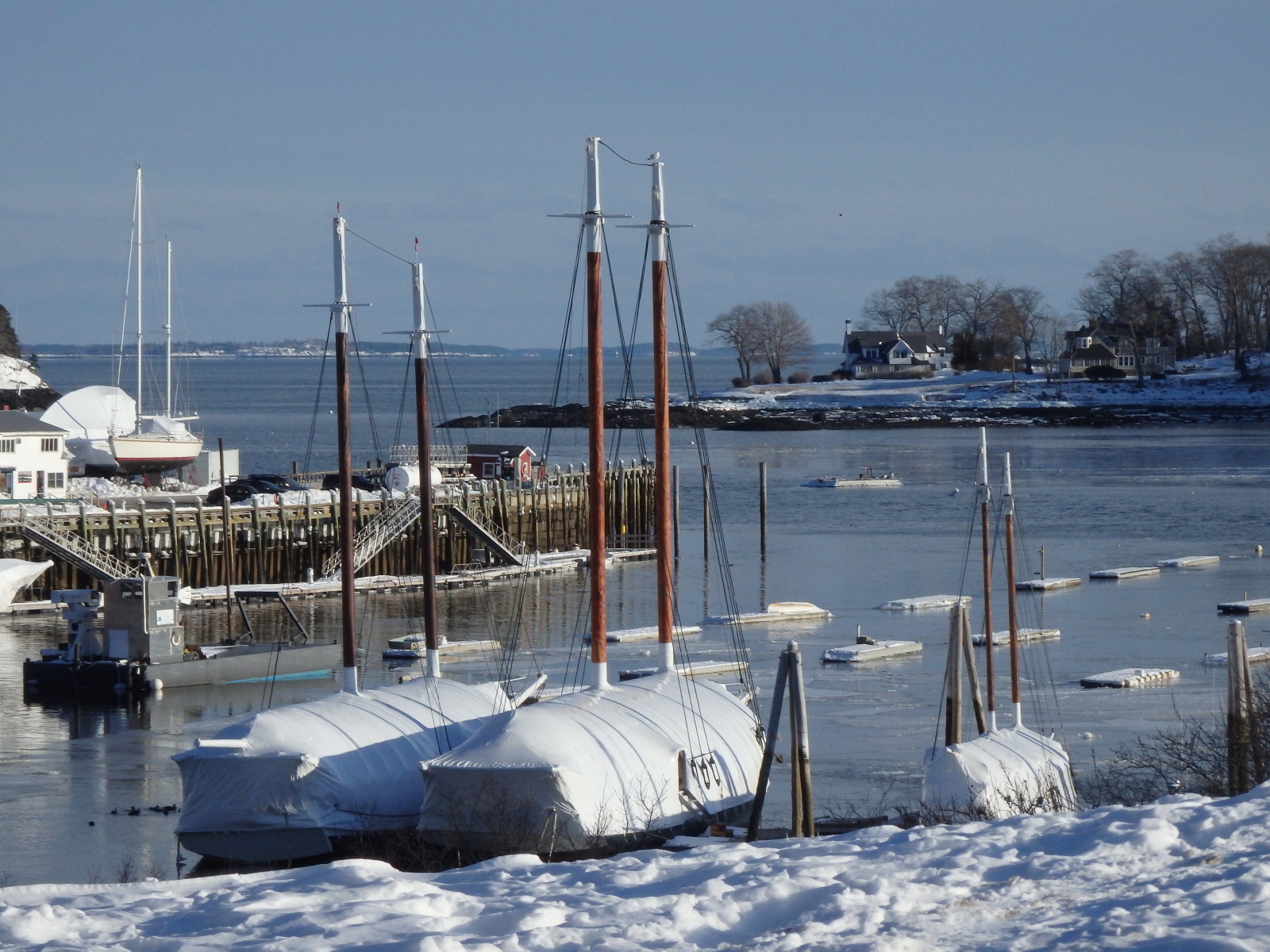
Following the rapidly changing weather forecast for the weekend as it evolved over the past seven days has spurred many emotions where I live. For a while, we watched our snowfall predictions rise for Saturday and then Sunday, prompting us to reconsider scheduling a gathering at our house. Let’s wait, my wife counseled, suggesting the next weekend could be even worse. And then the anticipated depths we viewed kept declining until, suddenly, there was no precipitation of any kind on tap for the weekend. What a relief, we thought.
But then we saw where that snow would be headed. It’s a strange feeling for New Englanders to see a blizzard steering south of us. Sparing most of us, in fact. We know what it’s like to be hammered and then buried. But we’re equipped to dig out, too, and accept it as part of the price of living where we do. We even know what it can do to a crowded city, where there are few places to dump the mounds as they accumulate. Driving along a street, you’d keep asking, Is that just a big pile of snow or is there a car under there?
It doesn’t take much snow to lock up a city, in fact. No matter how prepared a metropolis, six inches can really muck things up. And a foot can take days to clear free. But two? Now it’s getting serious.
We also know that even an inch of wet snow can make for some very hazardous driving. Forget what those four-wheel-drive advertisements say. We’ve seen enough of those vehicles spin off the road into the median strip or guardrail. There are acquired tricks to driving under these conditions, along with cautions. I think of it more along the lines of boating.
So when we see expectations of up to two feet of cold wet flakes blowing across Virginia and Maryland and even a corner of North Carolina(!) — and similar impacts on the District of Columbia and Baltimore — our sympathies fly southward. That’s even before Philadelphia and New York City are hit.
You probably don’t have neighbors with snowplows on their pickups, for one thing. You might not even have your own snow shovels at hand, much less snowblowers. As for those boots and gloves? We understand.
I can’t help but recall the broader term for “global warming” was “climatic instability,” which is what we’re seeing. Remember that if you hear the word “record” being applied to this storm. And no, I won’t refer to it by the cable channel’s name.
If you’re bearing the brunt of this storm, you have our sympathy. We know you’ll have your own names for the experience, few of which are publishable in polite circles. Our best advice is to stay put and take things easy as long as you can and hope you stay warm. Declare yourselves a snow day. And remember, this too shall pass.

