Now, for our big whirlpool

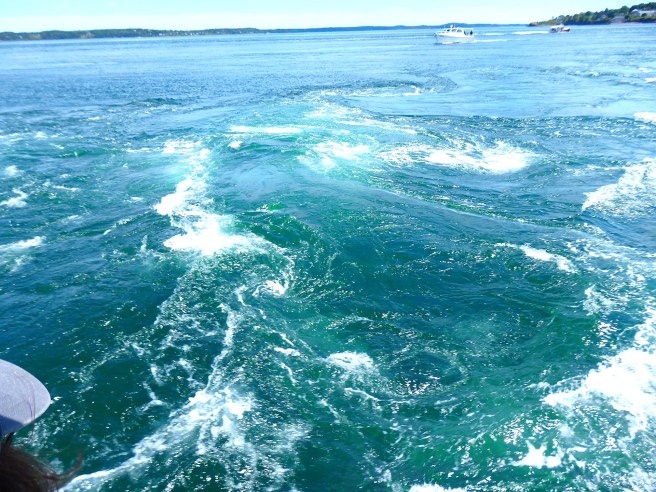
One of Eastport’s travel attractions is the “Old Sow,” the world’s second biggest whirlpool or the biggest one in the Western Hemisphere.

~*~

Before you make reservations to come see it, let me point out a few things.

  1. Its intensity varies greatly, depending on the gravitational tides cycle. It’s best about three hours before high tide, especially around the new and full moons when 40 billion cubic feet of water flood through the half-mile-wide passage to Passamaquoddy Bay.
  2. Its swirling diameter can reach 250 feet or drop 12 feet into its vortex, but it’s also likely to appear as a series of boiling countercurrent piglets and eddies.
  3. Most of the time, it’s not particularly visible from land. It is, however, a regular feature on Butch Harris’ whale watch runs. And even then, it will likely be a disappointment if you’re expecting to see a big hole in the water.
  4. It remains, nonetheless, a hazard to small boaters and has claimed lives, most notably in 1835 when a mother watched from shore as a two-masted schooner was sucked down with her two sons. The young men were never seen again.
  5. Another account, from the late 1800s, tells of two men with a barge loaded with logs, that went under and the bodies never found.
  6. It’s closer to Deer Island, New Brunswick, than Eastport, Maine, in part a consequence of public works construction of a causeway to the north during the Great Depression that pushed the current eastward.
  7. The name likely derives from the mispronunciation of “sough” as “sow” rather than “suff,” reflecting a “sucking noise” or “drain.” Or even “grunting.”
  8. The phenomenon arises from a unique funneling of powerful currents over a sharp trench on the seafloor, with water rising abruptly from 400 feet to 119 feet. It then intersects other trenches to thicken the action.
  9. The upswell brings nutrients and small sea creatures from the depths to the surface.
  10. The channel’s ferocious currents can run six to seven knots, a special hazard for divers as well as small boats.


This is the big day for pyrotechnic displays

Unabashedly, I am a snob when it comes to putting big fireworks together in an aesthetic whole, rather than something that resembles an action movie big car smashup.

A smart design team can use the entire sky as a canvas of evolving colors, combined with the timing of a sharp comedian.

That said, here’s some perspective.

  1. A show like Boston’s on the Charles River Esplanade fires off 5,000 pounds of explosives in its half-hour glory. That performance requires a computerized launch system for five barges floating on the water.
  2. Macy’s, the nation’s biggest, goes for an average 1,600 shells a minute – more than three times as many as a typical town display uses for the entire night. That show has more than 40,000 shells fired from six barges in the Hudson River.
  3. China produces 85 percent of the world’s fireworks.
  4. Many of the styles are named for flowers such as peony, chrysanthemum, or dahlia. Others, after trees, as in willow and palm tree.
  5. Prices vary wildly, especially when you’re looking for some serious color intensity and blending rather than honky-tonk garish.
  6. Shells are sold by tube diameter, commonly six-, eight-, and ten-inches, with each additional inch typically adding another 100 feet of elevation to the shot. Are some of those bursts really a thousand feet overhead?
  7. An aerial shell contains six parts. Or more, depending on what bells and whistles are added on.
  8. Larger shells cost average around $336 apiece and may require an 840-foot display radius.
  9. Even a small-town show will run between $7,500 to $15,000 to produce, just for the fireworks. Add to that set-up and clean-up labor, sanitation, musicians, and public safety expenses. The average municipal show costs $25,000. In contrast, a wedding show is tabbed for $1,500 to $3,000. But don’t hold me to those figures. Other estimates I’ve seen simply soar.
  10. Injuries send about 10,000 Americans to the emergency room every year, two-thirds of them males, and many of the injuries are to children. That’s in addition to 7.9 fatalities. As another safety consideration, more fires are reported on July 4 than any other day of the year – some 19,000.

I hate having to admit an unexpected ugly side of the hippie outbreak

The ’60s and early ’70s unleashed a revolution, one I tend to see from the progressive side of the experience.

But after writing about it in many of my novels, I’m having to acknowledge a dark underbelly.

There was a strand of ghouls who opposed any kind of common action, including politics. They were deeply angry but wanted to hide in a hole rather than celebrate oneness with each other and the greater universe and then work to advance that awareness.

That points, unfortunately, to the Trumpist ultra-right wing or Libertarians with no broader community sense other than what they can get out of it directly – or otherwise get out of supporting, period.

What I’m having to see as anarchy.

Yup, I’ve overlooked those who just wanted to escape any, well, Peace & Love revolution outside of their own turtle shell.

Maybe that’s the side the younger generations have perceived all too clearly in their negative view of hippie, despite the many other aspects they openly pursue.


A few prime strolls around here

Visitors on the street sometimes ask me about good places to hike around here, and looking at them, I don’t always want to recommend anything too strenuous. On my part, I do miss the old carriage road up Garrison Hill back in Dover, New Hampshire, but you can’t beat some of these.

  1. Quoddy Head State Park in Lubec. The parking lot is close to an iconic lighthouse, spectacular bluffs, and an Arctic peat bog. Not a bad combo as an introduction.
  2. Shackford State Park in Eastport. It almost became an oil refinery. The central trail leads to an incredible panorama of Cobscook Bay and a high probability of seeing bald eagles.
  3. Matthews Island. Also in Eastport, this Maine Coastal Heritage Trust site can be reached only at low tide. Getting there will give definitely give you a sense of mudflats. MCHT also has nearby Treat Island, which we intend to explore by renting a water taxi to get us there and back.
  4. MCHT includes other personal favorites, starting with Boot Cove in Lubec. If you like Acadia National Park, you’ll love these lesser known opportunities. Nose around in this Red Barn blog, you’ll find photographic evidence why.
  5. The Bold Coast public lands in Cutler. This is for the serious hiker, one willing to walk 1½ miles to get to the rugged ocean. From there, though, there’s a six-mile breathtaking clifftop trail along the restless ocean, and even primitive camping on a limited first-come, first-served basis at the end. The trailhead parking lot can be overflowing in prime season.
  6. Cobscook Shores. Thanks to a newer family trust, 15 small waterfront sites provide public opportunities for investigation. Most have outhouse or indoor plumbing facilities as well as picnicking, sometimes in screened-in pavilions around a single table. My favorite to date is Morang Cove.
  7. Moosehorn National Wildlife Refuge. So far, I’ve sampled trails at its Baring and Calais district but there is more in Edmunds township. Former roads, now used only for ranger access, make for broad, easy pathways through a variety of ecosystems. My big caveat for inland trails is to be prepared for black flies from late April into July. They can definitely spoil and outing.
  8. Downeast Sunrise Trail, atop an abandoned rail line. I see it primarily as ATV and snowmobiling in season, but it does offer insights in inland ecologies. Again, note the black fly warning.
  9. Mowry Beach in Lubec and Roque Bluffs State Park south of Machias. Sandy beaches in Downeast Maine are rare. Here are two wonderful exceptions for those who want to indulge in a long barefoot walk.
  10. Back in Eastport, the Hillside Cemetery is worth nosing about. It’s newer than many classic New England burial grounds, but the engraved stones add up to some fascinating stories.

With the Canadian border now reopened, I’m looking forward to some treks on Campobello Island, both at the Roosevelt international park and a few other sites.


What is the meaning of life?

Might as well start by eliminating the word “meaning” from the question.

That leaves the core mystery to savor before expressing its wonder in mere, pale words.

Life itself is unfathomable. Why me, you, us? As is our very awareness. It’s more than a neurochemical reaction or the like.

Descartes, for me, fails the mystery altogether. Thinking, which can wander all over the place, is secondary. Feeling is more primal, closer to what the Bible calls heart.

I prefer recasting it as “I breathe, therefore I am,” as more embodied. You know, inspiration, expiration. Inhale, exhale. It’s more Zen, and the Hebrew word for breath is the same word for soul, so I’ve been told. (And soul equals heart there.)

Action, then, perchance, as a way forward? Even one breath at a time?

Explain any of that, if you can.

Without raising too many more questions.

Now, have a great day.

Have you ever been to Acadia National Park?

Maine likes to tout itself as Vacationland, and Acadia National Park is definitely a star attraction. I know people who gush that it’s their favorite place ever. Not that I’d go that far.

Still, let’s consider:

  1. With four million visitors a year, it’s among the 10 most popular national parks. Most of them crowd in during the prime summer months.
  2. The official version has the park being named after Arcadia, a region of Greece that it supposedly resembles. New France, however, referred to eastern Maine as Acadia before being expelled by the English in 1763. In their migration, some of those Acadians became known as Cajuns down in Louisiana. I’m siding with the French here, despite my fondness for Greek culture.
  3. It was the first national park established east of the Mississippi and encompasses 47,000 acres, mostly on Mount Desert Island. Not that there’s any desert, it’s just wild. Additional, less well-known tracts are on Schoodic Peninsula (my favorite) and Isle au Haut as well as smaller islands. And a fourth of the land total is privately owned but under easements and similar arrangements.
  4. With 108 square miles, Mount Desert Island is the biggest island in Maine and the sixth largest in the contiguous United States.
  5. The park has 158 miles of maintained hiking trails spanning mountainous terrain, panoramic views, rocky Atlantic shoreline, mixed forests, and lakes. Former carriage roads are also popular with bicyclists.
  6. There’s a private trolley service for those who’d prefer to view the scenery more than the traffic jam.
  7. Backcountry camping and overnight parking are not permitted, but there are campgrounds and lean-tos for those who plan well ahead.
  8. French explorer Samuel de Champlain gets the creds as the first European. He encountered the place in September 1604 when his boat ran aground on a rock. He applied the name Isles des Monts Deserts, or island of barren mountains, to the bigger scene. Well, some are pure rockface.
  9. In the 1880s, the island became a summer retreat for Rockefellers, Morgans, Fords, Vanderbilts, Carnegies, and Astors who built elaborate vacation dwellings they called “cottages.” Many of those were destroyed by a vast wildfire in October 1947.
  10. Its principal gateway is Bar Harbor, a city of 5,000 full-time residents that swells with summer people and their second homes, tourists, and often a big cruise ship or two that add several thousand more people to the crowd. Be warned that parking is at a premium in high summer.

For more adventurous souls, let me suggest exploring two hours to the east, to the Bold Coast, for a less spoiled alternative.