Initially, I regard the mountain as another slumber-induced fantasy. Its climax appears pristine, boundless, haughty, mesmerizing, even eerie. Over time I behold its hideousness and terror as well. Such beauty may suddenly turn fatal. Timberlands netted with trails and campsites, plus unfettered wildlife, extend from its ivory helix. These opportunities are my primary rationale for migrating to this corner of the nation. But these woodlands border desert, and none of my maps alert me to the consequences. Not even Georgia O’Keeffe’s brilliant renderings of New Mexico, artwork I long admired, hint at its harsh thirst. Rather, the paintings emerge as another kind of dream to be savored, confined to a gallery or oversized pages. Besides, my definition of desert would have required camels, or at least organ barrel cactus, neither of them found in the cheat grass and sagebrush foothills surrounding my new home and workplace.
A glacier-glad mountain resembles a foaming waterfall. It is, after all, an endlessly frozen cataract. Below it, in late spring or early summer, breastworks are laced with plummeting streams racing toward September irrigation in desert to the east. On the clearest days, Rainier’s ice sparkles; its beacon flashes sixty miles to the orchard where we dwelled. At sunset the inactive volcano’s shadow is a finger reaching toward the rising full moon. It points as well to places we’ve abandoned.
The predominant mountain is also the moodiest feature of the vista. Everything’s arrayed in reference to this pillar. To observe it over time is akin to regarding one’s beloved. Neither the zenith nor one’s honey is as immovable as one presumes. They are not the divinity. They’re more accurately repeated dreams, where some episodes fade out over the years while others intensify. Sleep visions of the soul, having one foot in the dreamer’s past and the other in the present, dance on water. Sometimes they drown. Even a mountain.
You should see the way Kokopelli makes it dance before sunrise.
For more insights from the American Far West and Kokopelli, click here.
just a pony cart of vegetables
street vendor’s cry
(O! the Arabs of Baltimore!)
on his daily round
somehow getting by
yet clouds slipped in
with a long cord, the phone
this old apartment, all light and draught
the floor sinking, new cracks in the plaster
was giving way, downward, you could hear it in the night
paint flaking, more pieces falling to my bed
all going downhill, to the basement
rusty pipes, armies of cockroaches
at work in the walls
constantly dripping faucets
kitchen, shower, the bathroom sink
stacked magazines slid away on their own
new grit emerged immediately after sweeping
MY RESIDENCY IN a yoga ashram introduced its own sequence of seasons. I address these in my novel, Ashram, where different individuals embody different stages in the progression from soul-cleansing to community awareness and service to spiritual illumination. While I limit the plot to the activities of a single day, there’s no way to escape the histories that led each participate to this place or to the conflicts and achievements they’ve already shared in their adventures on the yoga farm.
The ashram allowed a kind of spiritual season I no longer see on American landscape – a place for youths, especially, to undergo intense reorientation and ego-stripping. More traditional monastic settings often point the practitioner in a different direction, something more resembling a career path.
In retrospect, the institution itself was evolving through its own series of seasons. Originating as a kind of laissez-faire hostel and spa before moving into a more rigorous retreat center and monastery and then into a Hindu temple and children’s camp, each season manifested itself quite differently from the others, held together by Swami’s autocratic vision, strengths, and weaknesses.
In season, too, many of my doubts and concerns also bore fruit. When I was ordered to return to the community and refused, only to be ostracized, I was being faithful to a larger Spirit. A different set of seasons was unfolding.
Why wait for the dust to settle? Here are 10 bullets from my end.
~*~
Daffodils and rising scrolls of ferns are two of my favorite proclamations of spring. Last year a sharp drop in temperature cut the daffodils down just as they were starting to bloom. We were so disappointed. (The same snap also wiped out peaches across New England.) How quickly, too, can a vibrant patch go scraggly if you don’t divide the bulbs every few years. As for our ferns, I now feel vindicated for all the ones I transplanted in futile efforts that first decade before they took hold here.
Likewise, hold true to a vision of progress, of a more just and loving society, a realm of selflessness over selfishness.
Hard for me to believe I composed Village of Gargoyles while living in an apartment complex atop the highest hill in the biggest city in the state – before moving to the smaller city where I now reside – a place more befitting the village of these poems.
Need to get new Tibetan prayer flags. The old ones are totally frayed.
Has anyone else read Ned Rorem’s Paris Diary or its New York sequel? Saturated in the self-centeredness and self-indulgence of youth, they’re deliciously juicy and fun reading, though I could never be snide like that. Besides, if I did it here at the Barn, you wouldn’t know anyone in my circles. They’re not even celebrities, even of the minor sort. So much for the gossip on my end.
While assembling the hammock, I heard a squirrel overhead scolding one of the neighborhood cats, likely the one we call Spooky. “Get it,” I urged the cat. Whereupon an empty Nutella jar landed on the table, barely missing me, its lid neatly chewed around. Something the squirrel had pilfered from what one of the kids had likely hidden in the barn sometime over the winter. I looked around but saw nobody to confirm was had just transpired. Trust me.
My emotional wall just may be a shell, too.
In my first moves, all my goods fit in my car.
During the American Revolution, the village center that served as Rhode Island’s capital changed its name from King’s Town to Little Rest, with its delicious double meaning.
Yearning for a renewed feeling of bliss – the holy ecstasy – something I wish she, too, would experience, however foreign it might seem now.
~*~
By my side at the moment. My coffee mug’s on a shelf above it.
If you want to see out-and-out prejudice by people who think themselves to be open-minded, here’s a good litmus test. Raise a matter of Christianity. Or, as a woman, wear a cross necklace. Then ask if it’s the same response you’d get had you presented something from another religion.
Put another way, I’d long ago been appalled by an assumption many of us liberals took in regard to Christians – and to be candid, I was once one who was self-righteously disparaging. Quite frankly, it’s out-and-out judgmentalism that hurts our progressive causes. It’s ignorant of the important support radical faith gave to many movements through the centuries and can still give to the future. It’s a point for dialogue with our opponents, if we’re willing to engage it.
Two common assumptions spring to mind here.
The first involves intelligence. There’s more to life, let me point out, than materiality. Think of love, music, morality, for starters – people with knowledge of ways of empathy, too. Extend that, then, to a recognition that to be a person of faith does not automatically mean stupidity, even if we do see way too many examples in the public arena – not just those of the Christian label, either. Nor do Christian do not come in a one-size-defines-all homogeneity – some denominations, for instance, refuse to bear arms or participate in war as a consequence of Jesus’ command to love our neighbor, while other churches rally around the troops. The ways of thinking and the emphases vary widely, from Fundamentalists to Evangelicals (yes, there are differences there) to Pentecostals to various strands of Calvinists or Lutherans (yes, again some key differences) to various Wesleyan (Methodist) and Baptist and Anabaptist (Amish, Mennonite, Brethren, Quaker) and on to the Unitarians. And that’s just among the Protestants. Add to that the Anglicans (Episcopalians), Roman Catholics, and Eastern Orthodox and you have a very rich mix, indeed.
Within those are some very intelligent and sensitive people, along with circles of personal growth and ethical accountability.
The reality is that religion is capable of engaging our innermost motions – our hopes and fears, especially. It’s a power that can run many ways, challenging the status quo as well as establishing community. The state and the establishment have many reasons to desire to curb it, as history attests. Even at a personal level, it can be scary stuff.
Pointedly, progressive movements have sprung from this source. For centuries, up through America’s civil rights revolution, social change has grown from radical Christianity. A central thread of the Bible has been the evolution of justice and then radical peace and equality. Read it closely, and what emerges remains a challenge to the status quo. Let’s not lose it now!
As the prayer goes, “Thy kingdom come, thy will be done, on earth …”
Many of us see that as a more loving, just, and peaceful society. Mock it if you wish, but think of the alternatives. Are they really progress?
All of that, of course, leads to my second point: the so-called Christian right, of the political sort, hardly owns the mantel of Jesus. And since any religion has the potential of engaging those most soulful endeavors of human existence, we see across the spectrum instances of appealing to fear and oppression, on one side, as well as forgiveness and oneness, on the other. Religion in this dimension presents an opportunity for conversation and growth, if we allow it.
On scattered reservations, a few elders rise before dawn each day and summon the sun to return. Don’t scoff. When I, too, get up in the dark and meditate, I feel my own self-confidence rising. Watch the world awaken. Light a wood fire, something I sit beside and watch for hours, its flames more imaginative than television. Bask in the radiant warmth.
Kokopelli, night owl that he is, still slumbers.
My wife, in another room, rolls toward the wall and finally rises to join me.
There’s a science, and then there’s an art. In the pyre, paper first chars, then shrinks, and finally explodes. Only then do flames engulf it. “Consider the bomb a ream would create,” I grin at her.
“Now who would you want to bomb, Buzzard?”
But I also know how difficult igniting that ream would be, and how difficult to keep it burning. Watch carefully and misconceptions turn to ash.
In the continuing drought of that fall and winter, I explore national forest well into February. Areas that should be buried in a half-dozen feet of snow are instead bare. Atop one mountain, I look over a cliff. “I think it’s dolomite.” Maybe it isn’t. Maybe the identification isn’t earth-shaking important, but learning the names of places and their minerals, fauna, and flora adds dimensions to a place. Improves your chances of survival, too, if put to the test. For now, I scramble on the scree and realize that white painted stones at the cliff’s edge marked out a heliport. Far below my feet, a table of forest spreads into basins that are invisible from my vantage, and other places I’ve already been. I trace Forest Service roads, such as they are — 1707 from Raganunda to the top or 601 down to Willy Dick’s. “Keep elk gate closed,” the sign reads when I came out, passing a few back country ranches to the highway’s rush and debris. Far above all that, I sing out: “God bless a bloody rib cage above gray fuzz. Perhaps we’ll have rain in the morning! We shouldn’t be kicking this dust.”
In a zero-degree fog, the sun rises as white as the moon.
“Let our liquid flow again despite this desiccation!” I cry in my dreams. “Why is it so difficult to recall the thoughts rainstorms instilled?”
“You put too much value on sorrow,” Kokopelli tells me. Even in my sleep, that old guide’s still at work.
For more insights from the American Far West and Kokopelli, click here.
Over the years, my own spiritual practice has undergone many changes. In the essays and notes of my Seasons of the Spirit collection, I touch on struggles that led me to reject the mainstream Protestant teachings of my childhood as well as my leap into the monastic life on a yoga farm before I chanced into the Society of Friends, or Quakers, where I’ve remained for more than four decades.
I arrived as an ABC Quaker – “anything but Christ” – but many sections in this collection arise in a subsequent, evolving evangelical encounter and language, especially as my community of faith moved into the more historically active strands of Quakers in Ohio Yearly Meeting and then into Mennonite and Brethren extensions.
That tone and scope of thought moderate as I grow older, living and working an hour north of Boston.
A crucial influence through much of this volume reflects seasons of relationship – intimate companionship, family, and friends, as well as the workplace. Cycles, too, like those of progressing from childhood and parenthood into retirement or release.
Even in a tradition like the one I’ve embraced, seemingly free from an annual liturgical calendar or its outward emblems, cyclical changes mirroring those of the seasons do appear. Since much of this time has been spent within the Society of Friends, or Quakers, I’ll give one example from Salem Quarterly Meeting in Ohio, where the session each Fifth Month (that is, May) meant rhubarb in the applesauce. See it as sacrificial and special, a kind of unwritten liturgical calendar waiting to be observed through repetition.
In speaking of this awareness and growth as Seasons of the Spirit, we may also consider their interplay with the Seasons of the Flesh – and ultimately, their unity, contrary to Descartes and conventional teaching. From my perspective, perhaps with a Buddhist twist, we can proclaim an alternative:
I breathe, therefore, I am.
Spirit, after all, is the very core of the word inspiration —and at its heart of meaning. I’ll also focus on Spirit as the Holy Spirit — the Spirit of Christ — in contrast to other spirits, such as jealousy, anger, envy, and so on. Translate this as you wish.
Seasons of the Spirit
Whatever the pathway, there are times of struggle, doubt, and distrust. Times of whirlwind passion and excitement. Times of discovery. Times of drought or deep winter, relying on what’s brought out of storage. Times of renewal and recharge.
This has manifested as periods where I’ve been able to dedicate significant time to meditation, solitude, travel in ministry, prayer, Bible study, research into history and theology, organizational service, teaching, correspondence, or writing, as well as to regular disciplines such as fasting or physical spiritual exercise (the hatha yoga sessions or even wilderness hiking). Emphatically, however, one would predominate while others would likely be absent or greatly diminished. In addition, they would be strongly impacted by the events of my daily life itself – whether I was single, married, divorced, or “in relationship,” my hours and nature of employment, my friendships and faith community, my driving patterns through the week.
The result of all of this would be a crazy-quilt tapestry or a ricochet trajectory if it weren’t for a spiraling within it. That is, over the years, various periods and interests begin to overlap one another, creating a kind of harmony or accumulated depth. My asparagus bed in New Hampshire has roots in my experience of asparagus along irrigation canal banks in Far West desert three decades earlier. A dog sitting through Quaker meeting here is a reminder of dogs sitting through predawn meditation sessions in the Pocono Mountains, or of the cats aligned on the scaffolding outside the windows, as if they, too, were deep in concentrated worship. I read a particular Psalm and see the passage taking twists I hadn’t perceived earlier.
In my own life, my childhood was filled with natural science, hiking, and camping, each with its mystical visions and moments. Adolescence led into politics, classical music, opera, and writing complicated by unrequited sexual yearning. Without romantic companionship, a Lone Ranger journey. Rejection of existing creed while ensconced in youth church office was followed by flight into atheism and hippie excess landing, inexplicably, in a yoga ashram with its hatha exercises and sustained meditation. From there, into liberal Quaker practice, where the ashram lessons were applied in circles of deepening prayer life. By steps, I moved toward Christocentric and Plain speech, and an especially faith fervent language. Among the traditional Wilburite Friends as well as Mennonites, especially, I came to wrestle within Scripture while simultaneously undergoing repeated Dark Night journeys and questioning. Turning to emotional therapy, I wondered if anyone could come along with me through all of this – my career moves, spiritual shifts, and geographic relocations. By now, too, I was no longer meditating to get high, or transcend, but rather to center down to what the early Quakers emphasized as the Seed. Here, too, with all of the Quaker committee work, I was engaged in a religion that combines mystical experience with social witness and activism. In a nutshell, then.
Each swirl also stirs up something from before. What failed in earlier marriage or relationships reappears. What has been left unfinished is not left entirely behind. What has been shredded remains to be woven. I’ve heard this opera in its entirety a hundred times. Have I ever heard this note before?
I moved from the Midwest to the East Coast and back before heading on to the Pacific Northwest in what seemed an epiphany but instead shattered amid volcanic eruption and devastation. I left the wilderness for another kind of wilderness, back across the Rust Belt of the Midwest and then on to the East Coast. The pendulum, as they say. Here, I now see life as both linear and circular – that is, spiraling. The spirit requires flesh, or is it that the flesh requires spirit? Seasons include times that are full or overflowing, and times that are barren or dry. I now welcome the questioning that is not hostile is both essential and healthy.
My first spring in the orchard, I expected all of the trees to blossom simultaneously. They don’t. The apricots and cherry petals give way to plums, pears, and peaches. The apple blooms arrive last, when others are already gone.
Experiencing a new place through a full year or repeated years provides a much different understanding than a tourist gets – even one who spends several months there. Relocating requires a year-and-a-half to gain familiarity with the new surroundings – to get beyond the obvious, to establish friendships, to be oriented with the elements one finds essential or special. A favorite restaurant, a woodland pathway or place to swim, a boutique or gallery.
There are seasons for a person of faith, from winter to spring elation and then into fullness, dryness, struggle, or disillusionment. To harvest, perchance. Marriage? Family? Children? Extended into joy, compassion, humility, appreciation – one begins observing and naming.
The turning point in my own journey came when I accepted a new name – Jnana – while living in the ashram. The rest of the developments followed.
The mind dances here and there, rarely in a linear fashion. So what’s on my mind these days? How about counting on these fingers?
~*~
I’m still impressed by all the latent energy stored above the waterfalls in the streams around us.
The water’s flashing. Rivers and ponds spark – shoot away – fire away – in rippling sheen.
Another of my spring tasks involves bringing the garden hoses down from the loft, connecting them to the faucets, and going to the cellar to reopen the valves.
It’s time to pencil in a trip to the Garden in the Woods in Framingham, Massachusetts. The site, headquarters to the New England Wildflower Society, is especially popular through May into mid-June, for good reason. The organization goes to great lengths to enhance nature, though you have to look close to detect their careful irrigation units and similar touches.
Even when the material for a blog is mostly already done, this act of posting takes up more time than anticipated. Where do the hours go?
A fine time to hike in Maine woods: no black flies and no skeeters. The only sounds in some places: wind in the trees or water sounding like highway traffic.
It’s one of those years when the Eastern (Orthodox) and Western dates for Easter coincide.
Time to be on the lookout for tender young dandelions for our diet. They’re surprisingly good with eggs over easy, a drizzle of bacon fat, or homemade vinaigrette. Gotta pick ’em, though, before they bloom and turn bitter.
A favorite minitrip: Head up to Portland, Maine (just an hour northeast). Hit the Standard Bakery near the docks and then the 10 o’clock mail-run ferry around Casco Bay. Six stops on five islands. Reminds me at times of Puget Sound, so many years back.
And, as they say, introduce yourself. These days, could use something catchy, humorous. Something, for that matter, like a good pickup line, not that I ever had any. Feel free to share your examples.
~*~
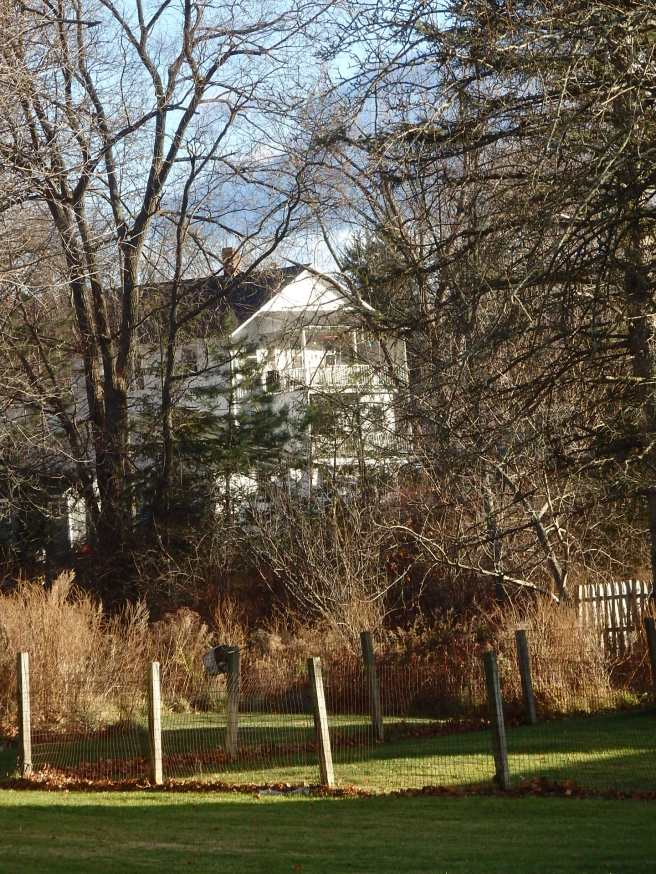
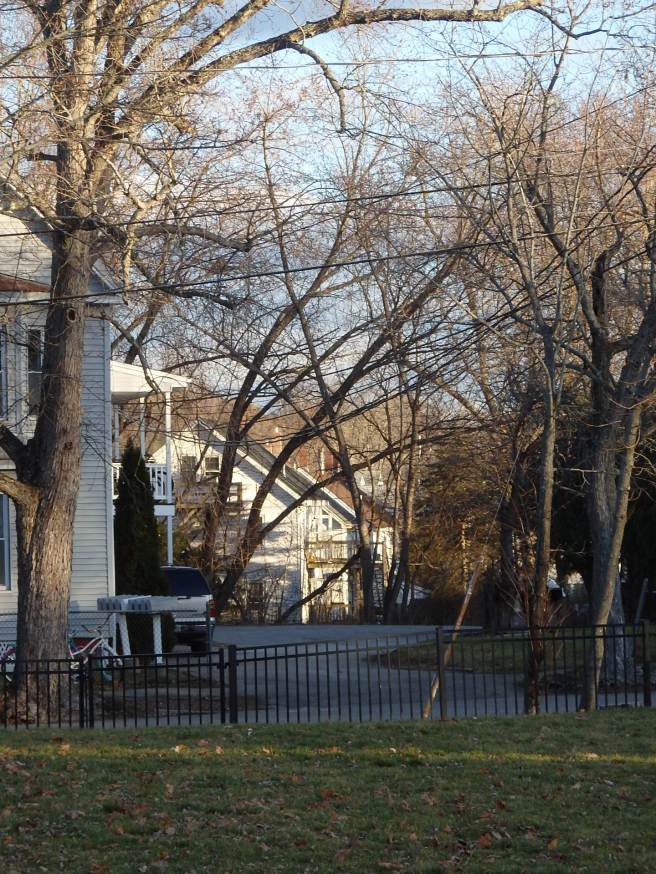
Here’s a view, one backyard to another, only a few blocks from our house. Looks a lot wilder than it is.
outwardly, my ways were simple
even austere or ascetic
my modest apparel
considered drab or seedy
still I was becoming
wary of self-negation
that denies the sweet
Bread of Life
* * *
when John from Tri-State Megabucks phoned the office
to report the latest week’s winning number, he asked
in an attempt to be friendly, if I had my ticket in hand
so I replied, “no, it’s against my religion” and then
sensed a stupefaction on his end of the line
there might be another position on this business
O Holy One
keep me tender in reaching across differences
where a holier-than-thou attitude accomplishes
nothing more than standing in faith
* * *
if there weren’t so much insufficiency all around
the homeless, unemployed, imprisoned,
impoverished, illiterate
quickly overwhelm
apart from family and spiritual community
within my neighborhood
how little I alone can do
against needs deeper
than those seen
where any sense of great inadequacy provokes
a hardening wall
while judging myself harshly
reminded
to my own consternation
of how I’m lacking
Poem copyright 2016 by Jnana Hodson To see the full set, click here.
Being mindful of what’s right in front of us can always be a challenge. Here are 10 new items from my end.
~*~
On the highway north, somewhere just before Tamworth, comes that first big view of Mount Washington. This time of year the crest is an eagle span of ghostly white spreading atop powder-blue ranges below. Sometimes another band of clouds resembling mountains stretches above, and all three sit below a blue band of real sky. Knowing what’s coming up simply heightens the anticipation.
Back home, my rounds of outdoor spring tasks soon lead to the Smoking Garden. The bags of leaves stacked beside the barn as windbreakers will need to be moved to the big compost bin, which needs to be emptied first (though it’s usually frozen tight this time of year). Then there’s the hammock to reassemble, after being stored in the loft. Strings of twinkle lights will go up overhead, too. I’ll often take lunch here, though my wife finds the air too chilly. Not too chilly, though, to prevent us from grilling on charcoal.
Yes, warm enough to grill a beer-can chicken (insert open can into bird, which you cook upright). Excellent, despite the stiff wind.
Seapoint in Maine (town-resident sticker required for parking, May 15 to September 30, where the road ends at the ocean): trek out to the spit between beaches, hunker down in clefts between rock and sunshine for needed respite against wind. The restless blue ocean opens before me. A tease, awaiting summer.
Woodpecker still has a splitting headache.
Income tax time runs up against my professional life as a journalist. How much I hate waiting till deadline to finish something. Get it off, quickly, if you can.
Need to find ways to keep my lair from becoming a chamber of static energy. Ditto, the loft of the barn.
The leadership we’re seeing is a bunch of cowardly brutes.
Once again, the moral issue of civil disobedience comes to the fore. For the record, regarding the Transcendentalist Henry David, it’s THOR-oh, not Thor-OH. And Nixon lawyer Charles Colson came to advocate some powerful moral guidelines for civil disobedience, after he’d repented – that is, “turned” – while imprisoned.
What turns you WILD? (As in dreams and passions, secrets and fetishes. Am I really so orderly or repressed at this point? I’m clueless, apart from anger.)