Full moon rising

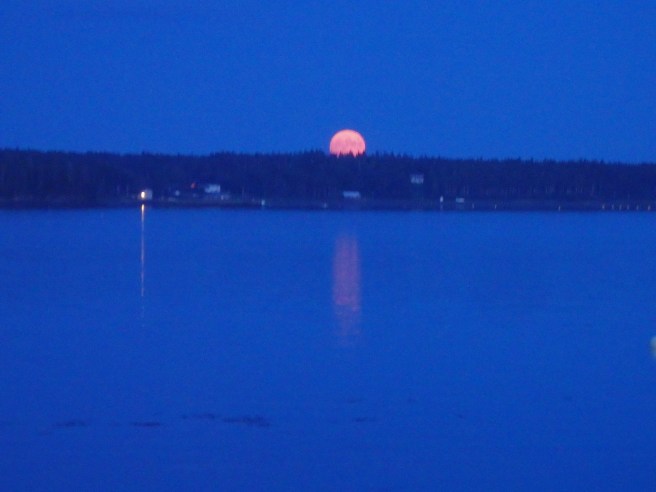
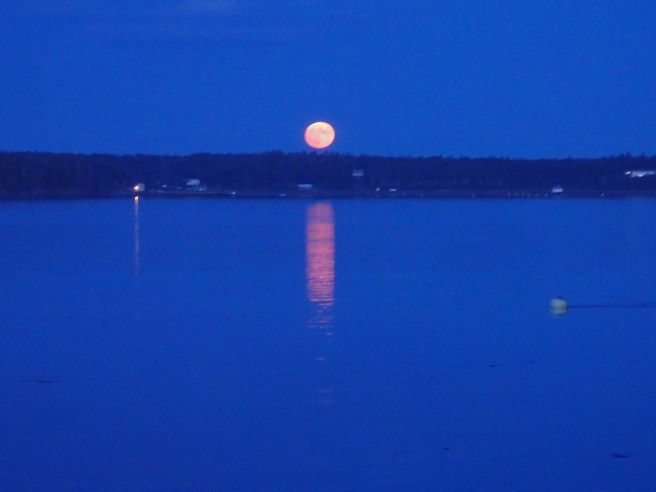
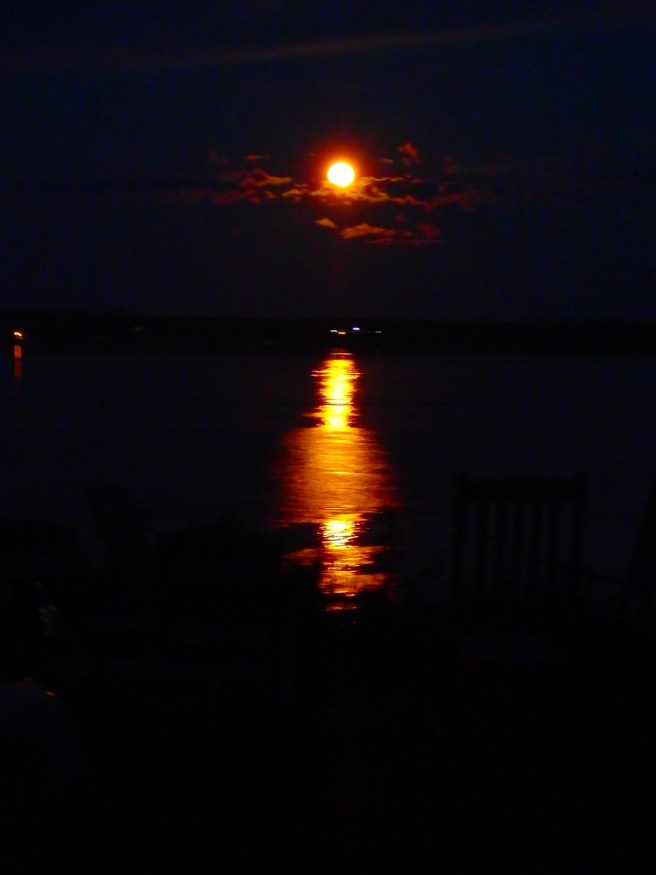
Refined Japanese, I’m told, would gather with sake to watch the full moon rise. First there’s only the crown of the head, and then the brow and cheeks and chin before the moon lifts altogether in the air. The passage is both slow and fleet, maybe five minutes, if that.

The event would be celebrated with the writing of hokku on the spot.

Here’s how it happened one summer night in Eastport, looking over Campobello Island. And this is what you get rather than a cocktail or poem.


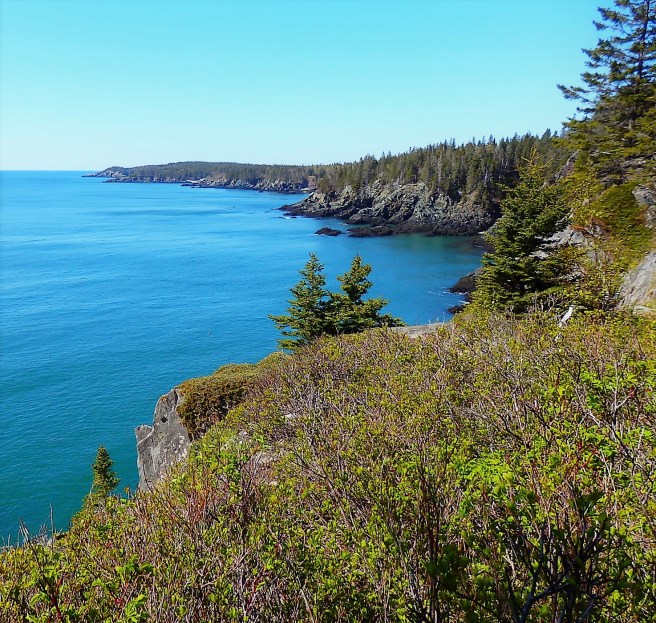
Bold Coast is an apt description

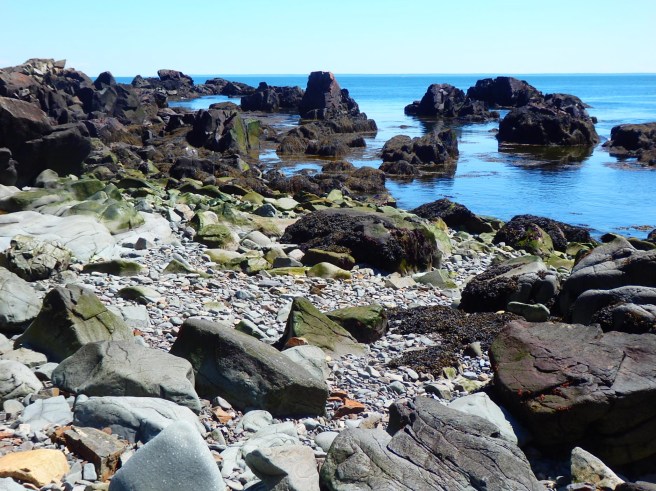
While Eastport and its neighboring towns are technically on Fundy Bay, they’re sheltered from the open ocean. Not so for much of Lubec and Cutler to our south, where the shoreline on the open Atlantic rivals anything Acadia has to offer. It helps to know where the trailheads and parking are, though. Here are some views from the trails in the Maine state public lands in Cutler.

Best of all, there was no crowd. Just me and a young couple who were planning to land one of the five primitive campsites at the far end of the coastal trail. I met only ten other folks in the next five hours, all of them delightful.
So what had been stripping the bark off these trees? My “Scats and Tracks of the Northeast” field guide points to Canada lynx, which leave “chin rubs” like these and live in “dense conifer forests interspersed with rocky ledges and downed timber.”  There are also forest edges nearby where their major prey, snowshoe hare, might be found. 
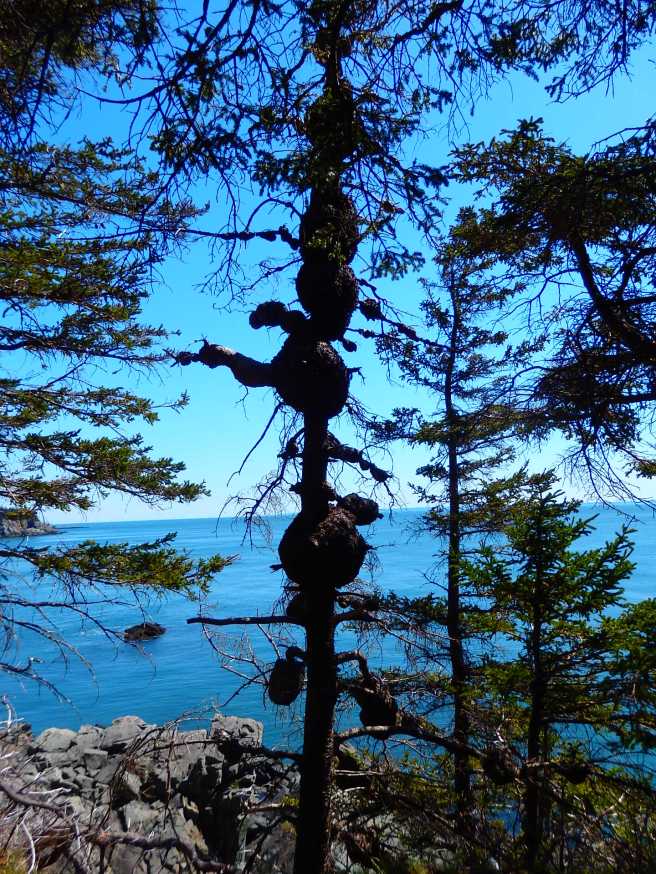
While this trunk seems to be a natural totem pole.
Look out, below!
Except that pretty soon, the trail’s crossing down there.
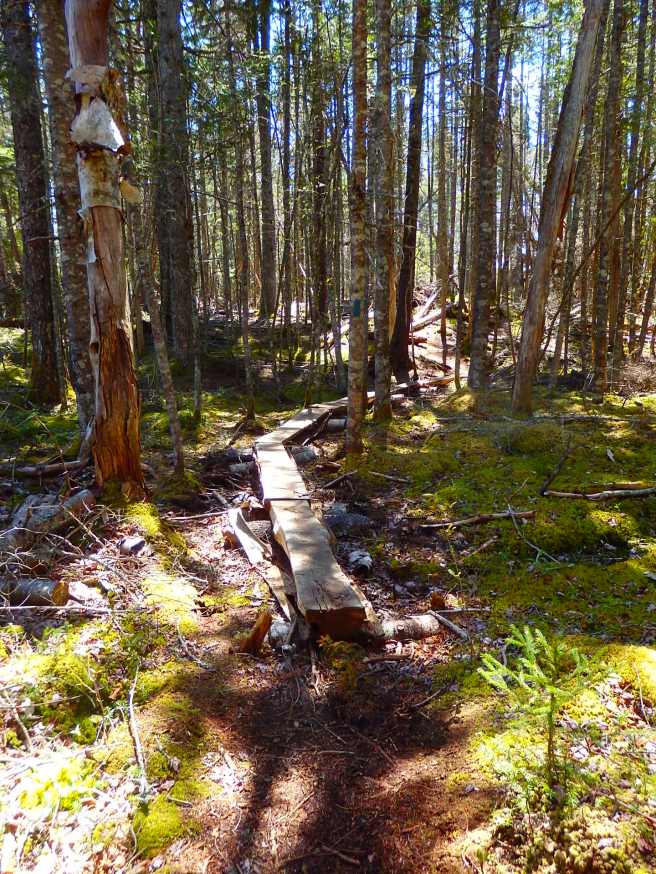
A slightly inland loop back crosses many peat moss bogs, where plank boardwalks are a necessity.

The lighthouses around Eastport are rather modest

Unlike the two most photographed and visited lighthouses around here – East Quoddy on Campobello Island, New Brunswick, and West Quoddy in Lubec, Maine, both of which have been featured here at the Barn – the remaining lighthouses I encounter locally are small-scale. They’re beacons, all right, but to call them houses may push the definition.

You be the judge. Here they are.

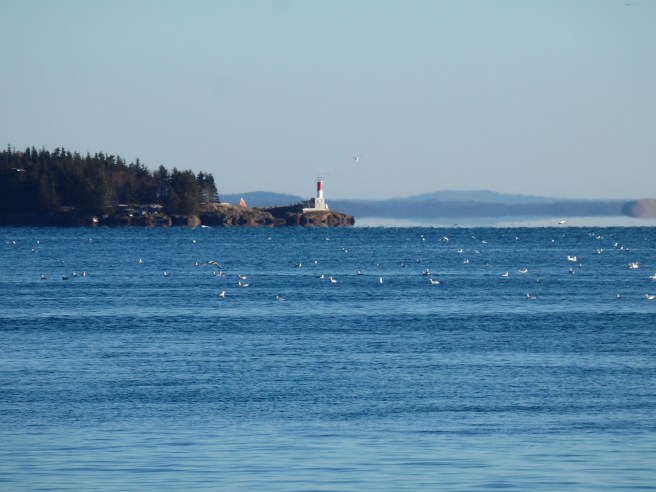
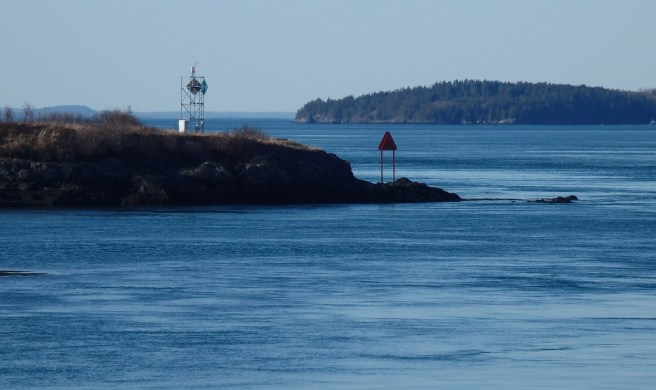
Cherry Island Light, New Brunswick, is the one we see most clearly. It’s an 18-foot-tall tower with a white flash every five seconds. As a lighthouse, it was first built in 1824.
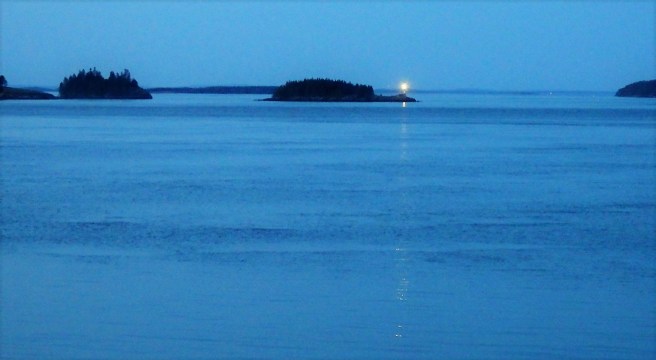
And at night it does this.
Deer Point, New Brunswick, is a 20-foot tall tower with a two-second red flash every 10 seconds. The famed Old Sow, the largest whirlpool in the Western Hemisphere and second largest in the world, is just off its shore.
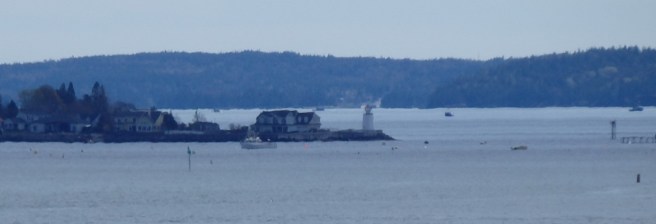
Facing Deer Island, the Dog Island Light in Eastport flashes white/red every five seconds. As you can see, it’s no longer a house, much less manned.
The Pendleberry Lighthouse, or St. Andrews North Point Light, in New Brunswick is glimpsed here from Robbinston, just up the Maine shoreline from Eastport.
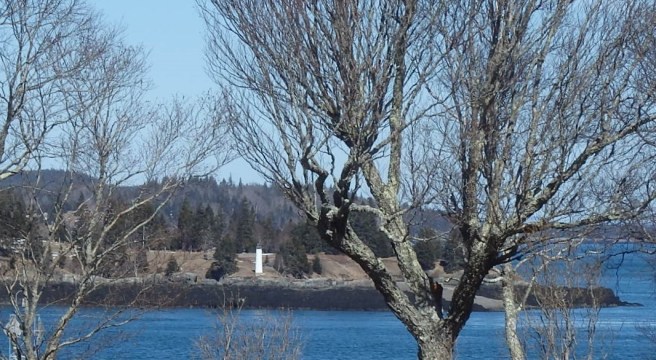
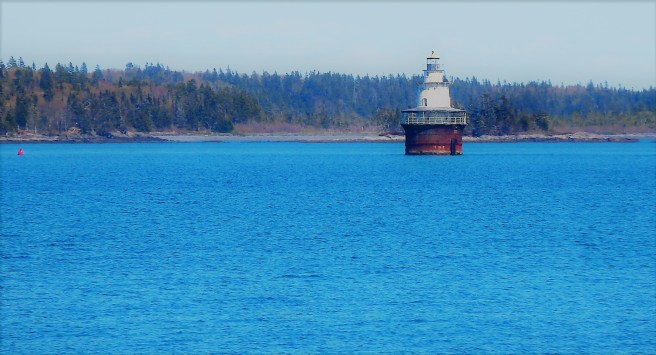
A “sparkplug” or “wedding cake” design, the Lubec Channel Light  can be seen framed by the bridge from Lubec to Campobello Island from points in Eastport, though never this distinctly. I shot this in South Lubec, where it stands 53 feet above Mean High Tide and emits a flashing white signal every six seconds.
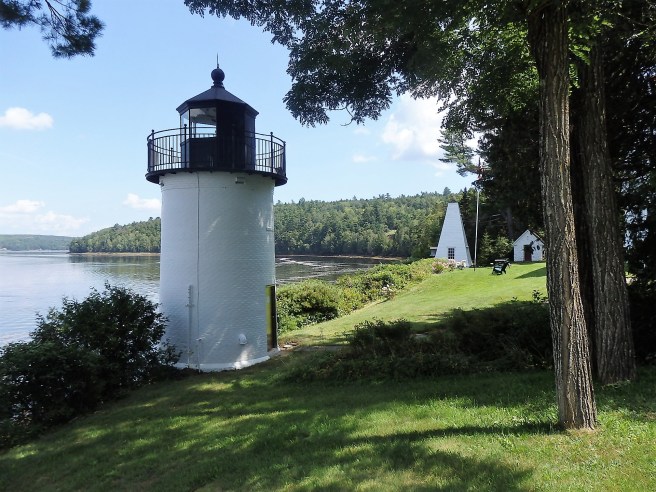
Whitlock Mills Light on the St. Croix River in Calais is the northernmost light in Maine. It’s on private property, and I’m grateful to the owner who allowed me access. The second tower has both a bell and a foghorn. I find this 25-foot tower, despite its small size, particularly charming.

There are times it’s taking me all day to write three sentences

That’s not the way it used to be, not when I was younger and could dash things off in the flush of inspiration, but it is what I’ve encountered revising my last two books.

It’s not even Wes McNair’s advice to write 400 good words every day. Not unless one of those sentences is an over-the-top wonder of 250 to 300 words.

The turtle pace here seems to arise when I’m trying to weave some new material into an existing draft, making it connect on two sides seamlessly. It’s not just the craft of fine writing, actually, but also the thinking more deeply about the unseen significance of the subject at hand.  What, exactly, is beneath the surface before us?

Of course, as a writer, this pace also has me wondering if I’ve simply used up all the easy stuff and left the bigger challenges for my senior years.

Any suggestions?

Chickens and the meaning of life, chapter whatever

A couple of incidents regarding my daughter’s chickens have me thinking about human affairs.

Her hens were increasingly picking on one another and squabbling until an incident with a neighbors’ dog posed a terror. In response, they instinctively banded together, including their otherwise useless rooster. For weeks after, their antisocial behavior was transformed, focused on a common enemy.

A year later, the same thing happened when a red tail hawk picked off two of the hens in the yard.

That leads to the question:

Do we humans really need some villain, however small, to make our own lives meaningful?

We see it in politics, for sure. And in sports. As for personal development and ethical living?

I am convinced we need to keep an eye on Satan, in whatever garb, but also need to be careful we don’t start “preaching for sin,” as early Quakers cautioned. The fact is that in fiction it is much easier to create a believable bad guy than a good one.

So even secular novelists must make sure to avoid exclusivity in their vision.

We also need to keep another eye on the Light and its leadings. Otherwise, well, we’d still be chickens at the mercy of foxes and weasels.

Goodness me, spritely?

In theory, at least, for a writer, nearly anything – or everything – is potential fodder. In my case, that leads to a new blog post, poem, or scene in a novel, but for others maybe a movie or streamed series of episodes or podcast.

Nicholson Baker demonstrated this quite charmingly in his alleged novel Book of Matches, striking on a practice of lighting a fire every morning in the dark depths of a northern New England winter. Novel? It’s simply a very lovely piece of masterful writing and insight, period. Any conflict is subtle.

But I am drawing the line at trying to do anything with a chart of daily blood pressure readings, before and after doubling the dosage of a prescription.

And that’s after bypassing those colonoscopy photos, with or without commentary of a travel guide sort.

Those of my age might understand or sympathize, but younger readers would no doubt be put off unless they possess a truly twisted mind. I can’t imagine the backlash. Besides, it just ain’t sexy.

In all fairness, I hate to admit I’m finding it harder and harder to comprehend a lot of the humor, video content, and even dialogue from their end of the spectrum. That part’s just scary, perhaps reflecting the realities they face. Should we start with global warming and its consequences?

Perhaps a typo I nearly released a moment ago suggests its own new genre. Fuction. Or fruction. With or without a k.

We don’t need to resort to physical gestures, do we?

A musician’s insight on leadership

The question of just what a symphony orchestra maestro actually does led to an unexpected answer about leadership on a YouTube interview. According to the 59-year-old Paavo Jarvi, a conductor is essentially a teacher, regardless of the quality of the players. That, more than his artistic vision or temperament or divine inspiration or managerial skills.

It had me thinking about the best bosses I’ve had and realizing their excellence was as teachers.

How about you? What do you look for in a leader?

~*~

By the way, I was rather startled when I came across Paavo’s age. I still think of him as a “young” conductor, one of Max Rudolf’s last students.

He’s now the age Dr. Rudolf was as music director of the Cincinnati Symphony orchestra, a fine ensemble Paavo later directed for a decade before turning his attention to Europe.

A few life lessons

Pack light, run, get out of the way.
I learned that in Boy Scouts.

Much later, that you have to take care of yourself first
before all the complications in whatever role as a parent.

Much less the seed catalogue
midterms or finals.

Porcupine climbing a tree at Quoddy Head State Park. Seems to embody a few life lessons too.