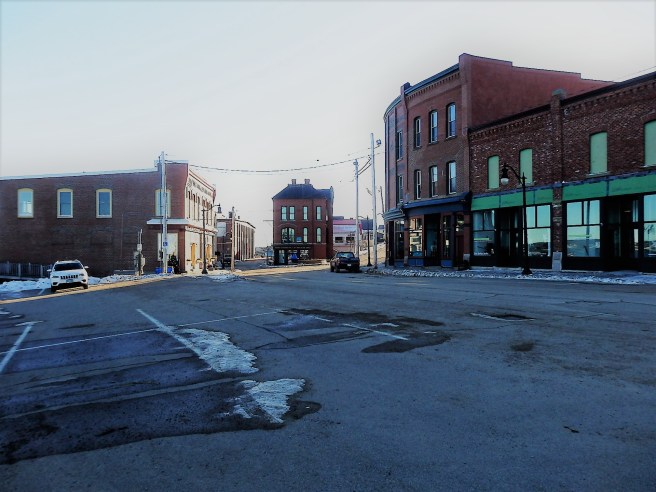
Some people and places just get bad raps for no reason. That used to be the case for the neighborhood just south of Battery Street. Or Assault and Battery, as the ditty went.
Or, in the more salacious version, Sodom and Gomorrah.
You can read the street sign yourself.
Residents of the allegedly more reputable North End of town, meanwhile, got dubbed Dog Islanders, after the tiny island at its tip, one that once had a lighthouse nobody in town could see.
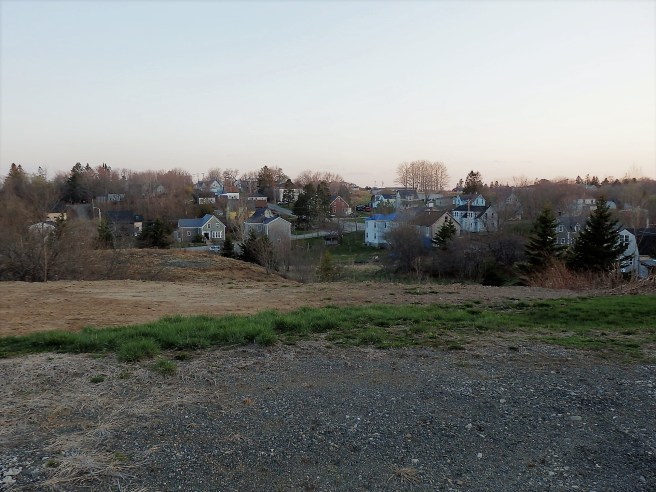
The neighborhood viewed from South Street.
Definitively, the two parts of the village were separated by Shackford Cove (aka Huston’s) , which ran further inland than it does today, as well as a seemingly nameless stream at the bottom of some steep banks. And the cove did have four shipyards at one time as well as the world’s largest sardine cannery a bit later.
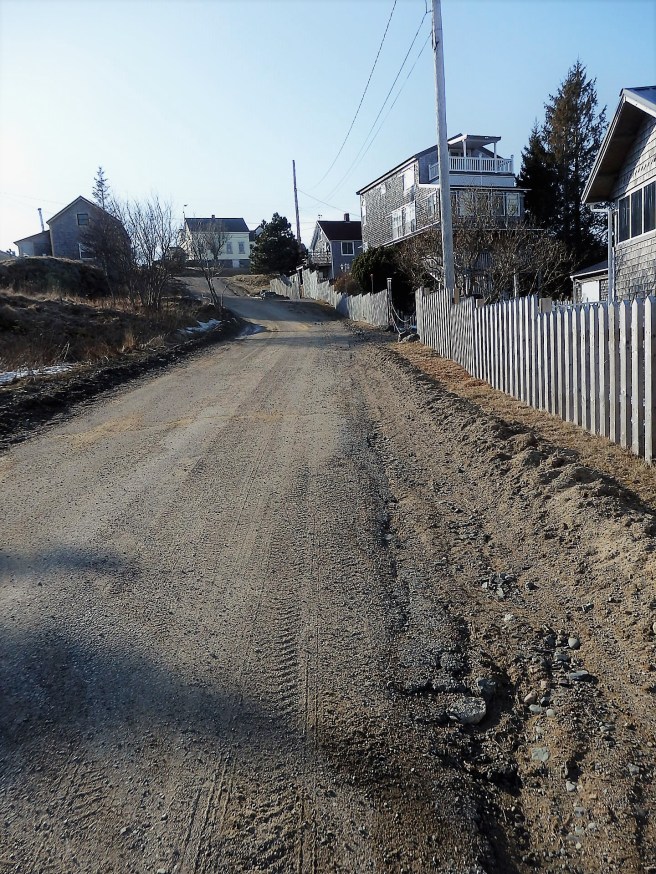
There are also some steep streets that end in the ocean.
Today, though, it has some fine homes mixed in, a few with some of the most spectacular views in town.
When it comes to finding your way about town, you need to know more than just the names of the streets.
Eastport’s a city of islands, with Moose Island the biggest and most inhabited. It’s roughly six miles long and three wide, at the most, but that still adds up to 20 or so miles of shoreline, I’m guessing.
So people will refer to Buckman Head or Estes Head or Todd Head or Kendall Head or, for variety, Harris Point, punctuated by coves.
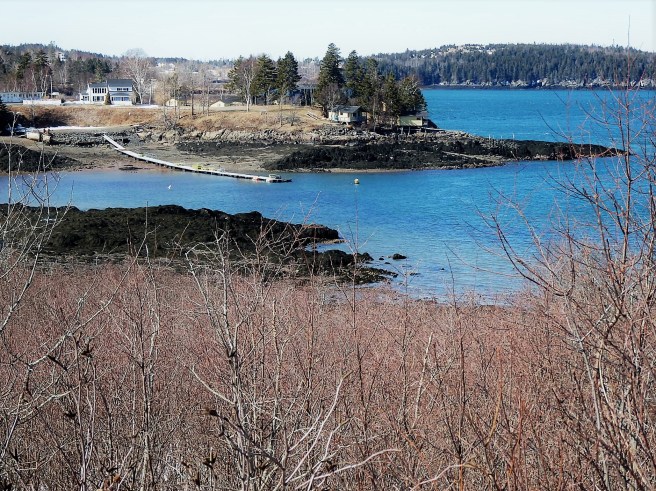
Harris Cove and Harris Point at low tide. Deer Island, New Brunswick, lies beyond.
So there’s Broad Cove or Deep Cove, which flank Shackford Head, or Prince Cove, for instance. As well as Carrying Place, Half Moon, and Johnson coves. Plus a few more. And that’s before we get to the neighboring towns, up and down the coast, which also name places this way.
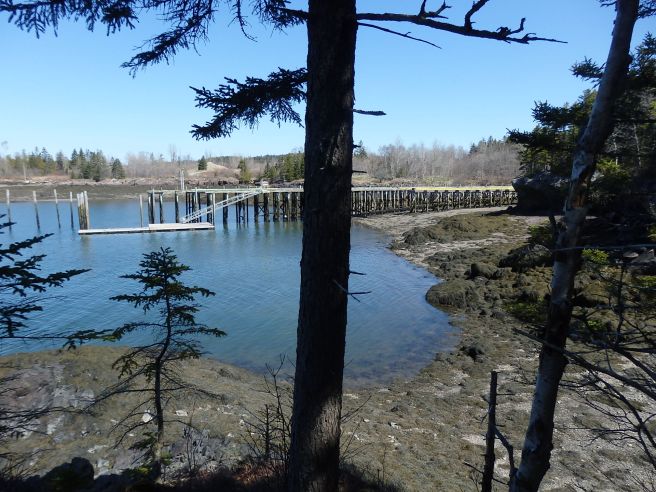
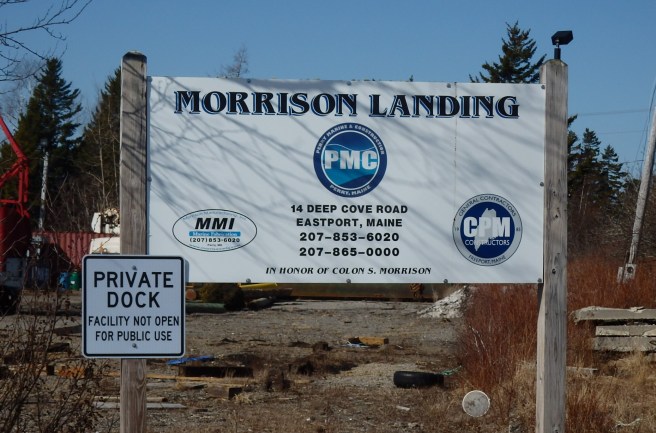
Getting a yacht or big fishing boat out of the water for repair can be a challenge. This pier on Deep Cove is connected to a trolley that carries the vessel to the shipyard on the other side of the road.Along with this warning.
Anchoring one end of Eastport’s main street downtown is the Post Office and former Customs House.
Though the Customs role has moved closer to the Breakwater but not so the mail, especially this time of year..
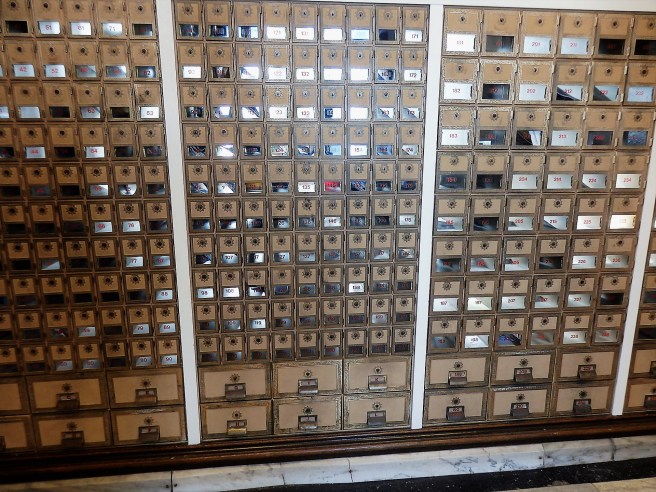
The building still bespeaks of a special authority and order.From the water, it’s a landmark.And inside, the post boxes are pure vintage.As is the staircase up the tower.
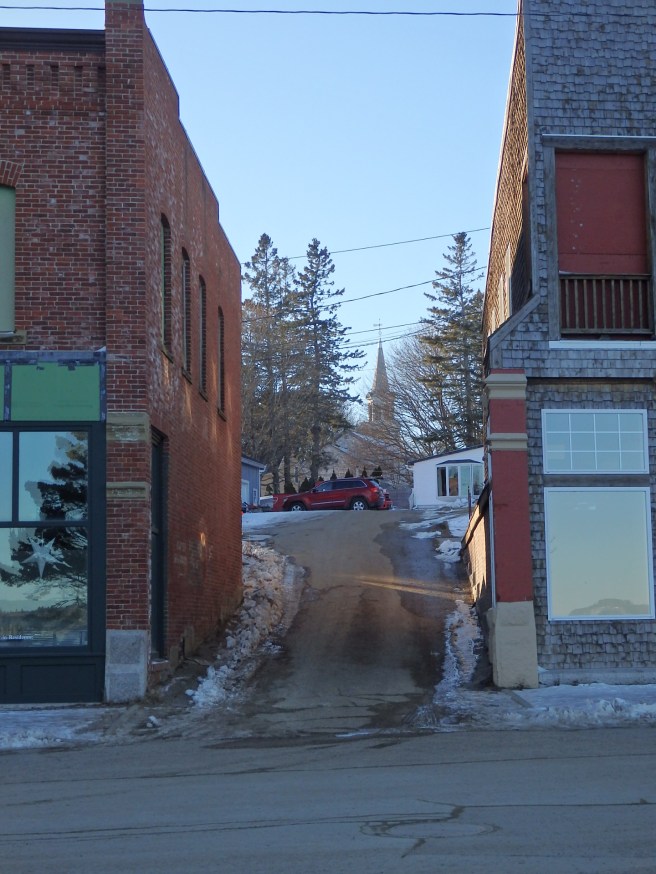
It may dwindle down to an alley when it reaches downtown, but it’s a real street as it climbs the hill and has some vital addresses along the way. Not that anybody enters it here.
Whale watches, the ferry to and from Lubec, plus the Fourth of July, salmon, and pirate festivals were all fun. I even observed a beluga that lingered just offshore my first time out on the water here.
The island’s ten degrees cooler than the mainland in summer – I wore shorts only three times, all of them when I was off to run errands elsewhere. And supposedly the temps run ten degrees warmer in winter, though this house is still cold. We really do need to replace the windows and thoroughly insulate.
We missed gardening, apart from the little fenced-in patch in the front yard, but not the weeding, though the rabbits still happily devoured anything I brought in. Rather than squirrels as a menace, we have deer – especially when the wild apple tree starts bearing. They eat nearly everything in sight, including tomatoes, as I learned before reinforcing the rim of our little garden. Still, I nearly got a doe to eat a cookie from my hand one evening. My wife wasn’t so daring. And tomatoes? They really don’t grow well around here. But the oxeye daisies, basil, and lettuce continued merrily all summer.
None of the big renovations we’d anticipated got done. Contractors are booked out a year in advance, and the one we had lined up backed out before tackling the roof that our insurance company wants replaced pronto. Well, even if we had gotten started, prices on building supplies did more than double. We’re hoping they drop – soon.
Come the first touch of chill here, and three-quarters of the population begins to vanish. Those folks quietly pack up and return to their primary residence, as have the many tourists. It rather reminds me of living in a college town, but in reverse.
Downtown Eastport in the off-season. The Tides Institute and Museum sits in the old bank building in the center of the scene.
The waterfront and downtown are no longer crowded and festive. Many of the stores, galleries, and eateries are closed up, as are the whale watch, water taxi, and passenger ferry to Lubec. By Halloween, roughly two stores, a diner and a restaurant plus a gallery or two remain open downtown, plus the IGA, two banks, and Family Dollar over on Washington Street.
It makes for a challenging business model, trying to pay the rent and all on a four-month retail prime time. Here the highly watched Black Friday, the make-it-or-break-it financial hurdle of American retailing, doesn’t wait till the day after Thanksgiving but probably hits sometime around the beginning of August.
I have to admire the entrepreneurs who manage it anyway, especially those who stay open through the slim volume of the two-thirds of the year when Eastport’s remote fishing village nature is most prominent.
It also means a lot of do-it-yourself involvement. If you want to see movies, you join the film society. Music? Pitch in with the choir or orchestra. Theater? You guessed it. Dining out? One of the neighboring towns must be having a church supper. Seriously.
And you turn out for others.
Yes, it means more work than just sitting on the sidelines, and with a small population, keeping things going can be a struggle.
But one thing I’ve noticed. It doesn’t take long to be appreciated when you take part.