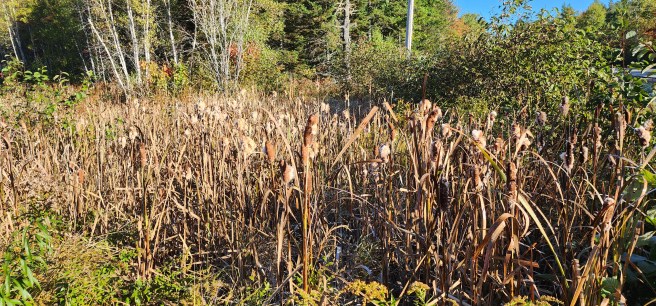
 Classically, this emblem of autumn is here. I remember the first time I saw these in the Midwest, however esoterically at the time of my preadolescence.
Tag: Downeast
Dale’s heavenly nap

As he had told me:
urchins once filled all the shoreline rocks
till the Japanese market opened up
flights from Bangor
fishery now tightly licensed
hoping for recovery

An old-fashioned farm windmill was doing whatever on one island we passed.
What do you know of the history of your home?
When our planned substantial renovations finally began last autumn, our contractor began uncovering particulars that indicated the house might be even older than we had reckoned.
It was enough to prompt me to follow up on friendly banter by more than one person who asked if I’d ever gone to the county courthouse to “run the deeds” back to the original owner.
Quite simply, no, not here or in the previous two homes I’d purchased and later sold as I moved on.
While I’ve done a great deal of genealogy, courthouse records were one line of research I’d never pursued. I had encountered other researchers who specialized in family properties and last wills and testaments, and I was grateful for what those legal documents added to the family picture.
Even so, do accept my disclaimer regarding some of the dates and locations that pop up as I applied that line of inquiry to our old residence. What I’ve gleaned and present here is in an attempt to get a big picture of the lives that have intertwined with the house we purchased and renovated. Some of the connections are admittedly soft and subject to further revision. I am surprised by how many gaps remain.
Keeping that in perspective, I did finally trot off to the Washington County courthouse in Machias, an hour away. Let me say that digitalizing the archived records has made this field much easier and more accessible, and the registrar of deeds and her staff proved to be very helpful and friendly.
The fateful day my curiosity about our house finally led me to the registrar of deeds in Machias came about while I needed something to round out the day while my computer was in the repair shop a mile or so away.
To get the bigger picture, I set forth with a sense of trepidation. Armed with little more than the plot number of our lot, I anticipated technical complications, a tangle of legalese requiring translation, and dark, dusty confines. Instead, I was pleasantly surprised to find the room well lighted and organized the staff both friendly and helpful. Better yet, the transactions have been digitalized in an easily navigated system. The original records were also at hand, should I desire, and I wouldn’t have to interrupt anyone to help me follow these.
Each transaction included a reference to the book and page numbers of the previous purchase, which was all you needed to trace the line of owners.
If only it were that easy.
~*~
Running the deeds means starting with the most recent transaction and working down through time, document by document.
Despite its modest appearance, our house has an unexpected significance, as you will find.
There are good reasons I’m calling my findings a genealogy of an old house. We’re surprised by some of the characters who’ve lived here.
Firewood wall
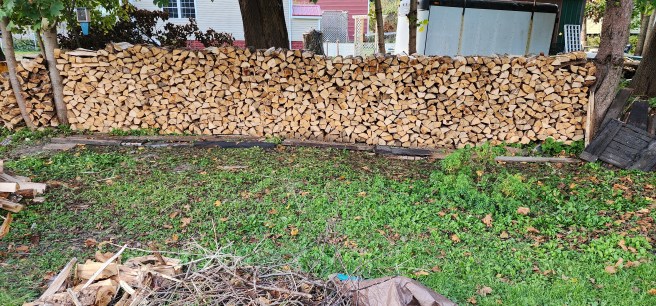
And now, to let it season for a year.
A classic autumn stroke

Cattails.
On Eggemoggin Reach
just passed an old sardine carrier
turned private yacht
Local traffic
sardines as a reminder of where I’ve settled
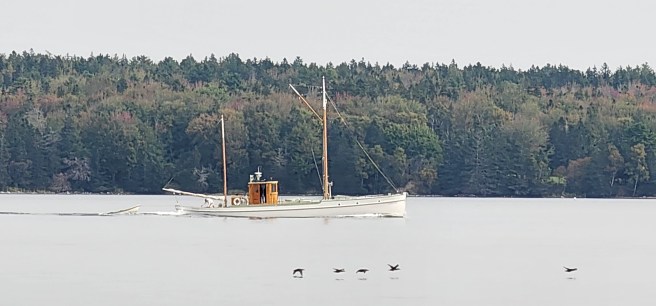
when the Louis R. French was based out of Lubec
and owned by American Can in Eastport
she had an engine and no masts
faring something like this
Now, for some background
While we wait for the continuing renovations to catch up with these weekly reports, let’s change the focus to the history of this old house itself. Give us a better idea of what we’re working with, too.
When we bought our full Cape at the end of 2020, the real estate listing dated its origin in the 1860s. As we became familiar with the home’s bones, we saw details suggesting construction as early as the 1830s. While the pedigrees of a few neighboring houses have been catalogued by local historians, ours was not one of them. The dwelling did appear more modest in comparison.
We did have to wonder if the dwelling had been rebuilt after one of the catastrophic fires swept the downtown and its fringes in 1886, 1864, and 1839. Some of our stone foundation is 18 or more inches thick.

The house did appear on a widely reproduced 1879 map of Eastport, one that gave a birds-eye view of the city. The two dormers may have come later – it’s hard to tell from the map.

An earlier historic map of 1855 not only had a house fitting the footprint of ours on the lot, but with two wings, accompanied by an identifying script “Shackford Est.” The difficulty came in trying to figure out which Shackford that would have been — the family was prominent and prolific.
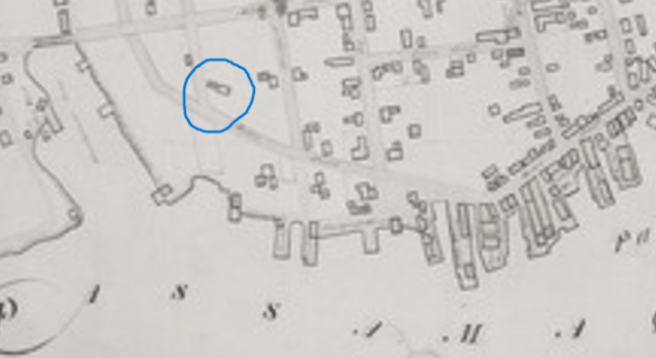
An earlier Plan of the Village of Eastport, 1835, by William Anson presented rough designations of the structures in town, including a house where ours is and only a few others in the blocks around.
Thus, we do know the house was here before 1886, as the charred rafters affirm, reflecting the great fire that destroyed the downtown. Local history dean Ruth “Ruthy” McInnis, owner of the Todd House bed and breakfast, had primed us to look for that detail when we were considering whether to bid on the place. Other dwellings, as we’re learning, share similar damage.
What I’ve uncovered is that this house is even older than we suspected, and more historic. In many ways, it tells the story of the town, too.
Ahoy, mates! It’s a small world, indeed
I’ve been caught off-guard several times while wearing my gray Louis R. French historic schooner hoodie around Eastport. (Well, one of them. I now have three, but that’s another story.)
The first encounter was at the county courthouse in Machias while researching the deeds to our home. A registrar asked what I knew about the boat and I started replying with the history. She smiled and said, “My dad worked aboard it,” back when it was a sardine carrier based in Lubec, the town just south of Eastport. During that stretch, the masts were removed and the vessel was powered by an inboard motor.
The second time was when a friend, a legendary ship pilot, smiled and said he rode many times aboard it as a kid. Bob did correct me, saying the French wasn’t a sardine carrier but a freighter carrying cat food to Canada. (“Cat food to Canada?” Sounds like a title to me.) His family did own canneries in Lubec, Eastport, Portland, and a few other places. That’s yet another history to consider.
The next incident came while leaving my dentist’s office and his wife ( a.k.a. center of operations) Mary, blurted out, “Lewis R. French? That was my family’s boat.” For 50-some years, in fact, or the time it was based on our waters, when her Burpee and Vose families possessed the vessel. From her I learned that during the Prohibition, the French was an active rum-runner. Sardine carrier? Huh? The missions do get more interesting, no?
She also said something about ghosts. Well, if they could talk.
She does have the book published later, but I do suspect some of those details are missing.
The most recent account came while watching a big cruise ship come into Eastport. A woman standing nearby saw my hoodie and then told me she used to work in the office when the French belonged to Seaport Navigation. (She confirmed that my dentist’s wife’s families were among the owners). The headquarters was on the second floor of a waterfront building that she pointed to, one where friends of ours have their gallery and apartment, and said she never got tired of the view. She remembered typing up many documents regarding deliveries of canned sardines to the railroad line in St. Andrews, New Brunswick. Shipping them from there rather than by truck from Maine was much cheaper. By this point, the French was Seaport’s backup ship.
So sardines were still part of the story.
This may seem petty but …
Do we really have to wait another year for the new Interstate 395 leg from Maine Route 9 to I-95 itself to open?
It’s only a few miles and minutes but eliminates a lot of aggravation in getting from here at the eastern edge of the country to most of the rest of the USA. That half-hour of narrow roadway competing with Canadian tractor-trailers on icy pavement plus small-town radar speed traps is an aggravating bottleneck, believe me, even before you factor in all of the Acadia National Park seasonal crush. The new route will ultimately get us around Bangor/Brewer more swiftly and maybe save us ten minutes or so at most, but on a five-hour drive that can be huge.
As it is falls back into a Trump-era vision of what’s supposed to be good at least as the fireworks and firearms retailers along the way declare.
What’s the biggest traffic hang-up you hate?
Whitneyville school


