DRESSING FOR LOGISTICS

It didn’t take very long for my philosophy class in college to realize our professor was wearing the same outfit all the time – suit coat, tie, pants, and Hush Puppies. We wondered about the white shirt, his socks, and underwear, and presumed he was changing those. The second semester, he did the same thing, but with a different outfit. (This was the same teacher whose final the previous year had a single question, “Why?” – which led most students to write profusely in their blue books, hoping to somehow hit the answer by accident. A succinct “Why not?” turned out to be the B+ answer, while “Because” earned the A.) Maybe he was just too lost in thought to be concerned about attire. On the other hand, some in the class repeated rumors that he had a girlfriend in Sweden and was spending most of his income on long-distance bills. (Why not?)

When I’m grabbing the same set of clothes for, say, the third day in a row while getting ready to dash off to the office, that recollection flits through my mind. Sometimes the thought connects with the concept of Plain dress, too, and how we’ve made things more complicated by switching to the less tightly defined “simplicity.” For old Quakers, the question of “What will I wear today?” was much easier than it is for us.

Of course, Plain dress was also a uniform – a symbol of belonging, and belonging to a cause, at that. There are all kinds of uniforms, and not just for the military – mail carriers, retail clerks, priests, mechanics, utility workers, many of them today wearing embossed T-shirts. You know what to expect from them.

There are many reasons I’m not suggesting we return to Plain dress. For one thing, such a move would have to express a unified community; otherwise, we would just appear to be quirky along the lines of my philosophy prof. In addition, putting the focus on the outward appearance ignores what exists within. Still, such a move would be a public rejection of the fashion industry. And it was said that Friends who had taken up Plain dress became more aware of individuals at the fringes of society – and more responsive to their needs.

As for the philosophy prof, I guess the biggest lesson he taught me was the importance of questions in the logic of life. The dressing’s purely secondary.
SMOKING GARDEN

At night these strands twinkle.

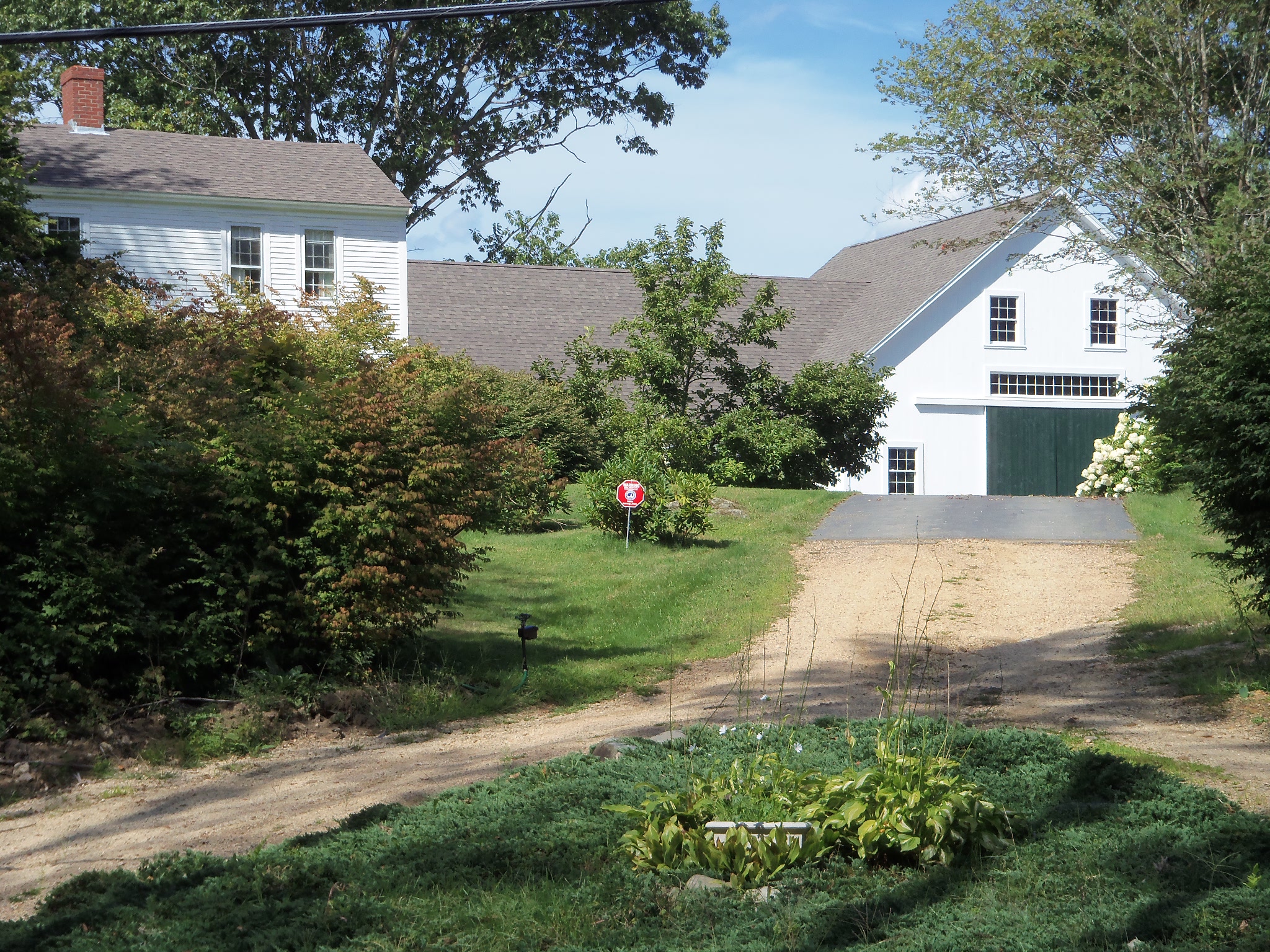
I’ve mentioned the space we whimsically call the Smoking Garden – the funky patio, as it were, beside the barn.

It’s great for late afternoon and evening dining all summer, or parties ringed by Tiki torches, though it’s been a while.

Even so, here it is.

WINDY CITY PERSPECTIVE

In 1922, the Chicago Tribune conducted an international architectural competition for the design of its new headquarters. The World’s Greatest Newspaper, as it proclaimed itself, could have erected a landmark modernistic tower envisioned by Walter Gropius and Adolf Meyer or an impractical giant lectern styled by Adolf Loos but instead went with a neo-Gothic bullet by Howells and Hood.

By the mid-‘80s, when I was employed by the paper’s syndication service, the grimy gray building was surrounded by many much newer buildings that resembled the glassy proposal the publisher had rejected. Maybe that says everything, in the end.

By then, though, the newsroom had definitely changed. Gone were the typewriters, long replaced by computer terminals and keyboards. Tours were guided through glass-shrouded catwalks overhead, where they could look down on journalists at work. I remember being fascinated to recognize there were four semi-circular copy-desks below me, each one ringed by copy-editors and a single “slotman” at the center, just as it had been when I started. I’d heard, too, that none of those seats were ever vacant long; this was a paper edited ‘round the clock for its many editions. But then I noticed that the editors on one of the rims were doing nothing except writing and editing photo captions. Nothing else for the entire shift. I’m sorry, but I’m used to far more variety when I’m editing. How did they ever stay awake?

Since we were really there to see two of our cartoonists, we headed for a set of elevators serving floors six through 32. And we were headed to the top, Jeff MacNelly’s suite, which sat just under the floor of microwave gear.

With his panoramic windows between flying buttresses looking out over Lake Michigan (you couldn’t tell where the water ended and the sky began that day), I wondered how he ever got any work done on his editorial cartoons or his Shoe comic strip.

One floor down, which Dick Locher commanded, was quite different. With its tiny diamond-shaped windows, the suite wrapped around the elevator and service shafts felt more like sitting inside a gargoyle.

At that point, one of my colleagues noticed a framed Pulitzer Prize on the wall. “That’s all it is? A piece of paper?”

Locher, who drew the Dick Tracy strip in addition to his editorial cartoons, had won two.

On the couch, MacNelly, who’d just won his third Pulitzer, grinned. “Yup, that’s about it. A piece of paper.”

THE PERSONAL STAMP

Until landing here, I’d never given much thought to selecting a garden plot. Flat, well-drained sunny soil was a given. Crops could be put out in easily marked rows. The Midwestern loam or Pacific Northwest’s volcanic ash-enriched ground demanded little, other than perhaps a bit of fertilizer boost. What came with our house and its small barn, however, were another matter – one abetted by a decade of deferred maintenance. On the driveway side, hedges had grown to overhang what’s now a kitchen garden and the ground was overrun by invasive ivy. Behind the house, one lilac bush stood nearly three-stories tall. Large limbs rubbed against the barn and blocked the pathway. Three garage-size brush piles soon emerged in the swamp, awaiting a fire department burn permit. It becomes a long history. What I was quickly introduced to is what my wife calls “dead dirt,” almost as hard as asphalt (plucking the stealth maples often required pliers), and then squirrels, especially as they dug up daffodil bulbs they had no intention of eating.

The process of restoring soil is another labor, one that becomes evident years later when the stealth maples slip from the earth, offering no resistance, a result of mulching, pruning, appropriate groundcover taking hold, and composting. In short, the improvement reflects a larger repetition of annual cycles of practice.

Moreover, I’d not appreciated the extent to which actions by earlier residents now shaped what we would build on. For starters, the siting of the house, barn, and driveway likely took advantage of drainage. Later, the construction of a gravel patio in shade on the western side of the barn – screened by a row of lilacs – has become so integral I cannot envision another use for the space, which we call the Smoking Garden, with the panels beside it that we filled with ferns, which have proved more difficult to establish than one might imagine. With two “springs” at the top of the swamp (we argue whether the pipes that feed them come from neighbors’ sump pumps or some other source), the seasonal flow of water becomes even more problematic. Combined with variations in sunlight levels and the soil itself – part of the yard remain quite hard, including asphalt fill – to see what grows well, and where, is eye-opening. For instance, our first season, we planted six pussy willow sprigs. One quickly croaked, followed by another. A third has barely grown over the next decade. Two others have shown moderate growth. The sixth, by the more active “spring,” however, has flourished and been the source of a handful of others planted close by.  The asparagus bed, meanwhile, was built atop an earlier raised bed at the top of the yard. And so on.

What has evolved is something that reflects our own style – more natural than formal, low-maintenance or at least relatively low-cost, and often eclectic. Our little city farm hardly provides enough to sustain us, but it does offer a taste of the changing seasons in all of the amazement that truly fresh produce delivers, as well as celebrating the unfolding of the year itself. This is far from the mossy Zen gardens I thought I would have desired, places I now perceive as expensive to build and maintain, or even from orderly, rectangular beds of rational efficiency. I love sitting beside the berm, in the far corner along the street, sipping coffee or wine – or, especially, in the Smoking Garden as late afternoon slips into night, with our torches blazing and clear lights strung overhead twinkling.

I love, too, gazing at the gardens when they’re buried in three feet of snow, appearing so pure and mysterious. They are both all potential and memory of the previous year – the hummingbirds and finches, butterflies and lady bugs.

WIND BLADE

100_8492

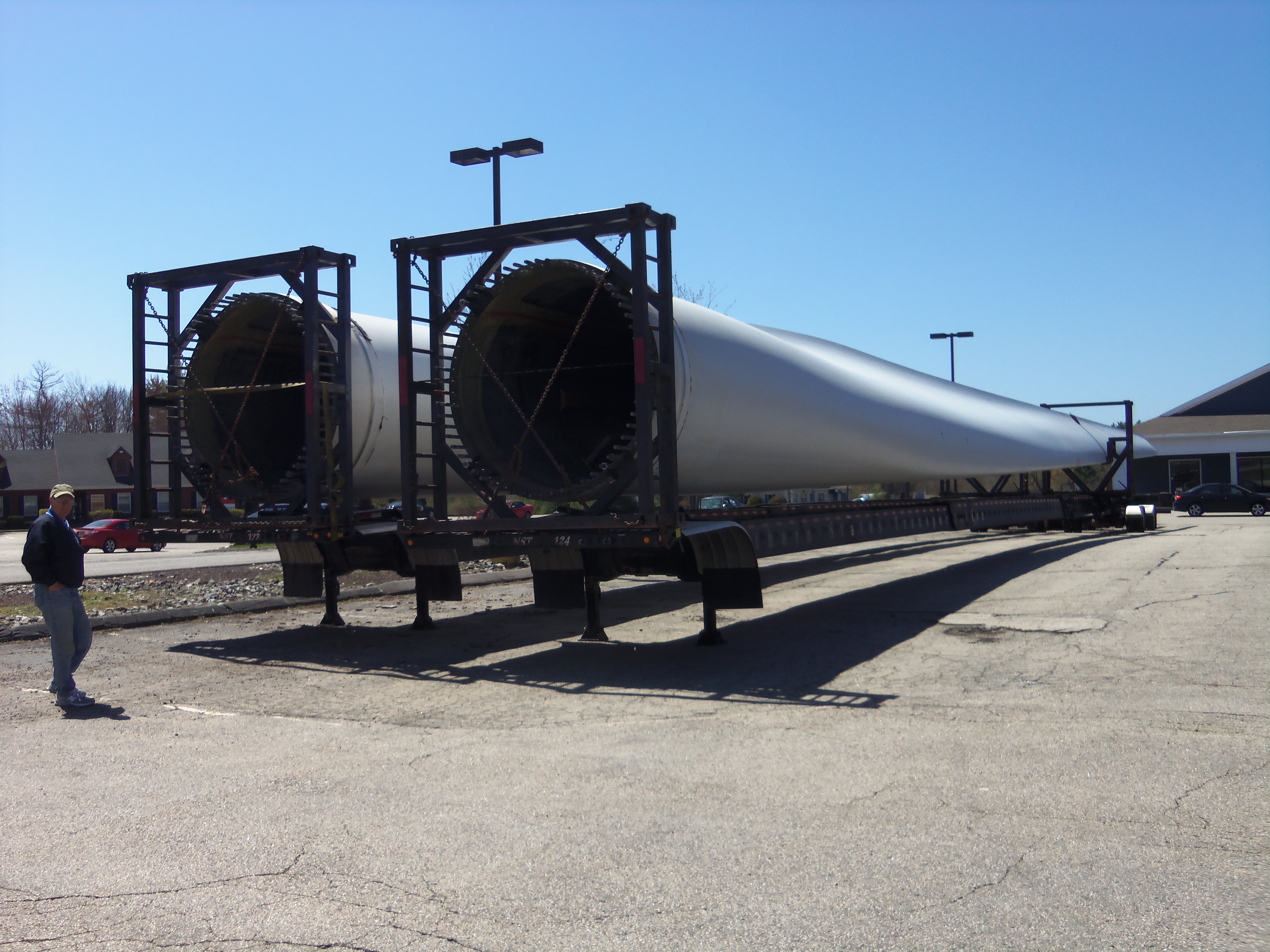
Several months ago, while driving on Interstate 95 to Boston, a remarkable view caught my eye. Headed in the opposite direction was a very long trailer, one at least three times longer than the usual tractor-trailer rigs. A few miles down the road, I glimpsed another. And then a third.

They were blades for wind-powered electrical generators being erected atop several ridges in Maine. Perhaps you’ve read some of the controversies erupting over proposals to build these “wind farms” in suitable locations across the country. But this was the first time I got an inkling to the size of each tower.

Earlier this month I came across two similar propellers, this time settled in a parking lot, no doubt waiting for a few more to join in a caravan. Even before being erected on a summit, they’re an amazing sight. Somehow, the gleaming sun on the metal reminds me of watching whales lolling in the ocean. Whales, you may recall, were the source of the oil used to illumine many homes in early America. They were another source of energy from New England.

100_8486

100_8490

MYSTERY SOLVED?

While Dover Friends (Quakers) proclaim that we worship in our third meetinghouse, erected in 1768, our history of the previous two structures becomes a bit foggy. Even so, ours is the oldest house of worship in use in the city.

In his authoritative New England Quaker Meetinghouses (Friends United Press, 2001), Silas Weeks mentions that our first house of worship was built about 1680 on Dover Neck, just south of the present St. Thomas Aquinas High School. Correcting an earlier version of the relocation of the structure to Maine, he writes that in 1769 “the 1680 house from Dover Neck was taken apart and re-erected in Eliot at the corner of what are now State and River Roads. There is a bronze plaque marking the site …” (Alas, there goes the tale of its being skidded by oxen across a frozen Piscataqua River. Taken apart and put on a boat now seems more likely.)

Apparently, when our current house was built, we had no need for the smaller structure. I suspect that until our current meetinghouse was available, Dover Friends met for worship in the two smaller structures and gathered together for business sessions.

The disposition of the second house, though, had eluded his investigation. It had stood at what Silas “believed to be the present corner of Locust and Silver Streets,” but there was no indication it had been incorporated in later buildings on the site.

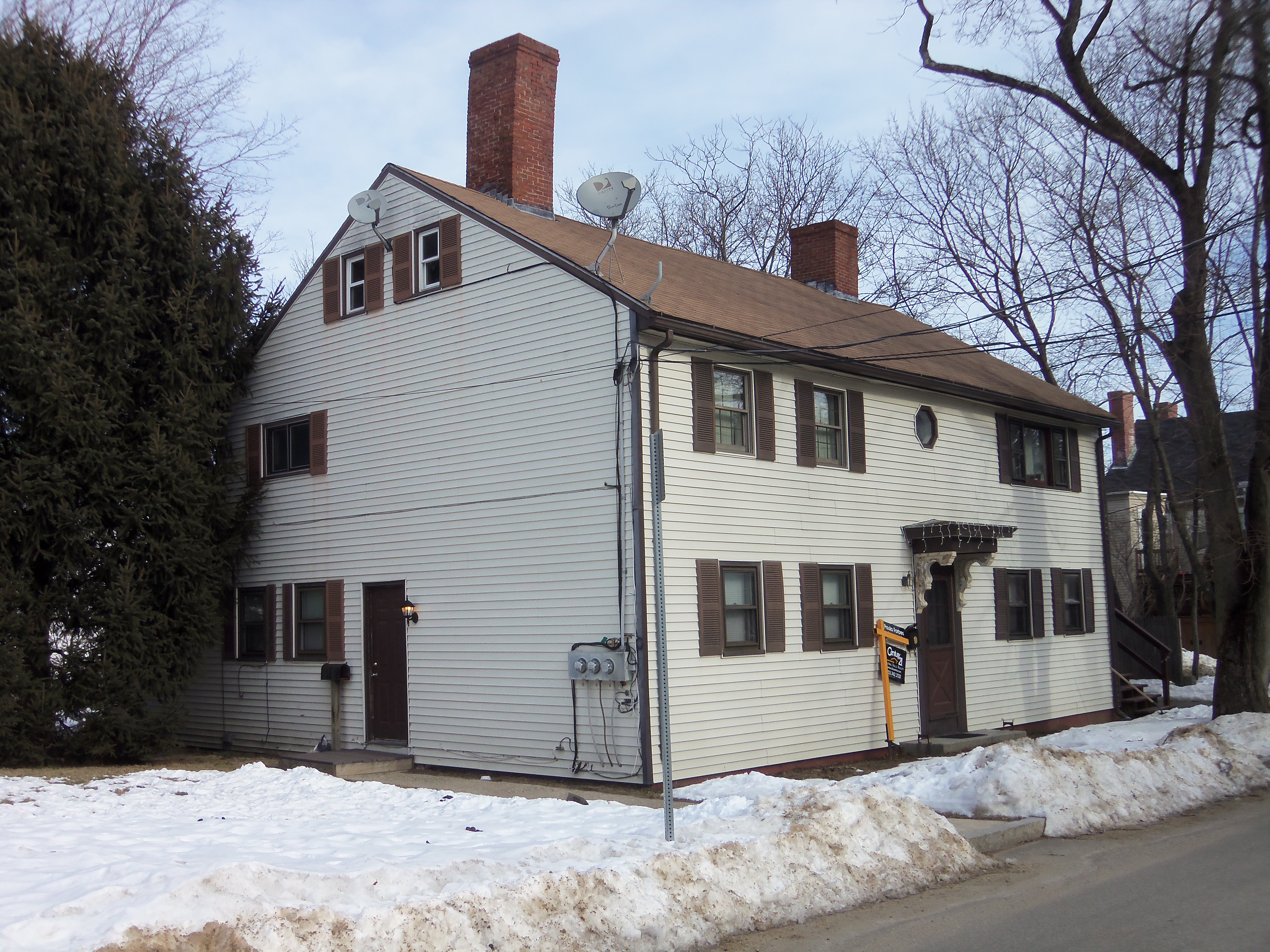
A publication from the Dover Chamber of Commerce, however, may have the answer. Dover’s Heritage Trails, a guide to historic walking tours through the city, notes this at 3-5 Spring Street: “This old dwelling was Dover’s second Quaker Meeting House, built originally at the corner of Silver and Locust Streets and moved to this location in 1728, before Spring Street existed.”

Silas reported “The second was erected in 1712 on land belonging to Ebenezer Varney. The deed, transferred to Friends in 1735, described the site …” in ways that support the Silver and Locust location. My guess is that the structure was moved in 1828, since the Chamber pamphlet mentions that neighboring houses were built in 1810 and 1811.

The building has no doubt changed a lot, inside and out, since it was erected three centuries ago -- including the addition of chimneys. But the shape is right for a Friends meetinghouse.
The building has no doubt changed a lot, inside and out, since it was erected three centuries ago — including the addition of chimneys. But the shape is right for a Friends meetinghouse.

As they say, the plot thickens. And to think, the answer to our search may wind up just a bit more than a block up the street from where we gather.

THE SHRINKING PAGE

l look down on the newspaper page and think how narrow it’s become – about half of the width of the pages I designed at the beginning of my career. The broadsheets of today are about the width of tabloids back when.

It’s all cost-saving measures, of course. Like the shrinking candy bar. Yes, I remember when the joke circulated, “It’s hard to find a nickel candy bar for a quarter these days.” Ditto, for the cola.

So we keep hearing the economists warning about inflation. Not a word, you notice, about the corresponding deflation of the product itself.