A spree of reading this Peruvian winner of a Nobel Prize was highlighted by the novels Aunt Julia and the Scriptwriter and In Praise of the Stepmother, but what I value more is his nonfiction A Writer’s Reality, especially his sense that Spanish literature veers toward its unique lines of fantasy surrealism rather than fact as a consequence of the Inquisition.
Tag: Culture
And then ‘What’s Left’ came into focus and changed everything before it
By the time the ebooks were published, I had remarried and settled into our little city farm on the New Hampshire seacoast, the one with the red barn that gives this blog its name. My life had stabilized and my job wasn’t devouring me alive, unlike my previous lower-level management positions.
But something kept nagging at me. I wanted to know just where the hippie movement had gone. Many of the insights have been posted here at the Red Barn, and I did draft a series of essays – Hippie Hopscotch – for a book competition that was cancelled after I sent my entry off. My conclusion is that the hippie impact is still around in many varied streams, much of the legacy taken for granted in contrast to the mass-media stereotypes or the current teens’ perception of hippie as being a girl thing. My wife and stepdaughters kept asking about the era and were astounded to hear just how much had changed for the better because of it. They were incredulous at the restrictions I had faced. Were things really as bad as Mad Men presented them? Yes, and the show had me retasting the first newspaper I worked for, the one that came closest to major metro. I mean, I could almost smell it.
Could any of this earlier work be salvaged? And what could I do with the searing childhood betrayal piece published online in Hobart?
My first published novel, Subway Hitchhikers, had ended with Kenzie’s return to Indiana. Intuitively, I had him, as a Tibetan Buddhist lama reincarnated into Iowa, marrying into a Greek-American family in Daffodil. I saw it as a way of blending two streams of ancient wisdom – one Asian, the other at the origins of Western culture. Something still felt incomplete in that ending.
Rather than trying to pick up the story with Kenzie himself two decades later, I decided to shift the focus to the next generation, which led me to create a daughter. This would be her story. As an added twist, I decided to have her lose him, not to divorce but an avalanche in the Himalayas, when she was just 11.
Unlike my earlier fiction, this one was undertaken totally in my retirement years. Yes, I had the ending of Hitchhikers as my prompt – and, based on that, some characters and a setting to work from – but this book would be done with fewer external demands than I’d faced in working on the others in my “spare” time.
Surprisingly, this became the hardest of all to bring to fruition, undergoing nine thorough revisions. In one version, there were no quotation marks. Another changed the tenses.
No quotation marks? Since she was relating the story anyway, including what other people had told her, who knows how accurately she repeated them. Blame Cormac McCarthy as a bad influence there. It was one flash of brilliant inspiration that ultimately proved confusing. Now, how many quotation marks did I eliminate in one sweep and how many did I have to insert as repairs? Both times, it involved a lot of keystrokes.
The focus shifted greatly, too.
At first, it was on what she uncovered about her father and his times. He was a hippie, after all, so we would see the hippie scene through her perceptions of his photographic record of people and events. In the next revision the focus turned to what had attracted him to join her extended family, one so different from his own roots. That led me to questions of just what a family is – a pretty slippery concept in today’s America – and then an examination of Greek-American culture in the Midwest itself. Finally, the focus was entirely on her, period, starting with her stages of adolescent grieving and emotional recovery.
I was a bit spooked when she began talking to me through my fingers as I was typing. She was snarky, too. Talking? She was dictating. Even scarier, she sounded a tad like my younger stepdaughter.
And it wasn’t just when I was up in my third-floor lair. Sometimes she talked to me while I was swimming laps or weeding the garden.
At some point this was no longer about a distant past, in her eyes at least, even when those roots impacted the present and its conflicts. By now, I was watching her grow up with each revision as she gained a snide, seemingly cynical tone and a goth appearance. I wish I had answers or at least advice for where she and her generation of the family wind up at the end of the book, but we do know what their options are.
The book also evolved into a multigenerational affair, reaching back to her great-grandparents and later jumping ahead to her nieces and nephews within a large, tightly knit extended family.
How to structure this baffled me until I came upon the way Jonathan Lethem handled a multigenerational novel that built on four sections of four chapters each, like a mosaic. Mine has five generations at play, once you include Cassia’s nieces and nephews, but the structure holds. Somehow it works differently than the traditional chronology of twenty-some chapters.
One of the 16 chapters, the subway ride to the Brooklyn art museum and its Tibetan galleries, comes from a lengthy outtake from a Hitchhikers draft, this time two or three decades later with Cassia, the daughter, rather than her father.
I should also admit that the title remained elusive. One I liked, Cassia’s Quest, got shot down for sounding more like a space journey. Another, in desperation, Diana’s Daughter pushed Kenzie out of range. What’s Left results as a double entendre, addressing both her situation and the manuscript itself.
Finding a suitable cover image was equally challenging. I liked a failing egg yoke as a reference to her being broken open and to her family’s restaurant. Photos of a grieving child or young woman never quite fit the physical description in the text itself and also failed to reflect the span from early adolescence into her 30s.
~*~
The project also had me reconsidering my own experiences.
Was I really ever a hippie? In my promotions for the novels, I contended that we came in all varieties and nobody fully fit the stereotype. That was, in fact, a central thrust of my novels, even when hippies are nowhere to be found, as was the case in Hometown News.
In the background, the local Greek Orthodox church opened the faith and culture to my curiosity. As I’ve discussed in posts here at the Red Barn, what I encountered was quite different from my Quaker simplicity but definitely enriched it, not just theologically but as in the traditional dancing, music, and food.
It was a good thing that I didn’t encounter the novels of the masterful Jeffrey Eugenides until after What’s Left had been published. I would have been too intimidated otherwise.
In addition to Jonathan Lethem, writers of inspiration during this project included Poppie Z. Bright, Anne Rice, and John Irving.
~*~
Not only was this the most difficult of my novels to writer, with deep revisions, but the central character, the snarcastic Cassia, had me rethinking everything that had gone before. She ordered me to revise the earlier books. Or else?
One of the advantages of ebooks is that new versions can be published rather easily. In this case, as you’ll see, she had my hippie books getting new titles, many characters getting new names, and many of the stories themselves being vastly enhanced.
All from what I jokingly called my culminating novel.
And that was before I returned to the others.
Here I had finally found myself in my goal of being free from the newsroom and having time to focus more fully on my “serious” writing. I just didn’t imagine it like this.
I still held a fondness for the hippie movement and its hopes but could clearly admit I had moved on. That part was liberating.
I’m still looking for that better world, though, as you know.
So here I was, back to the drawing board.
Balkan voices

Eastern European music features low bass notes prominently. I listened to this group with envy. They were doing an all-Ukraine program.
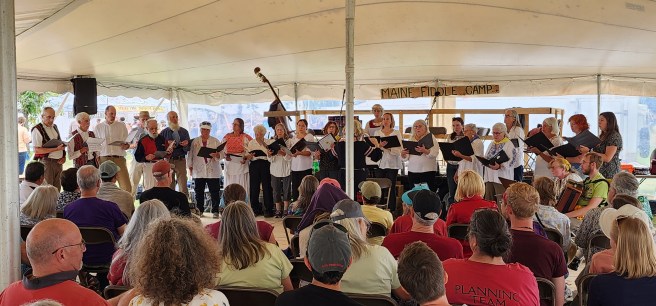
The Maine Balkan Choir international music and dance ensemble performs at the annual Common Ground Fair during hour-long breaks in the big contradance tent. The choir rehearses in three subgroups across the state and then comes together for events like this.
Their closest location to me is Ellsworth, two -and-a-half hours away.
Acid test essayist and novelist: Madeleine L’Engle (1918-2007)
Although she’s famed for her young adult fiction, what I appreciate more is her personal writing reflecting her life with a well-known actor, including the years of hiatus they spent in a 200-year-old farmhouse in Connecticut before they returned to New York City and his acting career.
Her candid reflections on being subject to prejudice from both liberal parties, who shunned her books for their religious content, and from conservative Christians, who avoided them for their universalism, speak of a painful reality for those of us who embrace a radical, even revolutionary, faith.
A devout Episcopalian, she mentions deep discussions with Chase, who turns out not just to be the father of a fine friend of mine but also a rector of the Cathedral of Saint John the Divine in Manhattan. My friend has mentioned babysitting her grandchildren in her apartment several floors above his family’s.
Acid test novelist: Kurt Vonnegut (1922-2007)
When I first encountered his writing during the fall of 1968 at the recommendation of a friend who was attending a college elsewhere in Indiana, Vonnegut was a breath of fresh air. I loved the sassiness, hipness, and dark humor of books. They had none of the pretentiousness of serious literature but were seriously satirical.
Besides, he was writing about the heartland of the neglected Midwest, at least at one point in each book. God Bless You, Mr. Rosewater nails the milieu and remains my favorite.
Overall, though, I feel an overarching nihilism negates a redemptive mission for his work. As for the gimmicks? Let’s just say this former favorite has shrunk in my estimation over the years.
Acid test essayist and poet: Kenneth Rexroth (1905-1982)
Indiana-born in the shadow of Chicago, Rexroth’s childhood took place in a liberal household filled with socialist activity in the years before the First World War. The radical network across the Midwest that he details in his Autobiographical Novel will surprise most Americans, who believe it was confined largely to big East Coast cities. Not so, as he insists.
His family was at a less restrictive edge of the Brethren heritage, today a handful of pacifist denominations where some still resemble the Amish. It was very much a counterculture from its arrival in Colonial Pennsylvania and Maryland and on through the Civil War. While Rexroth himself headed in a much different direction, some of those roots continued to shape his actions and his religious questioning and questing.
Orphaned in his teens, he broke loose at 19, filled with anarchist thought and an IWW (Wobbly) identity, hitchhiked west, and worked odd jobs, including a Forest Service stint at the Marblemount Ranger Station in the North Cascades, where Gary Snyder would later spend several crucial summers in the high fire watch posts, as did others who came under Rexroth’s spell.
With a wife, a painter, he settled in San Francisco in 1927 as what his biographer calls “forerunners of the flower children who flocked to northern California during the fifties and sixties.” All along, he was notably active in civil rights, anti-war, and feminist circles, along with jazz and Buddhist influences. His book, Communalism: from Its Origins to the Twentieth Century, remains a fine overview of counterculture communities over the centuries. In some of these circles, he was aligned with Brethren, Quakers, and Mennonites, perhaps without being fully aware of the connection. His personal life, however, had its tangles.
His translations of classic Chinese and Japanese poetry are what first caught my attention, and still do. His own works are strongly crafted, often with an erotic strand.
He’s sometimes called the father or even the heart of the Beat movement, both as a mentor and as the MC at the famed reading at San Francisco’s Gallery Six in 1955, but it would be more accurate to call him a godfather of the Bay Area poetry renaissance that began blossoming before that and flourished for several decades after. Weekly readings in his house now sound like a who’s who of literature.
I remember that when he died, about the same time John Cheever did, Cheever got the accolades in the press while Rexroth got brief mention. I still think they had it backward, considering the lasting influence of each.
Acid test novelist: Ken Kesey (1935-2001)
Although my classmates in a contemporary novel course rhapsodized over One Flew Over the Cuckoo’s Nest and the author’s later role as a Merry Prankster advocating LSD use, I was fonder of Sometimes a Great Nation, which I read while living not all that far from its setting in the coastal mountains of Oregon. Sections from the unfinished Seven Prayers of Grandma Whittier were also tantalizing. Now I am wondering about his naming of the grandmother, as a nod to … Quaker?
Kesey is fascinating as a forceful, larger-than-life counterculture celebrity, even notoriety, from the Beat movement on. How could anyone begin to compress his activities into prose, either fiction or nonfiction?
Both of his novels were published by the time he was 30. Maybe he was just too busy living to continue.
Acid test essayist and poet: Kathleen Norris (1947- )
The Dakotas, as I encountered them driving a U-Haul to Washington state, are a starkly open, even disturbing space that contrasts sharply to the expanses on either side of them. Much of my writing has included unique places as an essential element, sometimes approaching the role of an actual character.
Norris’ Dakota: A Spiritual Journey came to my attention after I had relocated to northern New England and was attempting to comprehend its unique landscapes and peoples. Her insights, with all of the directness of Midwest expression, proved helpful.
The friend who recommended – or perhaps even gifted – Dakota to me had lived as an Episcopal nun, and my ashram residency was a monastic experience, so Norris’ The Cloister Walk, following up on her introduction to a Benedictine community, was more like a dialogue. Yes, monks and nuns can be prankish and have a sense of humor, and as mystics, they’re often unexpectedly practical.
Norris was welcomed as an active Presbyterian to participate in the Roman Catholic convent without any pressure of conversion. Rather, her exchanges were mutually enhancing, akin to what both my friend and I repeatedly encountered in our own religious streams.
Building on that, Amazing Grace: A Vocabulary of Faith has been a helpful guide in translating key Christian words and expressions – jargon, if you will – in ways a wider contemporary audience might more clearly understand. I find it helpful to have at hand when writing directly about Biblical terms and thoughts.
Poets do make some of the finest prose writers, in my humble observation.
Acid test novelist: Jonathan Lethem (1964- )
Another of the circle of novelists I treasure who began writing after I graduated from college is Brooklyn-born Lethem.
“Genre bending,” used to describe Lethem, is a new term for me, but hardly a new concept. It’s something I’ve long pursued, if only in resisting genres outright. His multigenerational Dissident Gardens, especially its unconventional structure, even gave me a key for redirecting the material I had been gathering for what emerged as my novel What’s Left.
His essay describing the underground Schemerhorn station in Brooklyn is my nominee for the finest writing about the New York City subway station, period. Remembering, this is coming from the author of Subway Visions.
Some of my friends had resided near his locations in Motherless Brooklyn and The Fortress of Solitude, so the novels had some familiarity for me in addition to his takes on growing up in a hippie environment. I was especially intrigued by his treatment of his father, an outstanding contemporary painter and personal friend, as an eccentric videographer.
Now, to add Lethem’s earlier books to my TBR pile …
If these were paper books …
Discounted “sale” prices would be used to move a backlog of volumes, either at the bookstore itself or at the publisher’s warehouse. It was rarely a good sign.
With ebooks, there are no stacks of boxes or precious book-shelving problems.
Maybe you remember the “remaindered bin” with its cheapo prices. What you likely don’t remember was that authors didn’t get paid royalties on those.
Still, they got books moving into readers’ hands.
Events like Smashwords’ big July-long ebook sale exist to stir things up a bit.
Check out my four selected entries at my Jnana Hodson author page at Smashwords.com to pick up some real deals.

