Giving the devil his due

In researching a project of any scope, you can’t ever read everything touching on the subject, and sometimes that can be a blessing in disguise.

For one thing, it may mean you have to examine points afresh and unguided rather than relying on another’s assumptions or conclusions.

And, for another, you may find reassurance or in seeing how another researcher has come to the same results you have independently or, in another vein, you may strengthen your disagreement.

That’s where I find myself on The Devil of Great Island: Witchcraft and Conflict in Early New England, Emerson W. Baker’s 2007 examination of a paranormal outbreak of flying rocks in an inn on an island in Portsmouth, New Hampshire, ten years before the infamous Salem witch trials just to the south. Now that I’ve finally read it, I can say he’s cleared up some questions I had on events upstream and provided backup for some of my deductions.

My new book, Quaking Dover, takes place one colonial town upriver from Great Island, today’s New Castle, and shares some of the same cultural and historic influences. While I examine a sharp divide in Dover between its English settlers from Devonshire and the Puritans from East Anglia, Baker identifies this in Portsmouth and much of the rest of New England as the Old Planters, of Anglican faith, being pushed aside by the newer Puritans, and their rigid Calvinism. Quite simply, the tensions were more prevalent and widespread than I’d assumed.

The target of the airborne mineral projectiles was innkeeper George Walton, along with his family and guests, evening after evening through an entire summer.

Baker labels Walton repeatedly as a Quaker, as he also does for the identity for Nicholas Shapleigh, continuing a widespread misconception. The prominent Shapleigh proved a valuable ally but, as his descendants point out, he was never a member of the Society of Friends (Quakers). While Major Shapleigh suffers persecution for maintaining some of the Friends positions, nothing in Walton’s life or character suggests he did so. Quite the contrary, there were many reasons he would have been disciplined and disowned, if he had been part of a Quaker Meeting, the closest one being at Hampton.

As Baker, a Salem State University history professor, lays out Walton’s family and neighbors, what becomes clear that just about everyone had good reason to target the contentious innkeeper. As for a devil on Great Island, I’d have to say it was Walton himself.

Baker sees the New Castle incident as a precursor to similar events that culminate in Salem, and he traces individuals who would have been familiar with the Walton stoning incidents to the outbreaks elsewhere. He further finds common elements that include contested land claims and political upheaval, which far outweigh theological issues.

Baker has since written much more about witchcraft, befitting his locale. The Devil of Great Island is a fun and fast read and a fine introduction to a definitive moment in the American experience.

As I’m arguing, there’s much more in New England’s past than you were ever taught. Or maybe even suspected.


Elizabeth Hanson’s ordeal

Through the waves of warfare between the English settlers and the French and their Native allies to the north and the east, Dover Friends were caught in a bind.

Quakers espoused a pacifist Peace Testimony as part of their Christian faith, but in New England all fit adult males were compelled to participate in the militia. In some cases, accommodations may have been made, such as allowing the Friends to not carry arms or to serve as watchmen or in other non-combatant service. But some no doubt refused to do even that because it still supported the fighting.

Quaker testimony of non-violence was anything but an idealistic, abstract statement. It meant placing their lives – and their children’s – in jeopardy. The final fatal forays in Dover were on a Quaker family.

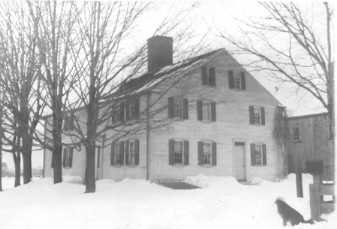
John Hanson’s house at Nock’s Marsh (more commonly known as Knox Marsh) was in an exposed position. Because of the renewed troubles, he was advised by neighbors to move into the more compact area of Cochecho village. Instead, as a “stiff Quaker” upholding the Friends’ witness of good relations with the Natives, he stayed put.

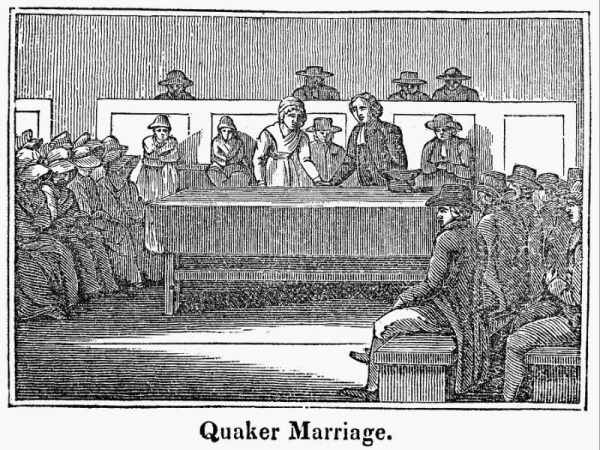
Life looked good to him. On August 9, 1725, his eldest daughter, Hannah, and Israel Hodgdon junior wed in a Quaker service. Four days later, Hanson’s wife gave birth to daughter Mary (also known as Mercy).

Only two weeks after those celebrations, though, 13 Natives, including French Mohawks, lay in wait for several days, looking for an opportunity to attack. On August 27, while Hanson and daughter Hannah attended midweek Quaker worship and his two oldest sons were work at some distance, the Natives swept in and “all naked with their guns and tomahawks” entered the house.

Elizabeth Meader Hanson was at home, along with a servant and three children. Two young sons, playing in the orchard, would have escaped but just as the Indians had finished rifling the house, the boys – Ebenezer, age five, and Caleb, four – came in sight and made such noise that the invaders immediately killed them by bashing out their brains and scalping them – in front of their mother – to stop the alarm. Daughter Sarah entered the house and was also taken. The raiders promptly started for Canada, with their captives in tow – Elizabeth Hanson, who had given birth to daughter Mary just two weeks before, plus seven-year-old son Daniel, daughters Sarah, 16, and Elizabeth, 14, and the servant girl.

The attack and departure came swiftly and quietly. Newly-wed Hannah discovered the carnage on her return from worship.

Was the Hanson house this big at the time? Or was it enlarged over the years, as many others were.

Not knowing the Natives were resolved to strike again, her father stayed briefly with a brother who, though Quaker, had three lusty sons with firearms loaded for big game. Still, John moved back to the farm. When three men came by on September 25, 1725, the raiders hid in the barn before promptly shooting and killing either 37-year-old Benjamin Evans or his likely nephew William. Slightly wounded but profusely bleeding was John Evans, whom the Natives thought was dead. They scalped him, turned him over, pounded him with their guns, and moved on. Making their escape, they took 12- or 13-year-old Benjamin Evans as a captive. He was later ransomed. John Evans, meanwhile, was taken to a nearby garrison where he recovered to live another 50 years. He was the last Dover man to lose his scalp.

The large Evans family was no stranger to Native attacks. Among the victims were patriarch John Evans, chained to Major Waldron’s barn and burned in the 1689 carnage at Cochecho village, and his son John, who died in captivity in 1692.

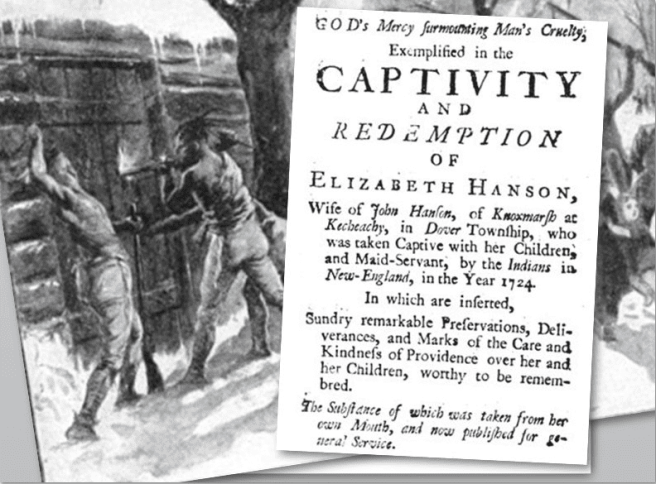
Her recollections were republished over the years.

Elizabeth Hanson’s arduous ordeal, though, turned into five months of captivity, which she later related in detail. The trek to Canada was merciless, leaving the captives wet, cold, bruised, and hungry. At one stretch, they had nothing to eat but tree bark, and Elizabeth feared for her infant as her milk began to dry up. Once in Quebec, all her children except the baby were separated from her, and in one instance, she was informed that her captor was very displeased with her and was planning to murder her the next night.

Funds for the family’s ransom included a large sum collected by Philadelphia Yearly Meeting, and her husband quickly went to Canada to redeem them. The price for Elizabeth and baby Mary was around 700 pounds. He also obtained the release of son Daniel and daughter Elizabeth, but the Natives would not release Sarah on any terms, though they did allow the father and daughter several hours together.

The chief’s wife had plans of having the girl become their son’s bride, even though the name they gave her translated as “the woman of the burning of the cooking.”

Back in Dover, John and Elizabeth had yet another child, Abigail, but he could not be content until rescuing Sarah, too. On April 19, 1727, he set out with a kinsman for Canada but fell ill at Crown Point, New York, on the west bank of Lake Champlain, and died.

The kinsman, Ebenezer Downs, and his wife continued on in hopes of redeeming their own children as well.

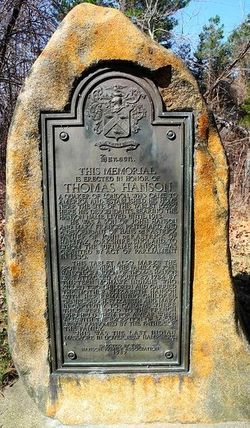
A marker along State Route 155 is all that remains at the site.

In Quebec, Frenchman Jean-Baptise Sabourin had interposed with the Natives and persuaded Sarah to obtain her freedom by marrying him, which she did on June 27, 1727. The record names her as Sara Ennson, daughter of Jean Ennson, deceased, and Elizabeth Midor, English of the village of Touba in the government of Boston.

Apparently, Downs had managed to meet with her and inform her of the death of her father. But she had been baptized at age 17 and renamed Catherine, perhaps as a step in gaining her release from the Natives.

With Jean-Baptiste, she had at least eight children, two of whom married children of Deerfield, Massachusetts, captives, two who died in infancy, and one who became a nun.

On March 24, 1730, her sister Elizabeth married Ebenezer Varney, the son of Ebenezer Varney, whose garrison had survived the 1689 attack on Cochecho village, and Mary Otis, who had been captured and returned.

Two first-person accounts of Elizabeth Hanson’s experience became widely known. The first, God’s Mercy Surmounting Man’s Cruelty, Exemplified in the Captivity and Redemption of Elizabeth Hanson, appeared in 1728 in Philadelphia.

A second, more detailed version was by English Quaker minister Samuel Bownas, who knew the Hansons from his travels to America. It was first published in London in 1760: An Account of the Captivity of Elizabeth Hanson, Now or Late of Kachecky, in New-England: Who, With Four of Her Children and Servant-maid, Was Taken Captive by the Indians, and Carried into Canada. This volume, especially, gives insights into life within a tribal culture. Both narratives lean heavily on a Quaker religious framework.

Kachecky, of course, was another variant of Cochecho, while Touba was a French attempt at Dover.

Widow Hanson, as Bownas repeatedly referred to her, never remarried and died in 1737.

~*~

Check out my new book, Quaking Dover, available in your choice of ebook platforms at Smashwords.com.

Welcome to Dover’s upcoming 400th anniversary.

There’s more to history than the usual names-and-dates scenario

As I’ve admitted, many of the historical persons in my new book, Quaking Dover, really deserve full-length biographical treatment or maybe individual operas or Hollywood blockbuster movies, if only we had time to linger. Four hundred years requires a lot of compression and that meant keep moving ahead. Anyone looking for a writing prompt can dig in with a host of possibilities on the list.

Retired librarian Olga R. Morrill, bless her, rises to the challenge with her historical fiction, Vagabond Quakers: Northern Colonies, published in 2017, focusing on the three women missionaries who came to Dover in 1662 and were whipped out of town in what was essentially a death sentence.

In doing so, she also portrays Richard Waldron and Nicholas Shapleigh as fully fleshed characters, even though they both have much more ahead in their lives after the three troublesome Quakers venture off-stage, the part she follows as the women venture south. (Yes, we need a full bio for each of the guys, please.)

As fiction, Vagabond Quakers resorts to some creative history and plausibility to fill in huge gaps. I see this in Waldron’s chronology, especially – with details where my findings and her tale conflict – but she does induce a compelling drama even in the minor players. She weaves fact and fiction seamlessly and manages a credible dialogue. (What they actually said would sound unintelligible gibberish to our ears.) If only I were sure which parts arise in her invention and which parts rest on solid evidence.

I’m happy to see that she examines Waldron’s life as a major figure in Boston, not just his existence as the most powerful man in New Hampshire, where he’s usually confined in the telling. Dover may have been his private fiefdom, out on the fringe of New England, but he wasn’t exactly provincial. She even manages to stir some sympathy for the man I dub the perfect villain.

She also gives full due to the deep conflicts in the town church before the Quakers arrive. Those are something I’ve long suspected contributed to the willingness of so many residents to join Friends early on. My one quibble is that I think Elder Starbuck would have been in the other party than the one where she places him.

For me, Morrill’s biggest contributions come in her envisioning the proceedings from the women’s perspective – not just the Quakers, but even those in the Waldron household. In the actual dates-and-names history, they’re mostly invisible. Many of Dover’s earliest wives remain ciphers, and even too many of their first and maiden names are missing. As for their language, demeanor, and dress? Morrill has me willingly suspending disbelief in her storytelling. Was one of the Quakers of short stature? Not that I’ve found anywhere. As for singing? Unlikely, but the quirk does pop the individual into three dimensions.

The events she describes in what would seem an out-of-the-way frontier settlement remain an important breakthrough in establishing religious freedom, anywhere.

Morrill and I both find these events to be endlessly fascinating, and hope you will, too.

Let me know of examples of courage you find that match the Quaker women’s.

Ours was a bloody frontier much longer than most Americans know

In 1676, during King Philip’s War, a number of Natives fleeing from the Massachusetts Bay colony militia received shelter among the Pennacook tribe living around Dover. The refugees were part of what’s called a rebellion that began the previous year, the first in a series of armed campaigns between the colonists and the Indigenous peoples in and around Dover and beyond.

The existing accounts, of course, are one-sided, but the devastation afflicted innocent non-combatants on both sides.

~*~

Up to this point, most of the fighting was to the south, though there were fatal attacks in Oyster River, still part of Dover, among others.

Not all of the tribes aligned with the rebellion. The Narragansetts, for one, were neutral, yet more than 600 were killed by the colonists in revenge.

Dover’s Richard Waldron and Maine’s Charles Frost led colonial forces in an incursion on the Mi’kmaq in French-held Acadia – today’s Downeast Maine.

In the midst of this, two events in Dover added fuel to the conflagration. Until now, Dover had largely mutually positive relations with the Natives, Waldron aside.

Waldron was ordered to attack the Natives who had found refuge nearby and turn any combatants over to the Massachusetts militia. He instead invited about 400 Natives to participate in a mock battle against the New Hampshire militia. After the guests had fired their guns, Waldron took them prisoner and sent them to Boston, where the leaders were executed. Others were sold into slavery in “foreign parts,” mostly Barbados.

The usual take on the “mock battle” comes from Waldron’s account and often has most of the captives being returned peacefully. In contrast, the Indigenous version handed down orally has the event being an invitation to a feast. Only twenty of the Natives were armed, and at least 350, mostly women and children, were taken, sold, and never returned. Among the consequences was the fall of the peaceful, Christian Wonalancet as sachem and the rise of the warlike Kankamagus.

Major Richard Waldron masterminded the sham war game that led to the captivity of local Natives who came in peace.

Quakers were no doubt appalled by Waldron’s dishonesty and physical violence as well as the enslavement – New England Friends, including children, had faced being sold into slavery by Puritan authorities at the height of the persecutions. Moreover, Friends cherished good relationships with the Natives.

They were not alone.

“The local Indians were released but never forgave Waldron for the deception, which violated all the rules of honor and hospitality valued by both sides,” as one version, drawing on the colonial record, relates.

Despite its brevity, King Philip’s War is considered the greatest calamity in 17th-century New England and the deadliest war in Colonial American history. Within a year, many of the towns had been destroyed or damaged, and the economy of Plymouth and Rhode Island colonies was all but ruined. Hundreds of Wampanoags and their allies were publicly executed or enslaved, and the Wampanoags were left effectively landless.

For northern New England, it was only the beginning of a series of wars connected to European conflicts that would devastate the frontier until 1763, when New France was surrendered to Britain.


One of the fortified garrison houses built in Dover. Each one was surrounded by a palisade. When the neighbors arrived for the night, things must have been pretty crowded.

Along the Piscataqua, the Natives were patient, waiting 13 years for revenge. As historian Jeremy Belknap related: “Friday the 28th June, 1689, was the fatal day in the morning of which Major Richard Waldron was murdered and the destruction of Cochecho perpatrated by the Indians of Pennycook and Saco. This caused the absence of Mr. Pike for some years.”

Was the town’s minister permanently injured in the attack? Or suffer mental illness as a consequence?

~*~

The Reverend John Pike noted “the eastern Ind joyning with those of Pennicook (thro the Instigation of Hawkins & a Sagamore) suddenly seized on Cochecho, about break of day, wn all things were silent & secure. Killed 23 persons … and carried captive 29.”

This was the beginning of King William’s War, a series of massacres orchestrated by Jean-Vincent d’Abbadie de Saint-Castin and Father Louis-Pierre Thury.

In New England, the conflict originated in the failure of the settlers to adhere to the treaties and agreements made at the end of King Philip’s War, but the renewed outbreak of hostilities was also the North American theater of hostilities originating when King James II, the last of England’s suspected secretly Roman Catholic kings, was deposed and replaced by Protestants William and Mary. Hence, the “William” in what was also known as Father Baudin’s War and Castin’s War. Baudin was a French Sulpician priest who had trained to become a musketeer and later ministered in Acadia. This segment would continue for nine years, ending in 1697.

Waldron had dismissed concerns about renewed hostilities, telling residents to go and plant their pumpkins, and he would take care of the Natives.

Instead, in the attack, the sword-wielding elderly Waldron was cut across his belly with knives, with each warrior saying “I cross out my account.” Five or six dwelling houses were burned, along with the mills. Fifty-two colonists, a full quarter of the entire population, were captured and carried off to Quebec or slain.

One view of the attacks.

The Indigenous account of 80-year-old Waldron’s demise is more detailed. His nose and ears were cut off and stuffed in his mouth, as were his thumbs. To the Natives, he had turned his nose to injustice, refused to hear all sides, and cheated on weights in trade – placing his thumb on the scale. He also avoided trading them useful goods they desired and instead paid them in rum or trinkets.

The garrisons were houses that had been fortified from 1675 and on, set within palisades and designated as places of shelter in the event of attack. At the time of the 1689 attack, there were an estimated fifty such sites within and around the sprawling town.

The most extensive toll came at Richard Otis’s garrison, where the 64-year-old blacksmith, his son Stephen, and daughter Hannah were killed. His third wife, Grizel, three-month-old daughter Margaret, three daughters from his first marriage, Judith, Rose, and Experience, and at least two grandchildren were taken captive. One adult son, Richard Jr., escaped. The garrison was burned.

The Otis family was Quaker.

~*~

Welcome to Dover’s upcoming 400th anniversary.


At last Dover Friends were allowed to organize and build a place of worship

One of the unanswered questions in Colonial history is why the anti-Quaker acts weren’t applied uniformly. Only in bursts, apparently to curb their political influence. In small communities across New England, Friends were important parts of the economy and social life – and often related by marriage to the dominant Puritans.

Still, during the yearly years of Quaker existence, much of the activity continued more or less underground. Friends’ absence from the town church may have been condoned if for no other reason than to avoid their nuisance.

Then, in 1679, the revocation of the Massachusetts Bay colony’s charter reestablished New Hampshire’s independence and also allowed for Friends both there and in New Hampshire to finally formally establish their Meetings.

After decades of worshiping in homes, barns, outdoors, or other places, Friends could finally build their own meetinghouse.

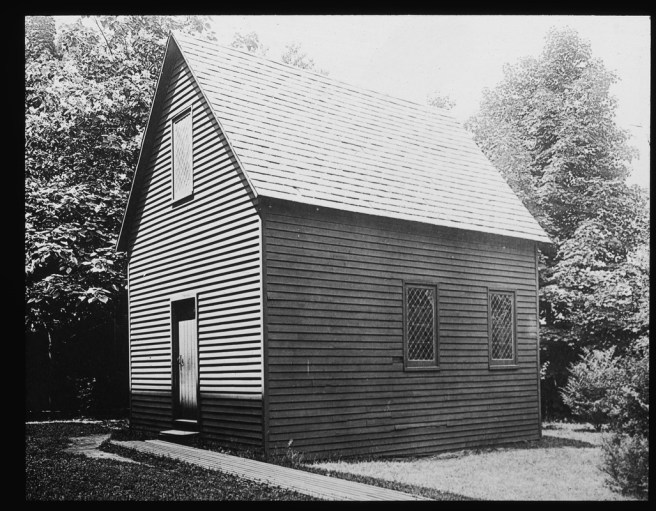
Dover’s first meetinghouse, just south of today’s St. Thomas Aquinas High School, was one of the oldest in the New World. After the erection of the town’s third Quaker meetinghouse, in 1768, the first building was shipped across the Piscataqua to a site a mile away up Sturgeon Creek.

Dover’s first Quaker meetinghouse was to the right of the Pinkham cemetery.

Salem, Massachusetts, claims to have built the oldest, but Dover’s may have been earlier – now, if only some solid documentation existed to support that claim.

Did it resemble the one built about the same time in Salem, Massachusetts? (Photo by Kathleen Wooten)

Around 1680, with the lessening persecution, Dover Friends were able to formally organize into a Monthly Meeting, although they were already the fifth oldest worshiping body in New Hampshire. After years of gathering together wherever they could find, the Quakers erected their first meetinghouse, choosing a site on Dover Neck on a site between today’s Pinkham Cemetery (begun in 1700) and across today’s Dover Point Road from the Roberts farm and First Settlers Cemetery (1633). The structure remained there until Dover Friends erected a third meetinghouse in 1768, and the original was disassembled, ferried across the Piscataqua River, and rebuilt in Eliot – about a mile to the east, not far from the site of the Shapleigh manor where the three Quaker women had earlier found haven. By road, incidentally, the two meetinghouse sites are more than ten miles apart. Although Eliot/Kittery is sometimes honored as the first Quaker meetinghouse in the Maine colony, that designation may belong to Friends at Falmouth, who are believed to have constructed their own in the 1750s.

The Dover Neck Friends meetinghouse was among the first in the American colonies. Between 1672 and 1682, only seven had been constructed in heavily Quaker New Jersey, and perhaps only four in Pennsylvania. Third Haven, on Maryland’s Eastern Shore, was open by 1682 and remains the oldest Friends meetinghouse in continuous use. The oldest confirmed date for a Quaker meetinghouse in New England is 1688 in Salem, and a reconstruction of that building is on the grounds of the Peabody-Essex Museum.

~*~

Check out my new book, Quaking Dover, available in a Nook edition at Barnes & Noble.

Turning the focus on his own mess

When I was revising two earlier novels into what became Pit-a-Pat High Jinks, I did wonder about a parallel volume from the point of view of his lovers. What a cad or sweetheart or lost soul or whatever they saw him as. Yeah, dump it all on.

You know, the self-centered hippie dude, Peace Love & all.

Well, there was a hot volume of erotica, Naked Came the Stranger, where each chapter was secretly written by a different person or party who then hid behind a character who got the author credit and posed for the interviews. The various writers didn’t even see the other material until the book came out, not that it ultimately mattered. She did have every color of eye you could imagine.

On this end, I’d welcome submissions for my own project, if only I had space to tackle it, but time is drizzling out, along with the original impulse.

I mean, the hippie chicks in his life weren’t the only ones screwed up, OK? Let’s be honest. Facing the music could be amusing and healing for all.


How I came up with the tags for the ebook edition

Don’t know about you, but I do find tags very helpful in searching for ebooks.

Well, they’re also very helpful in finding fellow bloggers. In fact, if you’re not using them, let me urge you to do so. I’ll even give some free advice, if you’re interested.

Part of the trick, of course, is in choosing ones that will connect with folks on the other end. When I was setting up Quaking Dover for release through Smashwords, the tags I had intended led to some others I thought would pitch the book far more widely and effectively, and, to my surprise, more accurately.

Here are the ten I went with:

Faith, Families, New England, Strong Women, Colonial, Quaker, Peace Movement, Spiritual Walk, Community Life.

The book’s already charted as Non-Fiction/History/American, so there was no point in duplicating those.

Do any of those appeal to you?

Check out my new book, Quaking Dover, available in your choice of ebook platforms at Smashwords.com.


Nantucket’s Starbucks came from Dover

Although it’s offshore of Cape Cod and close to Rhode Island, Nantucket Island was purchased by investors mostly from the Merrimack River watershed just south of the Piscataqua. Prominently, however, one was from Dover – Edward Starbuck. And his son-in-law, Peter Coffin, was another.

Edward’s the origin of the Starbuck surname in America, a signer of the 1640 Dover Combination, and a prominent figure in Dover’s early history. The name also shows up as Starbird or Starboard.

And, no, these Starbucks weren’t known for their coffee.

Before the arrival of the Quakers, Edward was an elder in First Parish, but historian George Wadleigh cites two curious controversies.

In 1648, “The Grand Jury presented Elder Starbuck for disturbing the peace of the church, and for refusing to join with it in the ordinance of baptism; for which he was admonished and discharged.”

Discharged, we can assume, from the office of elder, and not simply having the charges discharged.

(This was a month before future Quaker Richard Pinkham was ordered to start beating the drum to summon congregants to the Sunday service.)

In 1649, the baptism issue apparently involved the matter of children, perhaps his daughter Shuah, but then spread to his very hairstyle.

“The Court being informed of a great misdemeanor committed by Edward Starbuck of Dover, with profession of Anabaptism, for which he is to be proceeded against at the next Court of Assistants, if evidence can be prepared by that time, and it being very far for witnesses to travel to Boston at that season of the year, appointed Captain Thomas Wiggin and Mr. Edward (George?) Smith to take the testimony of the witnesses for the prosecution of Starbuck, whose offence, apparently, was the wearing of his hair beyond the statute length, ‘after the manner of ruffians and barbarous Indians,’ which had been decreed by the Court to be ‘sinful.'”

Let’s note that Anabaptism here doesn’t mean Mennonite. The term was applied to many who objected to the Puritan orthodoxy.

I suspect that some of Edward’s opposition to infant baptism was stimulated by Hansard Knollys before his hasty departure from the First Parish pastorate. Knollys, after all, then became a founder of the Particular Baptists back in England, and as elder, Edward would have been close to him.

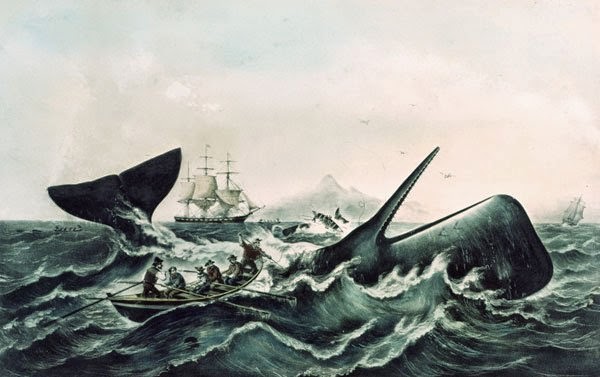
Nantucket Island was soon famed for its whalers, and perhaps notorious as a den of Quakers.

I’m uncertain whether Edward had any connection with Quakers in Dover before he removed with his family to Nantucket around 1660, but his Dover-born son Nathaniel definitely identified as a Friend.

In fact, Nathaniel’s wife, Mary Coffin, was a powerful Quaker minister who’s credited with converting the whole island to adopt the faith or at least make it the official town church. Besides, by doing so they wouldn’t be taxed to support an ordained minister.

Mary’s father, Tristram, was one of the island’s proprietors and originally from Devonshire as well as the progenitor of a line in Dover.

Edward Starbuck, meanwhile, was from Derbyshire.

Further connecting the two families as the marriage of Edward’s daughter Abigail to Dover resident Peter Coffin, also prominent in the settling of Nantucket Island and a cousin of Mary.

Another daughter, Sarah, married Joseph Austin, who showed up in Dover around 1647 as part-owner of a sawmill. He was born about 1616 in Dover, Kent, England, and appeared in Hampton, New Hampshire, in 1642.

They had six children before his death on June 27, 1663. She then married Humphrey Varney. Many of her descendants by each husband were Quaker.

Four of the children moved to Nantucket Island: sons Benjamin and Nathaniel and daughters Mary, who wed Richard Gardner, and Deborah, wife of John Coffin.

Their son Thomas remained in Dover and married Ann Otis, daughter of Richard Otis and Rose Stoughton. Together they had fourteen children who then became the stem of the family that proliferated in Dover Friends Meeting.

~*~

Check out my new book, Quaking Dover, available in your choice of ebook platforms at Smashwords.com.

Welcome to Dover’s upcoming 400th anniversary. Its influence is wider than anyone I’ve found has suspected.


For Quakers, preaching by women was normal  

Puritans had many fears regarding the Quaker outbreak and thus targeted Friends far more severely than any others. Quakers, for all their objections, were in debt to radical Protestantism like the Puritans’ more than they were (and are) willing to admit, yet they also stridently demanded that believers take holy perfectionism to a higher order than the Puritans would or could. More inflammatory, Friends openly criticized and even ridiculed Puritans for falling far short of that goal.

Puritans, in response, viewed Quakers as a chaotic threat to godly and social order and watched suspiciously and intently for signs of witchcraft.

Nothing, apparently, inflamed Puritan authorities more than the Quaker embrace of endorsing both men and women in public ministry.

Quite simply, Friends touched a sore, raw spot in the Puritan worldview. Sometimes, the ones you criticize most harshly who are those most like you. (That’s something that’s been observed in literature, especially.)

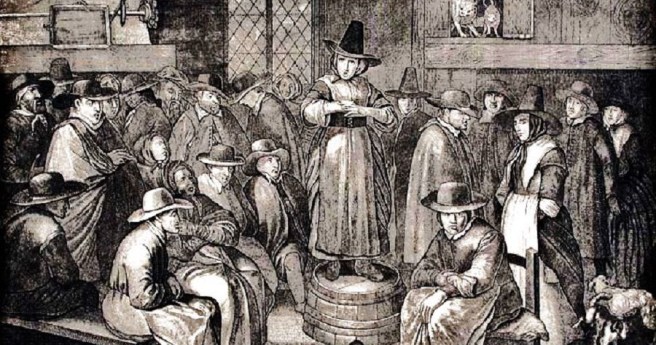
Preaching by Quaker women on the street and other public places was common at the outbreak of the movement.

~*~

WHILE FRIENDS DID NOT ORDAIN or hire individuals to prepare sermons for delivery from a pulpit each week, they did welcome appropriate vocal messages arising in their otherwise silent gatherings in worship. Appropriate were utterances deemed prophetic – explosive mixes of personal perception and Scripture that Quakers felt were being delivered by oracles of the divine – and those who voiced them consistently were endorsed as ministers. Quickly, a unique incantatory style evolved, regardless of the speaker’s background. It did, however, baffle many stuffier types, including the Puritan clergy.

The three Quaker women who were stripped and whipped out of Dover in 1662 were far from alone. Anne Hutchinson had already born its weight in New England earlier. Her adherents had, in fact, nearly toppled the Puritan polity from its position.

Other women Quaker ministers soon returned to Dover, notably the elderly Elizabeth Hooton.

She appears to have been a public preacher among the General Baptists in England, even before she took under her wing a young George Fox, who is generally considered the founder of the Quaker faith. Contrarian that I am, I consider her to the first Quaker, the one who converted you, George.

What she suffered in New England was horrific.

Quite simply, Hooten was a tough old bird. God bless her!

You’ll find a lot more about her in my new book.

~*~

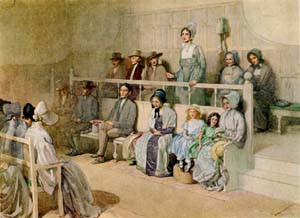
MANY FOLKS THINK OF A QUAKER SERVICE as silent, or what we sometimes call “open worship,” and while many Meetings today have pastors, others – including Dover’s – observe mostly a profound silence occasionally punctuated by a vocal message, song, or prayer.

The practice continued once Friends had settled into more orderly Meetings.

Historically, though, a Friends Meeting often had long, impromptu preaching, often of a half-hour or more. Among the Dover members recorded in that role were Tabitha and Mehitable Jenkins, Valentine Meader, Mary Bunker, John Twombly, Benjamin H. Jones, and Amos Otis.

Dover Friends also welcomed itinerate ministry from visitors, some of whom spent protracted time in town. One was the English Friend Samuel Bownas, who may have “learned silence” here. He’s best known for his book, A Description of the Qualifications Necessary to a Gospel Minister, which sought to curb affectations that had crept into the practice. His guidance still helps.

From their journals, we glean sharp insights into the life of Dover Meeting and nurture of spiritual experience. Even their encounters addressing the wider rough-and-tumble community.

~*~

Check out my new book, Quaking Dover, available in your choice of ebook platforms at Smashwords.com.

Welcome to Dover’s upcoming 400th anniversary. It wasn’t just any old town.

There are good reasons to join in a pre-release purchase of a new book

When a commercial publisher issues a print edition of a new book, the process includes a long buildup. Advertising and press releases go out ahead of a release date, followed by the mailing of advance reader copies for reviewers, retailers, and involved parties to examine. The author might even be signed up and prepped for a book tour of public readings and interviews.

It hasn’t been quite that orderly for ebooks, though things are shifting.

~*~

Check it out at Smashwords and its associated digital ebook retailers.

A pre-release period is one alternative strategy. It gives booklovers an introduction to a coming attraction and an opportunity to be among the first line up for a new work, often at an attractively discounted price.

In effect, this creates two release dates – an advance ordering period followed by a second big occasion when the book itself is finally “published” and available to all. It’s one way for authors to build up a stronger initial sales tally on opening day, tweaking the important algorithms that determine the placement of the work in the digital lineup where it can be more easily seen.

Even a few buyers can make a huge difference, and this approach avoids the uneventful situation of simply dropping the book, ragtag, into the marketplace.

In my case, the big release date is set for September 8 at Smashwords and its affiliated digital bookstores, including the Apple Store, Barnes & Noble’s Nook, Scribd, and Sony’s Kobo. And until then, it’s being offered at half price.

~*~

This option also allows me time to tweak the text, if necessary, and invites you to share in building a buzz. Nothing beats word of mouth, for sure.

Quaking Dover is one work where people have told me they want to read the book when it comes out, and here’s their chance to confirm that.

So buy early and save. Pretty please?