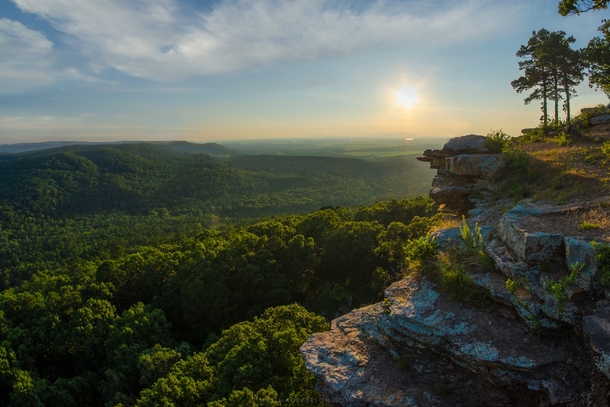
In my novel Nearly Canaan, Joshua and Jaya leave Prairie Depot and settle into a place unlike anything they would have imagined. It’s not where they promised themselves that they’d relocate, but it would have to do. At least it was hilly and wooded.
It’s hillier and more forested than I had expected.
Here are a few of the things they discovered.
~*~
The Ozark Mountains, also known as the Ozarks Plateau, stretches into five states but is situated mostly in southern Missouri and northern Arkansas. It’s the highest land between the Appalachian and Rocky mountains, having some peaks of more than two thousand feet elevation.
Technically, there are two mountain ranges: the Boston Mountains of Arkansas and the St. Francoise Mountains in Missouri, the latter having some of the oldest rocks in the United States.
The majority of the region is forested. Logging is a major industry.
The plateau is laced with underground caverns. Found deep within some of them is the species of Ozark blind cave salamanders, which lives nowhere else in the world.
The shoreline of the Lake of the Ozarks is longer than the coastline of California. The man-made lake covers 61,000 square miles and is a popular vacation site.
The Ozarks has a distinctive culture, architecture, and dialect deriving from its backwoods heritage. Square dances were a popular social activity, as was storytelling.
Historically, the Ozarks were predominantly Baptist or Methodist in faith. Today, the Assemblies of God and Baptist Bible Fellowship International have their world headquarters in the region.
Big-name live musical entertainment has made Branson a major tourist magnet.
Fayetteville, home to the University of Arkansas and with 77,000 population, is the third largest city in the state and is the principal metropolis in the Arkansas part of the Ozarks. It claims to defy many stereotypes about Southerners and could well be the model for Dolomite Center in my novel.
Wal-Mart is headquartered in Bentonville, a short drive from Fayetteville.
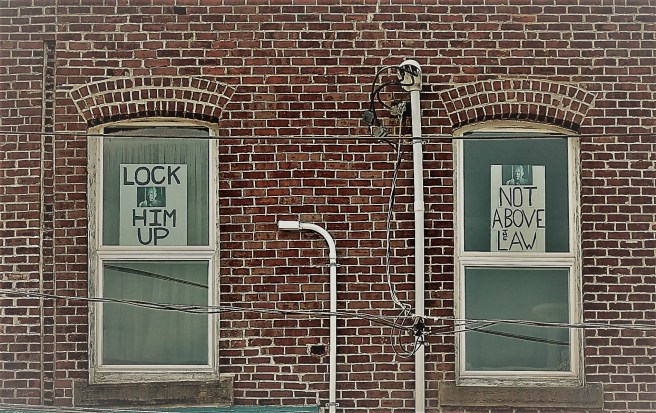
Two signs in a window give one view of the current occupant of the White House. My guess is that they’re in response to a banner flying over a lobster boat in the harbor below.
As the Highway Department’s electronic billboard warned drivers:
RADAR
LASER
AIRCRAFT.
I was expecting such strange things in the air, you simply can’t picture it. How could they possibly build these? Shimmering overhead, maybe flashing, too. Better than UFOs, most likely.
In a whimsical twist in my novel What’s Left, I placed the town along the Ohio River. Well, the navigable waterway is a defining element of southern Indiana.
Length of the Ohio River: 981 miles
Length along Indiana: 240 miles before adding twists. Drains all but the northernmost area of the state.
At its mouth: It is considerably larger than the Mississippi, making it the main hydrological stream of the whole river system.
Number of states feeding into the Ohio River: 15.
Largest tributary: Tennessee River, 652 miles long. Its watershed includes Virginia, North Carolina, Georgia, Mississippi, Alabama, a corner of Louisiana, as well as Tennessee and Kentucky.
Largest northern tributary: Wabash River, 503 miles long. It originates in Ohio and flows across Indiana before becoming part of the border with Illinois.
Average depth of Ohio River: 24 feet.
The biggest city along its way: Pittsburgh, metropolitan population of 3.5 million. The river begins with the confluence of the Allegheny, from upstate New York, and the Monongahela, which drains part of West Virginia and Maryland as well as Pennsylvania, at Point State Park in the Gold Triangle.
Next largest: Cincinnati, metropolitan area population of 2.2 million. Can be seen as the waterway’s hub.
Major hurdle: Louisville, Kentucky, sits at the Falls of the Ohio, which once presented a barrier to river traffic. The McAlpine Locks and Dam stand where the Louisville and Portland Canal was built in 1830 to allow vessels to bypass the falls. It was the first major engineering project on the river and, by some accounts, the first on an American waterway.
When it comes to election results in most of the locales I’ve lived in, I’ve awakened to find myself in the minority. Sometimes, discouraged, I’ve wondered if it’s even made sense to show up to cast my ballot.
On the other hand, believe me, being victorious can feel unbelievably vindicating.
That said, let me argue that casting your vote is not about winning. It’s about taking a stand.
Here are ten reasons you need to do it – especially if you live in the United States today.
It’s witness. The Bible presents a sequence of prophets and faithful individuals who have publicly done what’s right, no matter what. There’s good reason to have a multiparty system and its loyal opposition. Voting is one way of strengthening your own convictions.
It’s protest. In the current political climate, persecuted people and other nations need to know that not all Americans accept the tragic and reckless actions our government has been taking. History needs to know there have always been people of integrity, even when the current turns toward fascism.
You’re a reader. That means you’re better informed than the average Fox channel viewer. At the least, you cancel his vote. (Whew!) Better yet, you one-up him. (Yay!) Go for it.
As an informed voter, you can know who the big PAC money is supporting and cast your ballot against their candidates. Remember, in the end, the PACs want you to pay your taxes for their benefit. Defend yourself.
Some good people are running. Contrary to nihilistic conservative voices, not all candidates are crooks – in fact, that argument begins to sound like a mea culpa. Win or lose, honorable candidates need support in knowing they’ve done the right thing in campaigning. Otherwise, you’ve endorsed corruption and we’ll all pay dearly. You wouldn’t want that, would you?
Officeholders often feel alone when it comes to being true to their own moral values They need individuals to confirm their intuition. You can sway them in the direction events take, even into the next term.
Public policy decisions affect real actions for good or bad. You can back a candidate who’s going to solve problems rather than make more. And please, don’t settle on blank promises like “create new jobs” – ask what it actually means in detail. A job at Walmart won’t put much food on the table or pay the rent, not where I live, and will likely wipe out someone else in the process. Frankly, I’d rather have the someone else. Yada yada. Also listen for what they leave unsaid. Anyone remember hearing anything about taking over the Internet in our last national balloting?
Nurture future leaders. I’m encouraged to see talented fresh faces stepping up to the challenge across the nation. They need a boost. And we need theirs. Confirm their idealistic aspirations.
Screw the bastards. You can vote against incumbents and register your complaint, at the least. Rotten apples are destroying the barrel and need to be purged. This may be our last chance to trash them and wash the container. Don’t lose it. Let the good win out, please. Just look at what the partisan takeover of the Supreme Court is doing to the nation’s workers.
Defend your liberty. In essence, not voting is the same as not having the right to vote. Think about that. It’s time to come to the defense of your essential rights or else lose them. Democracy is being assaulted by reactionary forces.
In my new novel, What’s Left, her mother’s grandparents sail from Patras, Greece, to America in the years just before the First World War. In contrast, her father’s side appears to have farmed the Midwest in the oblivion of forever.
In observance of Independence Day, here are images from the Library of Congress in homage to those immigrants who arrived in that period by way of Ellis Island in New York Harbor.
Greeks board rowboats to a steamer in Patras to begin their voyage to the New World.The faces on these women still say everything.Imagine the anxiety of approaching the registration desk, to learn if it’s yes or no or maybe.The view of the harbor filled with hope and the unknown.Think of all that’s left behind, too.