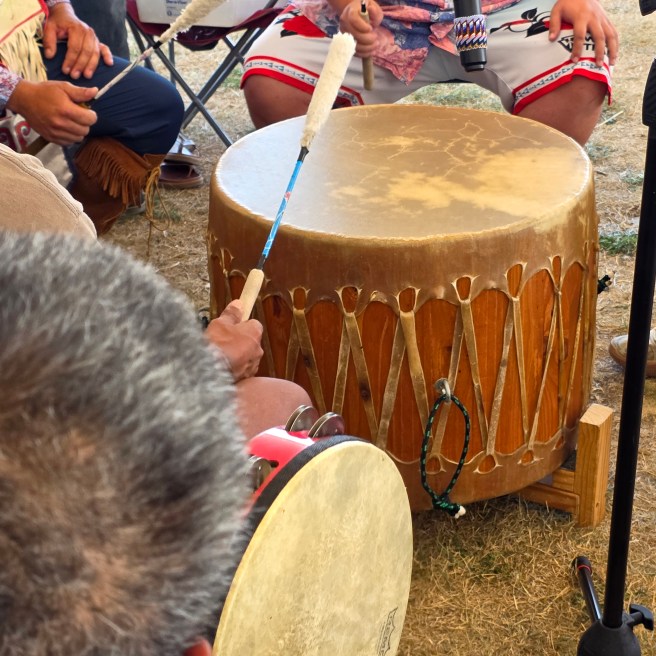
Drumming circle
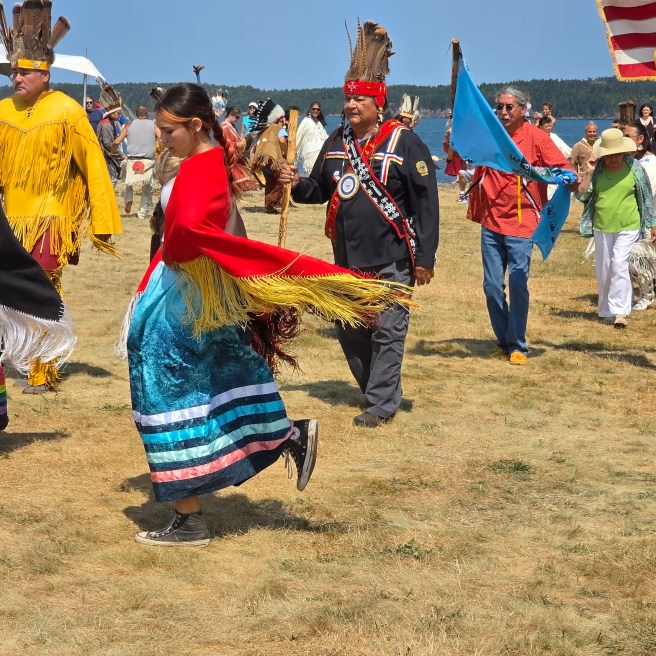
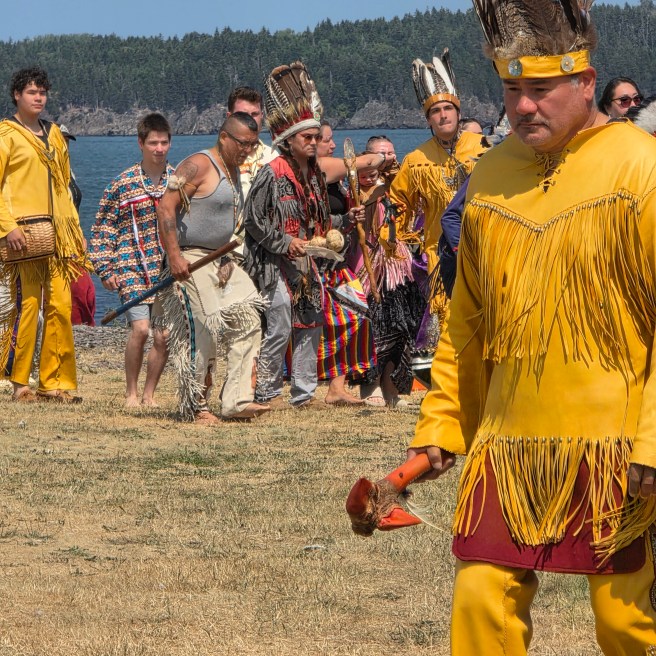
My introduction to Native drum circles came at the annual Tinowit pow-wow on the Yakama reservation in Washington state. That event is much larger than the more relaxed annual Passamaquoddy Days gathering near my home in Maine today, but drum circles are still an important part of the culture and identity. By the way, the Passamaquoddy emphasize that their celebration is NOT a pow-wow. There are some formal distinctions.
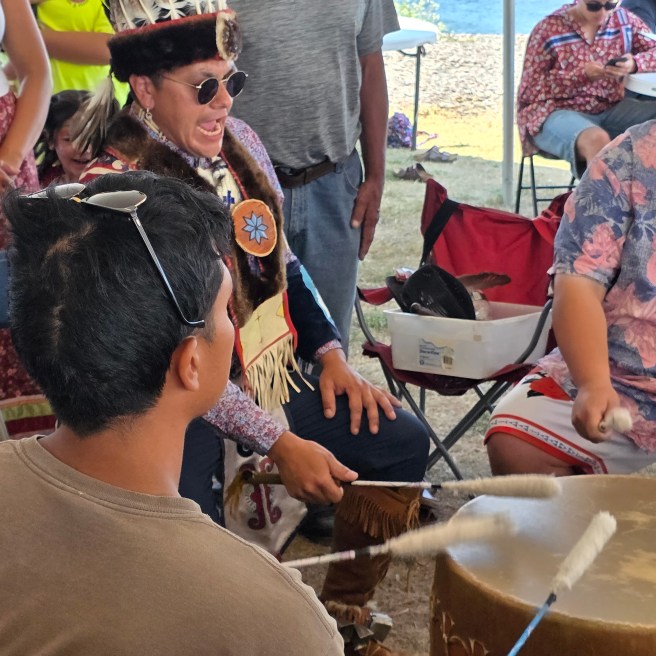
Dance! Dance, then!
Some parts of my life today, here in the easternmost corner of the USA, echo my experiences in the interior Pacific Northwest. Dancing at the Passamaquoddy Days, which tribal members pointedly say is not a powwow, is one of those. At the Yakama reservation’s Tinowit, the event was much larger and more established. Here, it’s more a sense of rediscovery and reconnection, which has its own sense of excitement, especially as the younger members of the community gain familiarity with those roots.
My initial explorations in the Cascades
The primary attraction had been the mountains. We were in the foothills on the eastern flank of the Cascade Range. I was getting out into the wild probably every week from summer to the start of winter. Here are a few excerpts.
Darling Mountain
One of my first exploration, maybe the first, was on a Tuesday I had off work, when I drove up the Middle Fork from Tampico and then logging roads to Darling Mountain crest. Sheep scats and tracks around the snow and awesome meadows. Old site of forest fire lookout, since torn down. Climbed a dead tree to enhance the view. Mount Hood, above clouds. Adams, thrusting into them, closer. Goat Rocks across the way, and St. Helens’ perfect cone beyond. Straight ahead, following the road, Rainier thicker into the clouds somehow superior to the others. Then, a golden eagle sailing straight toward me, turning off perhaps 30 yards away, soaring off, circling briefly, and disappearing. With my guest status, I gave gratitude.
Deep forests were extraordinary.
I had no idea that this was on the second-highest logging road in the state.
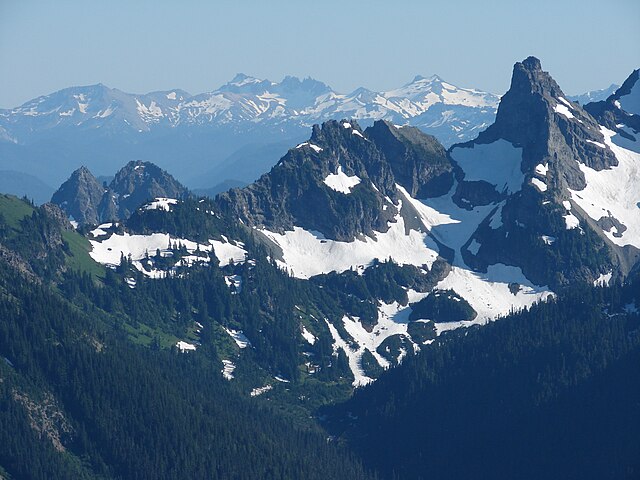
Rainier route
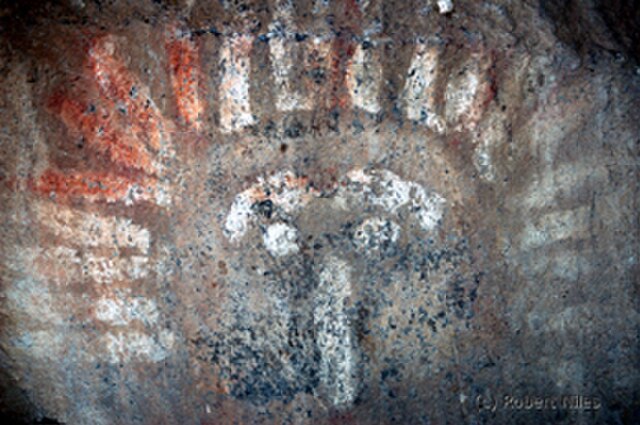
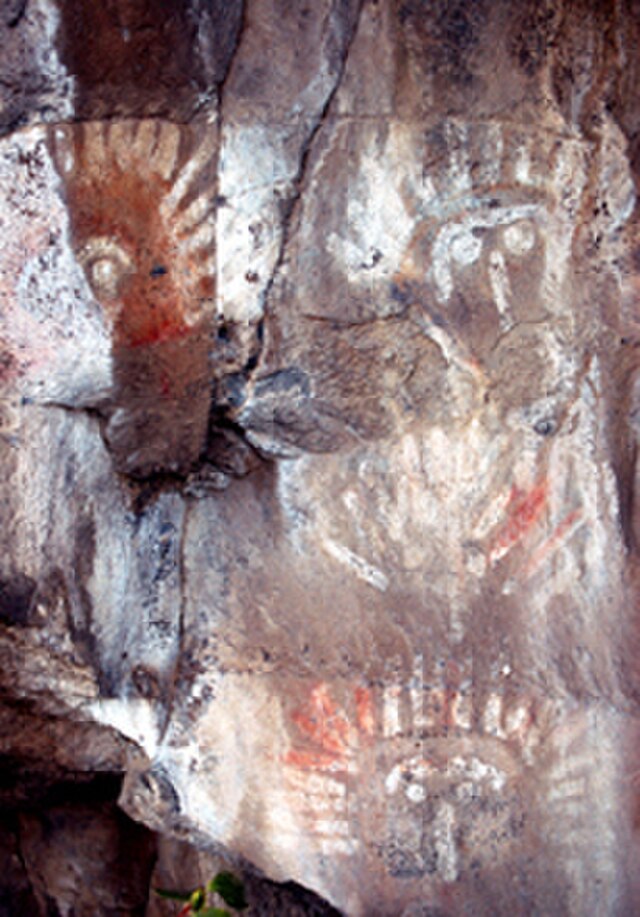
On another trip, on my way to Mount Rainier, saw my first petroglyphs (rock inscriptions) and petrographs (rock paintings) outside of Naches. The paintings looked a little faked — red and white, perhaps with a little blue or red.
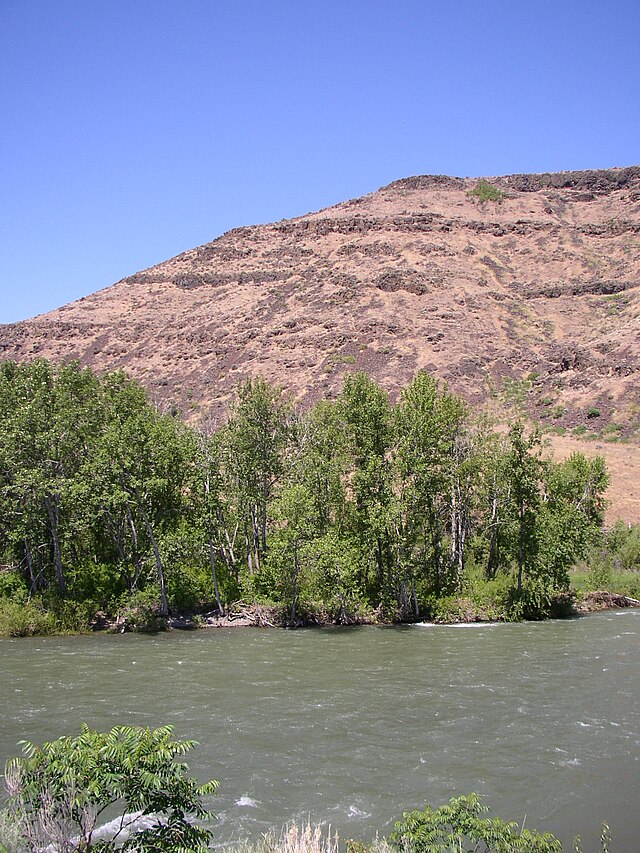
Our routes to Rainier were progressions through ecosystems that became familiar over repeated exposure as we drove from sagebrush desert into ponderosa pines and reservoirs of future irrigation waters on our way to the high country of the Cascade Crest and the rainforests beyond.
Rainier hikes inspired many poems as well as scenes in my novel Nearly Canaan.
Each day trip was intoxicating.
To the south
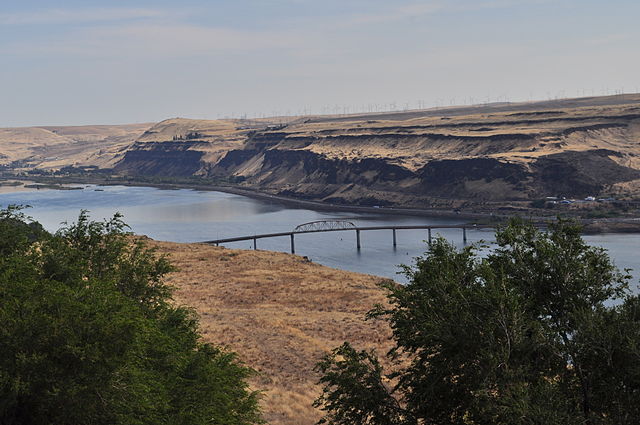
John Day Dam in Columbia River: fish ladder and 80-foot drop of locks: air in stomach, at man’s mass of cement: aluminum company by the RR tracks.
Steam locomotive at Maryhill State Park, reflecting Sam Hill’s source of wealth: Maryhill Museum of Fine Arts, his castle above the palisades, green lawn dropping off into clouds. The sculpture studies by Rodin the claim to fame. During the trip, pondering Mount Adams vs Rainier …
~*~
Along the way
Sweet vinegar smell of hay [up to 5 mowings a year in the interior Far West; the hay was grown in the sunny lands east of the Cascades, and much of it was trucked to dairy farms and other livestock operations on the rainy western side of the mountains].
~*~
From Spiralbound Cascadia with commentary.
Consider your audience
Most poets write of themselves or lovers or at least things around them: poetry as a conversation with yourself. Or maybe God, on a good day.
Getting into a groove, a route, routine, even rootlets
My 2nd tall, kraft-colored Citadel spiralbound opened with “May you be inscribed with a good year,” Rosh Hashanah 5737.
Apart from the office, I faced a host of new discoveries.
- The mountains, especially.
- The canyon from Selah to Ellensburg, with its river road as an alternative to the Interstate beside the U.S. Army’s vast firing range.
- The Lower Valley, below the Union Gap, a vast expanse of orchards and more …
- The Reservation, meaning the Yakama tribe, though much of it was laced with Japanese vegetable gardens …
- The metropolis a four-hour or so drive over the mountains.
- Learning to eat crab.
- Maryhill, a quirky museum overlooking the Columbia River and Mount Hood off to our southwest …
- Portland, further along the lower Columbia …
- Gathering the Quaker Meeting …
- My new colleague Zenny and his wife, Wisteria, living a dozen or so blocks away from us.
- Gasperetti’s … gourmet Italian, when we stretched our budget.
- Mount Adams,, which we viewed prominently, was not Rainier, which was easier to drive to and my primary focus of early high-country hiking …
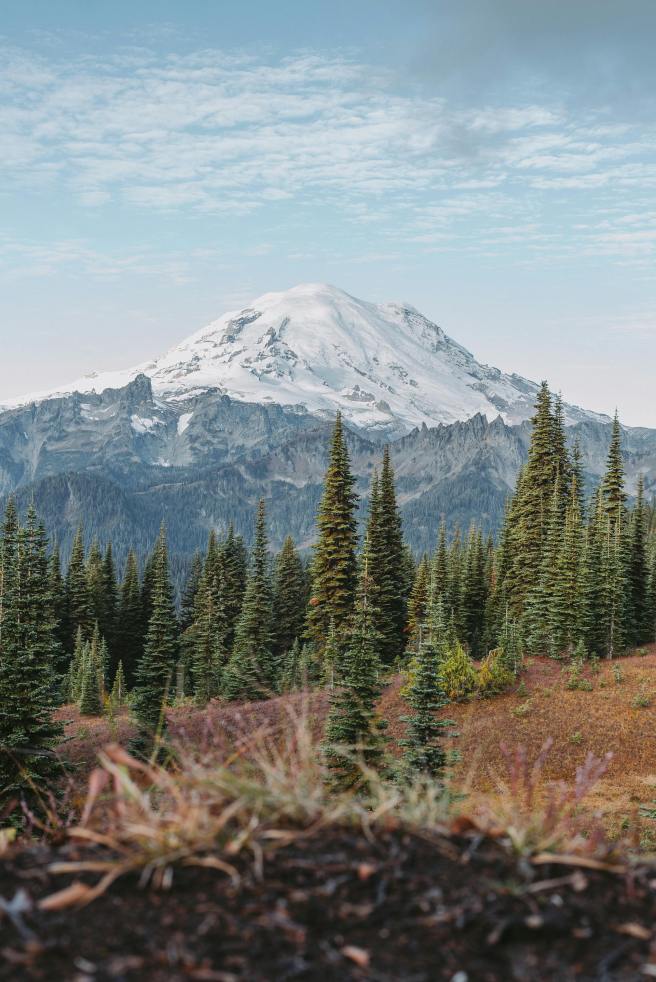
Photo of Mount Adams by Josh Hild at Pexels, as seen from the high country at the fringe of our valley.
Looking back, I see that few in our circle of friends in Yakima were from the place … At the office, a few filled me in …
After my promotion, did my mountains explorations diminish?
~*~
From Spiralbound Cascadia with commentary.
What do you know about jellyfish?
With their many different species, jellyfish are found in every ocean in the world, including very cold waters of the Arctic and Antarctic. Some are even found in freshwater. Some species live in shallow, sunlit waters near the surface, while others live in the deep, dark, cold or somewhere in-between. Here are a few other points.
- They predate dinosaurs, bobbing along in the currents for at least 500 million years and possibly 700 million years, roughly three times the age of the first dinosaurs.
- They aren’t fish. They don’t have a backbone or spine, nor do they have brains, hearts, eyes, scales, gills, or fins. Instead, they swim by opening and closing their “bells.” Many scientists simply group them as “gelatinous zooplankton.”
- A few species have surprisingly complex vision. For instance, the box jellyfish has 24 “eyes,” two of which can see in color. It’s also believed this animal’s complicated array of visual sensors makes it one of the few creatures to have a full 360-degree view of its environment.
- Its lifespan depends on the species in question. Some live for just a few days or weeks, while others can live for several decades or more. One species, called the immortal jellyfish (Turritopsis dohrnii), is capable of reversing its life cycle and returning to a younger stage of development after it reaches sexual maturity. This means that it can essentially live forever as long as it is not killed by predators or other external factors.
- This ability is a major subject of research, as it could help the medical field understand how to turn cancerous cells into noncancerous cells like muscles, nerves, or skin.
- Jellyfish use tentacles to catch their food. These long, thin appendages on the sides and bottom of the jellyfish’s body are covered in tiny stinging cells that contain a venom to stun and capture prey. When they encounter something edible, they use their tentacles to bring it closer to their mouth, located in the center of their body.
- They are carnivores, meaning they eat other animals. Since they’re unable to chew their food, they usually eat small marine animals they can swallow whole, such as
- plankton, small fish, and crustaceans like shrimp and lobsters. They’ll also eat smaller jellyfish.
- The power of their stings can vary widely depending on the species. The most venomous is probably the box jellyfish, capable of killing an adult human in just a few minutes with a single sting. Each box jellyfish reportedly carries enough venom to kill more than 60 humans. To make matters worse, their stings are excruciatingly painful — it’s said the pain could kill you before the venom does.
- Jellyfish are eaten by larger predators, such as tuna, sea turtles, and whales. They’re even a delicacy in some places, such as in Japan and Korea. The Japanese have transformed jellyfish into candy. More often, they find their way into salads, fried into crunchy noodles, or are eaten with soy sauce like sushi.
Living in seeming luxury
We settled into a new three-bedroom duplex with an attached garage, situated at the base of the ridge.
Living in town: the newest and most modern dwelling of my life, even now 50 years later … (of my first decade after college, I’m seeing on aerial photos that the majority have been demolished) … It was about a 30-block walk to the office, something that could be done if needed but still long.
We even had a fireplace, come fall and winter.
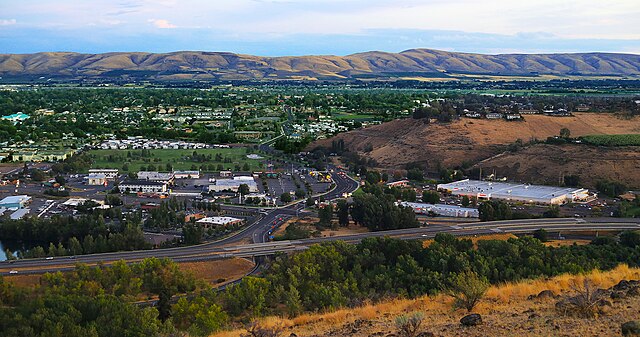
Summertime, though, had us learning the intensity of the desert sun, including the need to close both the blinds and the curtains in windows being struck by direct sunlight. The radiant heat was brutal. That was especially true of our living room in the late afternoon. Many houses had extra blinds on the outside, too.
As I set up my meditation room slash studio, I noted: European/American Eastern poetry reflects a resignation, where Asian/American Western has an acceptance of life / one is essentially sad, the other full of discovery and delight / the curious juxtaposition of East and West here!
While I was reading the Hindu classic Patanjali, the doorbell rang. Thought it might be the mailman, answered it to find an old man carrying Bible tracts denouncing crime, asking if I had watched the presidential debates, handing me his Bible to read two verses — an answer, he said — talking all the while of meekness — but this was no dialogue, no conversation — it didn’t matter if I were here or not, only that there be an audience.
In his demeanor, no meekness, yet my feelings were mixed. Admiration in his determination going door-to-door, but sadness in his lack of holy radiance. His book for a quarter? “Can you speak to the dead?” and “Is Hell really hot?” And then his magazine, the Watchtower.
He kept speaking of the Kingdom. “Kingdom, isn’t that what it’s all about?” Guess he’s never heard of love.
Well, you can speak to the dead but don’t expect an answer.
Rosh Hassahna began that night — a new year of thanksgiving.
We were certainly on the verge of a new year, personally.
~*~
From Spiralbound Cascadia with commentary.
Kinisi 254
JELL-O
CADILLAC
Great spam subject line
“Do you remember what you sent me?”
Who? A 250 area code, British Columbia. Don’t know anyone there,. Still, my curiosity nearly got the better of me.
 Jnana's Red Barn