A RATHER CHECKERED CAREER

For someone who has engaged in a writing life his whole adulthood, I’ve had a rather checkered career as a reader. After a precocious outburst in the classics – Robinson Crusoe, Tom Sawyer and Huckleberry Finn in second- or third- or fourth-grade (not as class assignments, of course – who knows what we were reading there), I found myself largely oblivious to fiction. My attention turned to history and biography (the Landmark series, especially) and then science and politics. Non-fiction, with a sense of content. Fiction came later, in high school, curiously through political fiction – Brave New World, Lord of the Flies, 1984, rather than any of the traditional British canon. Throw a little Shakespeare in, and I was off – into journalism. (Let me mention that Huck Finn was much harder reading in my junior year of high school than it had been when I was younger; as a novice reader, I wasn’t tripped up by the strange spellings of dialect.)

In college, for whatever reason, I developed a passion for Samuel Johnson. Not for his moralizing as much as the sarcasm, I’d say, as well as a fascination with the baroque richness of his style. Maybe it was just the force of personality projecting from the writing. And then came Virginia Woolf, Kurt Vonnegut, Richard Brautigan, Jack Kerouac … the widening stream.

Surprisingly, a major turning point occurred in the span when I had the fewest opportunities to read – my years living in the ashram, a monastic community in the Pocono mountains of Pennsylvania. Out of the practice of meditation and reflection, however, I began to approach literature in a new way. The quietude opened poetry to me, both as a reader and a writer. The experience also introduced me to mythology, with the Hindu stories being more fantastic and meaningful than anything I had encountered in the Greek and Roman stream. Later, I was able to leap from this into the stories of the Bible as well, returning me to my previously unknown roots.

Others have written of being a promiscuous reader. I wouldn’t say I’m addicted to reading that way – at least, not any more. One of the ashram exercises, in fact, was a “reading fast,” meaning written words, rather than food. It’s all a matter of focus. That is, when I’m eating, I want to choose to concentrate on my food rather than a text. When I’m traveling, I want to see where I’m going. (Airport terminals, on the other hand, or stretches before takeoff, are another matter — they are among those place of limbo.) Later, when the newspaper first comes off the press, I found I could no longer focus on the stories – not after a shift of heavy editing. If anything, my head was so full of disjointed stimulation I needed to slow down to savor what I’d already encountered. For that matter, I prefer walking to jogging, with its restoration of a natural pace. I rush too many places and deliver on too many deadlines as it is. When I enter someone’s home for the first time, I must take care to pay attention to them more than the spines on their bookshelves. Now what were you saying?

I read, then, with greater focus these days. More selectively. I can no longer have classical music playing in the background. (It used to provide a barrier for noise from my family or neighbors.) Now, I immerse myself in what is before me. The text, then, as in scripture.

~*~

Out of all of this, my own work emerges. As a writer, I strive to create a linear progression. That is, the parts must advance is some sort of logic. Curiously, in my own work, I am often inspired by a Hegelian model – thesis, antithesis, synthesis – as drawn from cinema theory. On a wider scale, my earlier interests surface in new ways, resulting in something more akin to a matrix or spiral or collage than a straight line. I have been called a Mixmaster, with good reason. On top of it all, in my many moves about the continent, I’ve found myself exploring the soul of each place – something wine aficionados consider, in a smaller range, when they discuss terroir.
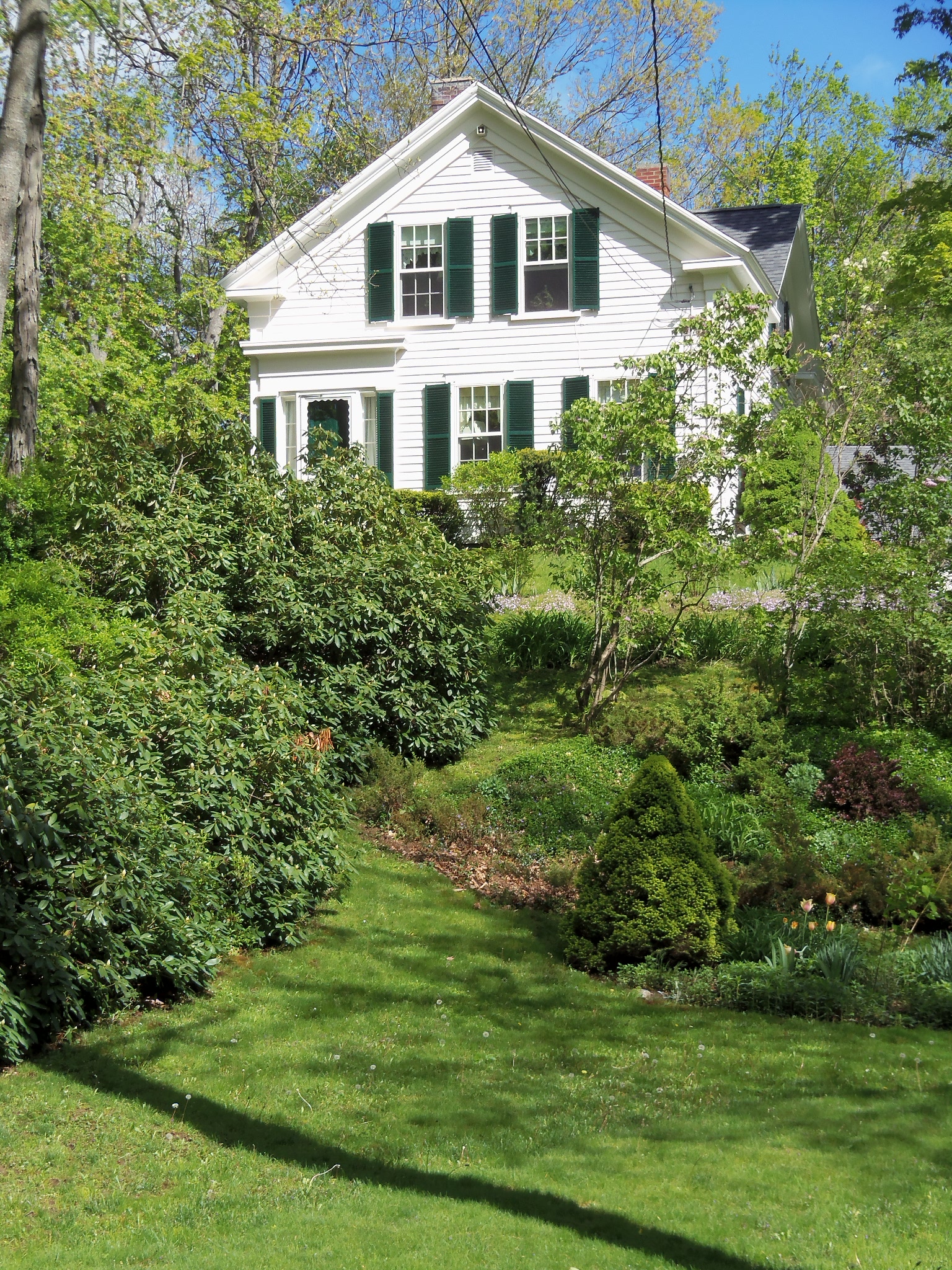
LOOK, WE KNOW WHAT WE MEAN BY A ‘NEW ENGLANDER’ STYLE HOUSE

Around here, if you mention New Englander as a style of house, everybody knows what you mean. Gable end to the street, perhaps a bay window beside the front door, typically two full stories and a usable third floor. Not Greek Revival, except in a stripped-down way with some carpenter gothic touches, and definitely not Colonial Revival. Modest, middle-class – maybe even working class – sometimes even as a duplex.

But try looking it up and the best you can find is an accusation that it’s New Hampshire Realtor BS.

Well, that’s where we live. Ours seems to be from the 1890s.

~*~

My poems on the challenges of renovations, repairs, and relating as a husband are collected as Home Maintenance, a free ebook at Thistle/Flinch editions.

A CASE FOR NURTURING SERIOUS READERS

One of the challenges facing contemporary society is the shrinking percentage of active readers. (I say percentage, but fear what we face is more a shrinkage of actual numbers.) It’s not simply the decline in readers of fiction or the number of people who recite poetry from heart, but the lack of literary engagement of any kind. So I rat on myself early here, with my belief that the act of reading carries social value – especially when serious literature is the subject.

It is no mere coincidence that Americans’ widespread ignorance of history and our political system has accompanied the growing addiction to a sensual media orgy – large-screen television, movies, rock music – while habitual reading, including newspapers, has been declining. That is, what is superficial and easy – and ephemeral — has the upper hand. Little is demanded of the receptor, and loud excitement, rather than a deepened awareness, is the expectation; escapism, rather than engagement with life itself. Several European writers have suggested something more troubling is at work – the loss of reflective people, contemplative individuals – a theme I see developed, obliquely, in Stephen L. Carter’s Integrity and the labor of moral discernment. In other words, is the mind being enlarged or merely numbed? The fact that so many people cannot name their own senators or governors or are largely ignorant of geography, yet recognize countless actors and rockers points toward a disintegration of community and social service.

Paradoxically, the act of reading is largely a private enterprise. It’s a dialogue between a reader and a writer, sometimes separated by continents or centuries. It requires more activity from the receptor than a movie, short song, or television sit-com does – in fact, one of the concerns these days is the atrophied state of the imagination among those who have been raised on “electronic media” rather than the printed word or, for that matter, stories read aloud or in radio broadcasts. (There are, after all, degrees of imaginative challenge.) In the act of reading, there are no visible intermediaries – no actors, soundtrack, directors, sets, or costumes. The editor or printer or bookseller is of an entire order altogether. Here, the reader and the writer engage in a dance of the soul or a passionate argument. (Serious readers can be as demanding as lovers when it comes to this relationship.)

But the act of reading can also take us into the existence of another person, viewing the world from within that context. A movie, in contrast, leaves us looking at that person, hoping for a hint of emotion or profundity. The author can reflect on the situation, suggest ranges of experience, voice moral struggles in ways a movie might only touch in passing.

Here I think, too, of large-scale musical compositions – symphonies or string quartets, for instance – that demand intense listening, inducing reflection and emotional awareness. Like reading, the audience for serious music is in decline – and with it, a link to the riches of the past and its aspirations and wisdom.

BEYOND THOSE GLOSSY ARCHITECTURAL MAGAZINE PHOTO SPREADS

More and more, when I look at a dream house, my reaction turns the other direction. Is that where I’d want to live? Who keeps it clean? How do you get truly comfortable? Make a mess? The kitchen, especially, looks like nobody’s used it for anything more than microwaving a frozen entree.

~*~

My poems on the challenges of renovations, repairs, and relating as a husband are collected as Home Maintenance, a free ebook at Thistle/Flinch editions.

JUST ONE MORE RENOVATION UNDER OUR BELT

These home renovation projects – I hate to call them remodeling, which points in some other direction – have established a pattern. The latest, the bathroom and utility room round, is one more in a sequence that began with saving the barn from collapse and then inserting a mother-in-law apartment 16 years ago, then redoing the kitchen five years later, followed by opening up the barn loft for easier access and three-season use just seven years ago. Looking back on photos taken before each of these always startles me. I could have kept living with that?

Each project begins with a vague sense of definition or direction. OK, I did make drawings for the mother-in-law apartment, and my wife had to order the kitchen cabinetry and plan for what would go where in that undertaking. But other than that, much more has happened – should we say been improvised? – along the way than I’d care to admit. Want to talk about lighting, for instance?

The pattern itself begins with ripping away obstacles. Even the first barn project had drywall to come down, windows and doors to trash, improper wiring to tear out.

That, in turn, leads to an urban archeology stage as we discover clues about earlier residents.

The barn, for example, had been inhabited by what we concluded had been an artsy set – the cable television line remains, no matter how outdated its specs – even though their arrangements were simply not allowed by zoning or building codes. Or so the inspector told us. A horse or a goat, we assume, had chewed away at some of the framing years earlier.

The kitchen, in a one-story el extending from the main house, had been added in 1928, as we concluded from Boston newspapers used as insulation next to the sheathing. As one of my favorite headlines optimistically proclaimed, automobile sales and production would just keep soaring through the coming years. So much for the Great Depression right around the corner. Our mudroom had been a pantry with a door where our stove had been, rather than the entry right around the corner. So the original kitchen had been somewhere in our current dining room or utility room?

Framing we find for former doorways often makes no sense now. Rooms have definitely been shuffled around. A hallway ran through two bedrooms, and then the bathroom was added – a small window there had been a full-size two-over-two. The closet to the front bedroom had apparently been just an opening atop the staircase, which would have let daylight in. Was there a second staircase in the back of the house? And were the stairs to the third floor moved from elsewhere? What we often see is how little had been done “right.”

We reflect on what we’ve heard about the previous owners and speculate on which ones made which decisions – many of which we’ve come to regret. Somewhere in the ’60s or ’70s, according to our calculations, two-inch-diameter holes were bored about a foot apart in a horizontal line along the exterior walls so that foam insulation could be pumped in along the framing. Great idea, except that in the subsequent years, the foam itself has dried out and turned to dust or useless puffballs. In reality, we have no insulation against New England winter. Still, I have to wonder about the asbestos siding, just when it was added – whether it was pried away for the foam project or added at the time.

As more and more debris comes down and goes out the door, the remaining exposed rough, dark wood leaves me feeling hemmed in. The windows grow small in response. It’s all part of the pattern.

In the next stage, though, I find myself staring at the open space. Think of an artist looking at a blank canvas or a writer, well, we used to have blank paper. This, though, is something else. For me, it’s Zen. The open framing, unfinished flooring, freedom from furniture – it’s all potential we will soon fill in. Unlike many who prefer lush surroundings, I love openness. The wiring and, if needed, plumbing need to go in, along with insulation and then drywall. We need to make decisions about lighting and color scheme. Toward the end comes the actual painting.

Add furniture. Then get used to the results.

As I said, it’s a pattern.

~*~

My poems on the challenges of renovations, repairs, and relating as a husband are collected as Home Maintenance, a free ebook at Thistle/Flinch editions.

FRIENDLY GREETINGS

As I said at the time …

I’ve heard there was a time when elders would hand tracts to Friends entering Meeting for Worship. I suppose it was like the ushers in many congregations who distribute bulletins listing the order of hymns and sermon title, as well as announcements. Let me confess I’ve been tempted to randomly distribute some of our weekly mail that way, just to see what pops up.

Tracts and pamphlets do seem quaint in an Internet era, but a lot of Quaker teaching has been passed down in those small pages. Are there new ways of doing this without “spamming” the message? Maybe relying solely on the written word is too limited. Perhaps the actors and visual artists in Friendly circles will step up to the challenge. Audiotape? DVD? Web streaming? Well, the newsletter as a PDF download is one step in that direction.

All the same, in this frenzied season, there’s something comforting in opening next year’s Plain-style calendar – the one from the Tract Association of Friends. And who would have guessed how helpful it is, thanks to the numbered rather than named months, in dealing with the computer protocol at the office? Maybe some things are simply timeless, even when looking toward a Happy New Year at the end of frenzied holiday celebrations. So here we are, turning the page, and in some ways, just starting all over again.

WHEN OUR LIVES OVERLAP

I never intended for my blogging to take the place of personal journaling.

What I’m posting is, after all, far more public, drawing on a deep archive of writing on all fronts now augmented by current happenings in my life and the world around us. What’s emerged is a kind of collage roughly defining the boundaries of my life and thought. I was about to say “normal” life and thought, but not everyone would agree.

Over the past few years, the blog’s also evolved into a showcase for my literary writing, even during a politically overcharged year like the one we’ve just encountered. Remember, I live in the Granite State, which remains a political bellwether as well as the home for many well-known writers. After all the years of having to keep quiet about these concerns, it’s been a relief to be able to air my feelings.

That said, let me admit I’m never quite sure what will turn up here. Maybe that’s why your likes and comments, especially, are so welcome. It’s nice to know when our hopes and dreams and experiences overlap or when there are alternatives to what I’m thinking or even presuming.

Now, back to work …

MAYBE I’VE BEEN LOOKING AT LIFE WRONG

Let’s be honest. We have days like this. Ones where we wish we didn’t have to deal with these a#!/?\*s. You know the ones I mean, even if you live halfway around the globe. They’re one and the same.

But we’re all in this together. No matter what they think.

Now, what can we do together … to solve the real problems we’re all facing?

Well, that’s how it too often feels. But could another take give us a healthier way of dealing?

Suupose, for example, what if we’re all nuts?

Not just the others, the ones all around us who leave us pondering the rampant lunacy. (Not just in politics or the workplace, either. The highways are full of them. As for the checkout line at the store?)

No, what if we who’ve thought ourselves responsible and sane, are really the looniest of all?

Might we enjoy life more if we joined the out-to-lunch club?

~*~

Close to home, I’m seeing how trying to cope with an elderly family member afflicted with advancing dementia can put the caregiver in a tailspin. Somehow there must be a better way to span their alternative outlook and our reality without losing our own balance or course of action. Is it possible to enter their world and still stay grounded?

Just why am I here, anyway? What am I supposed to be doing? Or, as my dad used to ask when looking at his nursing home, “Who’s paying for this hotel? Who’s paying for this dinner?”

From my perspective, he seemed to be trapped in a dream that would rarely allow him to waken. As much as I love good dreams, I anticipate and appreciate the clarity of a wakeful state.

But then I write and read fiction and poetry, and maybe they bridge these awarenesses in alternate worlds. And I meditate, which enters other realms as well, at least as far as most people are concerned.

~*~

So here I am, still trying to make sense of it all. Maybe it’s time to reread some of those old stories about celebrated lunatic Zen monks. Think we’d find a clue there? Loud laughter, after all! Unexpected twists in everyday perception!

Stuck with a similar diagnosis, I’d want to be the one filled with childish delight in the trip. Maybe the one lost in a world of prayer for the world and all within it. Maybe I shouldn’t even wait – start now to look at all my surroundings with such wonder.

I’m open to other perspectives and suggestions. Anyone else on board here?

WHAT CAN YOU DO WITH THE CONSTRUCTION DEBRIS?

We’ve not yet rented one of those green dumpsters that so often accompany a renovation project. To date, at least, that’s been one expense we’ve skipped. Yes, I’ve learned about the recycling center, as it’s called – in the old days, town dump was the term – except that now these things are hauled off somewhere else.

What it does mean is that we have temporary mounds of debris until I can borrow a pickup truck or find some new use for the waste.

With the bathroom and utility room projects, I kept pondering secondary uses for all the tile we ripped from the walls and floors. Any ideas? Can’t see using it as fill if there’s any possibility someone might want to dig there in the future. And yet?

As for the wood, I’d love to just have a big bonfire but know I’d never get a permit from the fire marshal. Alas.

Old piping, wiring, vents, fans, other mechanical parts, insulation, lathe … it all adds up.

The old drywall, at least, will disintegrate in the garden, and it’s a good source of lime to loosen up our clay soil. I’ll be using that stack on the new raised beds we’re planning for flowers.

As I blog about this, please remember I have no intention of speaking as an expert or saying this is how it is done, step by step. Far from it! Instead, these are simply the confessions of someone who’s fallen into the situation of being the owner of an old house – and whose abilities and interests fall far more into literary or theological realms than those of more pressing domestic matters. So much, it turns out, is a matter of muddling through. Or as one expert replied when asked where we were going with one problem: “We’ll know when we get there.”

OK, we did get that overbuilt monolith out from the doorsill we needed to repair and left it on the other side of the driveway. Six months later, I finally buried it – all 500 pounds – in a hole. We’re still thinking of building a gazebo above it. Now there’s one project I think I can handle!

~*~

My poems on the challenges of renovations, repairs, and relating as a husband are collected as Home Maintenance, a free ebook at Thistle/Flinch editions.