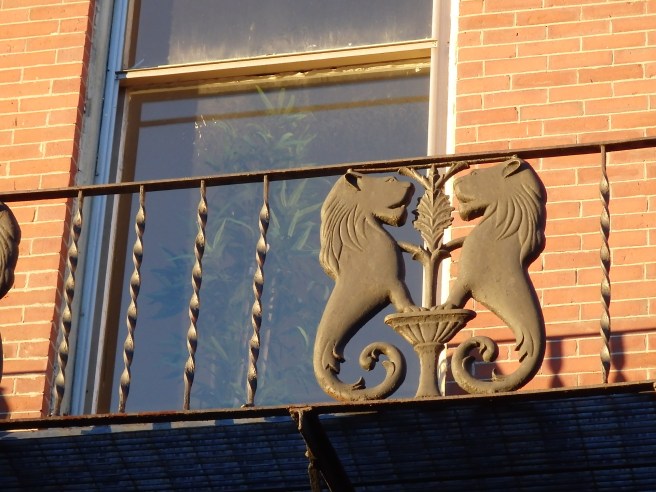
A BACK BAY FLOURISH


In the second-floor railing ...
In the second-floor railing, they strike me as a cross between lions and seahorses.

A distinctive railing adorning a Beacon Hill house somehow fits in with the district’s predominantly federalist style.

Boston is a rich and varied destination – the Hub of New England, or the Universe, as they used to say. Living a little more than an hour to the north, we’re well within its orb.

OH, BOY, WHAT A MESS

from the heart of the building in the night

“I hate your ass!”
countered by
“do I look like somebody who’d put you away”

and then she just screamed

~*~

behind the scenes at the fancy restaurant

a cook got shot
the maitre d’ was in the hospital with food poisoning
and the chief dishwasher overdosed on something

how many knives went missing

~*~

with all the Freudian potential

“Daddy, I LOVE you!”
drawing the twisted
“I want you out of here”

oh, boy, what a mess

To continue, click here.
Copyright 2015

MULTIPLE MAPPING

Knowing how far to go — and when to turn back, to the best effect — are difficult matters. The wise traveler relies on those who have gone there already and returned. You hope they speak truthfully. Often your life will depend on their directions. Even knowing what to pack and what to omit may be based on their counsel. Mountains and rivers are only the beginning.

When there’s too much to remember, a map begins forming. That or a guidebook. But the map presents more possibilities than the book, with its linear narrative confined to one route at a time — even maps with vast portions blank or missing. Take two points on a map and connect them, this way or that. Add a third. And then a fourth.

I never would have arrived in this desert without maps. The airliner’s navigation charts, of course. And then the highway atlas. Many others, as well, become useful. Those that show back roads. Others, topography. Still others, property divisions — including the Indian reservation and Army artillery range, both declared off-limits. Maps of emotions, economies, explorations. Maps of oceans, weather, the heavens.

Disembark and you go to work filling in details and then connecting points like a spider. What’s around that corner? What’s over that ridge? Where will we stay, and what’s the best way to get there? A single map is only an blueprint. The particulars never quite fit. Especially in two dimensions. A breeze lifts the web. Coyote walks through it.

Each one distorts — some far more than others, and rarely by intention. Who made the map in your hands? And to what purpose? Some were mathematicians of few words. Others were empire builders or real estate developers. Some weave the directions into the stories they tell beside the campfire. Some ignore shadows. Fail to repent, ask forgiveness, extend blessing. Others know survival, as well as play, requires definition and decision. Obligates searching within, as well as around, in fullest candor. Some even deceptively point you away from your destination (why should they reveal their secrets?).

Those who were born and raised here know it in a different way from those who have migrated. Magpie will tell you one thing; a Canada goose, another. Same goes for where they’re positioned. Jackrabbit and dragonfly take separate pathways, as does beaver. You simply log where they cross and hope to find meaning.

I had thought maps were the essence of geography. Now the definitions spill over into history, geology, meteorology, political science, psychology, and much more. Because many misunderstandings afflict each life, there are bound to be collisions. Sometimes you move into a thorn that pierces consciousness, but even that rarely brings clarity. You see there’s endless discord among individuals, clans, tribes, nations, denominations — all to be traversed and mapped in the search for ways out and back safely. In this knowledge, jobs, aspirations, faiths, possessions, social standing are merely reflections of fundamental conflicts between human consumption and the good earth itself. No one can dwell anywhere without disturbing the whole; individuals and collectivities distort and contort to their own ends, some more benignly than others. The lines on the page do not hold their place. Without a divinity as a guide knowing these connecting pathways, then, there’s no return to full measure and health. The breath people exhale, fires they build, grains and flesh they devour are diverted to their chosen applications. “Tell us something better,” I implore. “Teach us the highest way.” Where anyone takes it from here is another matter.

Sadly, whether this transformation’s harmonious and renewing, guiding individuals as merciful stewards and co-creators with the divine, or self-centered and destructive as thieves, is rarely considered. Just observe how communities rationalize, arguing that the welfare of their women and children comes first, even as they bankrupt the farm to support worldwide armies or strip timberlands in a rutting for coal and iron.

You could perceive many aspects of this in these orchards within desert. While the choice of irrigating and producing fruit sustains many more humans than the arid range would, also ponder the long-term impact of the poisons applied through each season. Kill harmful insects and molds, but what else? And how soon before it seeps into the groundwater and household wells? It’s all an interplay of good and evil, which I observed through a giant spider web. As a practice within my spiritual discipline, the Dedicated Laborious Quest, I place maps atop other maps and find they are drawn to different scales. Many of the words require translation, which introduces its own misunderstandings. Some of the maps are even of places far from here, landscapes in memory.

Too many details and the sheet becomes a scribble. Maybe that’s why here, at an extremity of the continental United States, I now comprehend the American Midwest of my childhood and early adult years as something other than a uniformly Protestant corn belt. Even overlooking ecological differences between woodlands and prairies, or between the Great Lakes and the Missouri or Ohio river valleys, I reconsider its varied ethnic traditions and the hidden cost of the melting-pot focus. Speaking with other exiles like myself, I become aware of unique distinctions some of our ancestors resolutely upheld, at the cost of their own lives, if necessary. There were strains of Scandinavian Lutherans in the Dakotas, Russian Mennonites in Kansas, and Scottish Presbyterians in Iowa, whose distinct cultures were eroding like the topsoil itself. You would hear, too, why so many had fled. Some, desperately hoping to forget forever their terrors or shame, buried the evidence as best they could. Others, however, defiantly kept it aloft as a reminder of their liberation and a warning.

For more insights from the American Far West and Kokopelli, click here.
A FEW NOTES ABOUT READING MUSIC

On one of her first nights at the helm, our new director asked the choir, “Do you read music? Raise your hand if you do.”

Well, ability to read a score is not one of the requirements for joining and we have no auditions, so it was a fair question.

To my surprise, my hand stayed down. Just what did Megan Henderson mean by “read music”? Hear it in my head, the way a composer, conductor, or professional performer would? Not me!

Immediately identify a note on the staff? Well, I studied violin, but that was in the treble clef and I sing in the bass clef and that causes a delay when I have to translate what I see as G to a the B it really is before I pipe up.

Sight read? Well, sometimes yes. For many of the notes on the page, I know how they feel or fit in my throat and on my tongue.

And then there’s the matter of keeping time. Sometimes I’m a stickler for the beat, but sometimes I miss. Just saying.

It helps being in a good section, surrounded by strong musicians. But then it’s also fun when we sing mixed, surrounded by the other parts instead.

So do I read music? I really should have raised my hand – halfway.

MY CALL

for dancing, I want fiddles or flutes
more than saxophones or electric basses
for the measure

how true when they say accomplished waltz
extends either romance or seduction

moving either toward shelter or some dangerous
fascination, all the same

when we link together in a line or a circle
we will pivot and fly . take me away, then

with equipoise into the periphery

Poem copyright 2016 by Jnana Hodson
To see the full set, click here.

LET’S CAST THE SPOTLIGHT AWAY FROM POOR JOB

Could it be that the Book of Job isn’t so much about the suffering of Job, a man of faith, as it is a critique of conventional religion and religiosity itself?

In my volume Eden Embraced, I approach Job’s plight as if the text were a Hebrew Upanishad, one paralleling a type of classic Hindu writings. Yes, the thread holding the plot together follows one innocent man’s spiritual journey through unspeakable suffering. Blameless as he is – and uncomforting as God’s role is here – Job would have every right to turn in other directions, though he chooses to remain faithful.

The story is endlessly troubling, especially for those who read it from a legalistic perspective. From the outset, God is arrogant, even vain and cruel, rather than compassionate or even all-knowing. And Satan, a member of the sacred council, could be a favored golfing buddy arranging another wager.

The setup can easily lead to contortions as a believer attempts to reconcile other, more conventional, definitions of the Holy One with the action at hand, especially when Job’s buddies begin to weigh in with their platitudes. In many interpretations, Job’s faithfulness is held up as an example to emulate, no matter what. Fat lot of encouragement, right?

As a writer, though, I can see the axiom of trying to address a situation by taking an opposing, uncommon position, which is where I see the story of Job originating. After all, we are faced with the question of just where does evil originate, along with human suffering. Why not blame the Creator?

Is there even a large measure of humor in this? Take the events over the top, asking just what more can happen to poor Job? And that’s where his so-called friends step in, adding misery to his plight and their condemnation rather than comfort.

Would it be nearly as compelling if they did the right thing? If Mother Teresa had showed up instead?

By the way, I delight in the happy ending, which many purists object to as a later revision that doesn’t fit with the general thrust of the plot. Feel free to weigh in as you will.

AIR, AND THEREFORE

imagine
some flying heaven

with sparks
and the fantasized constellations

wind . inspiration . beclouds and clears

memory . learning
philosophy. theology. mathematics
within logic a song or cunning ethics

the conception . over land, over waters
even fire

all the legged and winged creatures
the very words God said

goodness as well as
food for the mind

dreams
wishes
visions

nothingness
and everything that moves in some fashion

positioning sun, moon, stars
the multitudes of birds
yes, singing

the WAY

I breathe, therefore, and am

ANY

light entering a shadow

light chasing a shadow

headlight of a passing car
swirling around the room

*   *   *

come to me anyway

come to me any way

Poem copyright 2016 by Jnana Hodson
To see the full set, click here.

THE MYSTERY OF MOZART

In the annuals of genius, today marks a special observation, the birth of Wolfgang Amadeus Mozart in 1756.

The traditional biography reads something like an extended fairy tale, starting with the child prodigy who charms European royalty in the flowering of the Enlightenment. Yes, there are emotional conflicts with his taskmaster father, who nevertheless deserves much of the credit for those early successes as a performer, improviser, and composer. That doesn’t stop the son who dashes off masterpiece after masterpiece in lively company or en route on stagecoaches rather than in deep solitude with a keyboard. Later tales of poverty and domestic desperation, however, mask his inability to handle money or patrons. You could say he was a tad spoiled but, oh my, unbelievably talented. Besides, it turns out he was the second-highest paid musician in the world, after Franz Joseph Haydn, who lived in conditions offering much less freedom. You could also say that in his prime, nobody wrote with more spontaneity, perfection, or elegance. So much for the standard version.

The fact is that Mozart set a standard that, on its own terms, could not be matched. much less surpassed. In the world of opera, his are among the very best, even without considering how he lifted the genre to new heights. As an opera composer alone, he would have been among the top handful. He essentially created the piano concerto. And the symphonies, alongside Haydn’s, are models of an evolution leading to a final culmination rivaled only by Haydn’s two London series.

I must confess that my deep passion for classical music began in fifth grade, age 10 or 11, with an encounter with the 29th symphony, in A major. Its infectious, joyous outburst, order, and underlying idealism struck a deep chord in my young soul, spurring a hunger for much more, which I found in his work and those of other symphonic and, later, operatic masters.

The prolific legacy Mozart left at his death at age 35 is prodigious, even before we get to the chamber music, choral compositions, or instrumental offerings.

With him, sooner or later, we come face to face with the tragedy of a life cut short, in the fullest blooming of genius – like his fellow Aquarians and composers Schubert and Mendelssohn, especially. The question then turns on the what-if of whether he could have advanced in the artistic challenge of Beethoven and a torn-apart social order to ever greater heights or whether he would have failed to adapt and, thus, withered.

Which leads us to the biggest mystery regarding Mozart. What if he had lived a longer life, say one as long as Beethoven’s? There’s the inevitable comparison, Beethoven. Not Bach, curiously – maybe it’s the matter of those symphonies. Put another way, had Beethoven died at the age of Mozart, his reputation would have been as a second-tier composer, one resting largely on 23 piano sonatas, culminating in the “Appassionata,” plus three classical-style piano concertos and three symphonies – including what would have remained the enigmatic “Eroica,” one that would likely not make much historical sense without the Fifth, Seventh, and Ninth for perspective. There wouldn’t even be his tortured venture into opera. Oh yes, we’d also have the six string quartets, Opus 18, in their homage to Haydn. Had he died at 35, Beethoven would have not been regarded in the same league as Mozart or, for that matter, Bach. I was about to add Brahms and Dvorak, but hesitate since they were so beholden to Beethoven’s challenge and model.

Within the Mozart-Beethoven dichotomy is another deeply intriguing consideration. The conventional interpretation is that Mozart would not have adapted to the artistic and social revolutions ahead, that he had simply gone as far as anyone could in what we call the Classical period and its dimensions or that he would have been baffled and outmoded by the changes to come. More and more, though, what I hear in the last four symphonies and the unfinished requiem suggests something quite different. Mozart was yearning for wider horizons and expressive possibilities. Yes, we have a surfeit of his work as it is, how can we truly desire more when there’s so much already, but what may be lacking is that singular, definitive great gesture along the lines of Beethoven’s Missa Solemnis or late quartets or late piano sonatas or even the Choral Symphony’s final ecstatic outburst or perhaps Bach’s Chaconne from the Second Partita for solo violin.

Alas. Remind me of that when I’m immersed in one of Mozart’s extraordinary opera arias or a slow movement from a piano concerto.

I could recast the consideration, then, into a question of whether Mozart had moved to Prague, which adored him, rather than stay in Vienna, or even on to London, which had so embraced Handel and would later welcome Haydn. Suppose Mozart had lived another decade – or three or four – in fresh, more supportive surroundings? We’re back to genius and its nurture.

In the end, we have what we have, filled with delight and such promise. Let’s see what we choose to play today in that honor.

OLD STATE HOUSE

Dwarfed by contemporary office towers, the Old State House stands in stark witness to the earlier roots of New England’s enterprising prowess.

Built in 1713 — long before the American Revolution and statehood — the Georgian-style structure originally served the General Court of Massachusetts. In New England, General Court and state Legislature are synonymous.

From colony to statehood.

Boston is a rich and varied destination – the Hub of New England, or the Universe, as they used to say. Living a little more than an hour to the north, we’re well within its orb.