In all frankness, it’s the dreariest month. In a flash, the trees are bare. The switch from Daylight Saving Time has many folks going to work before daybreak and coming home after sunset. Still, we can try …
Harvesting root crops.
Chill mornings with fog wisps rising from ponds and rivers.
Election Day. We can always hope for a miracle. A return to sanity, for starters.
Ministry and Counsel retreat – even years in Deerfield, Massachusetts; odd years in Winthrop, Maine.
Days can be warm enough to work outdoors … or go for a hike.
No bugs. Beware of ticks, though.
Neighborhood souper. Everybody brings a pot of their own creation, then eats what everyone else has concocted. It’s outdoors, though, rain or clear.
Tagging a Yule tree.
Thanksgiving dinner. Why mess with tradition?
Community Thanksgiving service. It’s turned into a showcase for local church choirs.
~*~
What do you like about November?
~*~
A sampling of carrots and parsnips from our garden.
“Sister Act,” a profile of the German twins Gisela Getty and Jutta Winkelmann in the May 2018 issue of Vanity Fair, reminds me of another disturbing side of the hippie era. The two celebrity “cosmic flower children” are portrayed as the antithesis of the poor underage runaways-turned-beggars who populated Haight-Ashbury a few years earlier, desperate for a better life than they’d had growing up.
No, these two had access to anything – and anyone – they wanted. They were already the Jet Set, slumming for fun during the day and partying with the rich-and-famous at night. Or the other way around, depending.
The photos made their stylish life look so beautiful. Much more so than the rundown places where most of us were living or the clothing we wore.
Their biggest leap into the spotlight came when Gisela, then 24, became engaged to marry oil-fortune heir J. Paul Getty III, age 17, shortly before he was kidnapped and held for ransom – and had his right ear severed and mailed away as proof during a five-month ordeal. His abduction itself may have been prompted by his own wayward wanderings and musings. They did marry after his release, though it had its problems leading to divorce.
So just what upsets me so in the article by Mark Rozzo?
I think of social activist Saul Alinsky’s revulsion at the yippies and the like, perceiving that their actions actually harmed efforts for political and economic justice.
Over the years since, too few dreamers have stepped up to do the nitty-gritty daily labor toward these ends – a protest march is superficial in contrast to serving on a board or writing to officials or work on campaigns for office.
The article also has me recalling an op-ed piece in the New York Times in the early ’70s that noted six types of hippies – and a huge gap in the middle of the range. In the upper categories were altruistic social reformers, artists and poets, spiritual practitioners – the ones I celebrate. In the lower categories, though, were misfits who had little ambition and few abilities. Ultimately, the two extremes had little in common.
Rozzo’s depicted counterculture is self-indulgent, narcissistic, rife with drugs and promiscuity, and celebrity connections like actor Dennis Hopper and his machine guns. This is the Revolution of Peace & Love? Or its spoiled countercurrent?
What a waste, I mutter. What a waste.
What did they contribute to the common good? What was their vision for a better world? They had so much to begin with, they could have supported so much.
The very tempting beauty they embodied winds up feeling hollow, even venomous.
Pipe dreams, then. There’s so much we lost that still haunts me.
The once grand dame of an apartment house turned shabby that I describe in my novel Daffodil Uprising was real, though situated in Upstate New York rather than southern Indiana. A little bit more poetic license, if you will, in my relocating the blocky building.
I use the past tense, because satellite searches inform me the structure has been demolished, no doubt because of some of the health and safety issues the story relates. Bringing everything up to code would have cost a fortune.
Well, maybe a fire did it in. That, too, feels quite plausible.
When Kenzie and his two buddies flee their dorm, they have such high expectations. So did I, in what was supposed to be a haven after college. Look, this was what a professional journalist could afford – slum housing.
Still, the moldy manse was memorable and possibly haunted. I certainly heard rumors to that effect.
When it comes to election results in most of the locales I’ve lived in, I’ve awakened to find myself in the minority. Sometimes, discouraged, I’ve wondered if it’s even made sense to show up to cast my ballot.
On the other hand, believe me, being victorious can feel unbelievably vindicating.
That said, let me argue that casting your vote is not about winning. It’s about taking a stand.
Here are ten reasons you need to do it – especially if you live in the United States today.
It’s witness. The Bible presents a sequence of prophets and faithful individuals who have publicly done what’s right, no matter what. There’s good reason to have a multiparty system and its loyal opposition. Voting is one way of strengthening your own convictions.
It’s protest. In the current political climate, persecuted people and other nations need to know that not all Americans accept the tragic and reckless actions our government has been taking. History needs to know there have always been people of integrity, even when the current turns toward fascism.
You’re a reader. That means you’re better informed than the average Fox channel viewer. At the least, you cancel his vote. (Whew!) Better yet, you one-up him. (Yay!) Go for it.
As an informed voter, you can know who the big PAC money is supporting and cast your ballot against their candidates. Remember, in the end, the PACs want you to pay your taxes for their benefit. Defend yourself.
Some good people are running. Contrary to nihilistic conservative voices, not all candidates are crooks – in fact, that argument begins to sound like a mea culpa. Win or lose, honorable candidates need support in knowing they’ve done the right thing in campaigning. Otherwise, you’ve endorsed corruption and we’ll all pay dearly. You wouldn’t want that, would you?
Officeholders often feel alone when it comes to being true to their own moral values They need individuals to confirm their intuition. You can sway them in the direction events take, even into the next term.
Public policy decisions affect real actions for good or bad. You can back a candidate who’s going to solve problems rather than make more. And please, don’t settle on blank promises like “create new jobs” – ask what it actually means in detail. A job at Walmart won’t put much food on the table or pay the rent, not where I live, and will likely wipe out someone else in the process. Frankly, I’d rather have the someone else. Yada yada. Also listen for what they leave unsaid. Anyone remember hearing anything about taking over the Internet in our last national balloting?
Nurture future leaders. I’m encouraged to see talented fresh faces stepping up to the challenge across the nation. They need a boost. And we need theirs. Confirm their idealistic aspirations.
Screw the bastards. You can vote against incumbents and register your complaint, at the least. Rotten apples are destroying the barrel and need to be purged. This may be our last chance to trash them and wash the container. Don’t lose it. Let the good win out, please. Just look at what the partisan takeover of the Supreme Court is doing to the nation’s workers.
Defend your liberty. In essence, not voting is the same as not having the right to vote. Think about that. It’s time to come to the defense of your essential rights or else lose them. Democracy is being assaulted by reactionary forces.
How far can a restaurant extend its business base? Its “brand,” as they say. This passage is prompted by meals at restaurants that expanded into new revenues, even though I cut this from the final version of my new novel, What’s Left:
Still, the playful concept feeds into what emerges around the corner as an elegant multi-purpose restaurant, plus a bookstore, art gallery, gift shop, and even a small greenhouse.
And that’s before the bakery or brewery comes into sight. For whatever reason, though, I shied away from launching Carmichael’s own brand of bottled products.
This has me thinking of a couple of specialty food markets on the tourist trail that include a cafe featuring their products. Turns the concept I’m discussing around, in effect.
The identity, of course, is built on something that makes us go gaga. Something that makes us want to return again and again.
What’s someplace that features your favorite comfort food or special treat? Would you wear a T-shirt proclaiming it? What do you think of restaurants that have a gift shop attached? Does it add or detract from the mission?
~*~
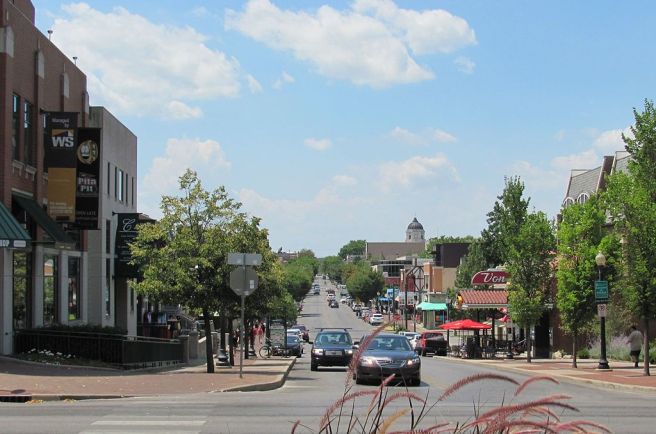
Bloomington, Indiana, by Marelbu via Wikimedia Commons.
I had long been perplexed why my modern American poetry class in the late ’60s had spent so much time on Edwin Arlington Robinson, especially since we never got up to more pressing figures like Kenneth Rexroth, Lawrence Ferlinghetti, Allen Ginsberg, or Gary Snyder.
I made a jab at this plaint in my Daffodil Sunrise novel, where our budding photographer was panicking while typing away on his take on Robinson.
More recently, when reworking that manuscript into Daffodil Uprising, I found myself running with the poet more fully.
For one thing, I had to admit he was more contemporary than I’d allowed back in college. His lines and insights are clean, prescient of new approaches, even snippy.
For another, he could be bitter, sarcastic, depressed – as were many beats and budding hippies.
Edwin Arlington Robinson. I still think he looks like a proto-hippie.
His parents themselves weren’t that far from bohemian, either. His mother couldn’t even come up with a name for him, after all, and that fell to a circle of “summer people” visiting Maine. They put names in a hat or whatever and the slip of paper that came up was Edwin. The woman was from Arlington, Massachusetts. Bingo. We have a middle name.
His eldest brother went from being a successful businessman to bankrupt and alcoholic to die in poverty with tuberculosis.
His other brother, a physician, became addicted to morphine and died of what might have been an intentional overdose.
Living the past 31 years in northern New England, I’m now familiar with the culture Robinson grew up within. Gardiner, Maine, is a few hours up the road from us. I have friends whose roots are there.
Without giving a spoiler, let me say Robinson is now an active figure in the new novel. He infuses some wonderful, if sardonic, perspectives to the younger generation, and becomes a foil for similar spirits from the Edwardian past that sway the photographer’s girlfriend, too.
Would he talk this way, though? Who knows.
By now we’re dealing with fantasy, anyway, and that’s so unlike the concrete details of his verse. Again, we’ll excuse ourselves with poetic license.
Okay, I know churches don’t have podiums for their music directors, but Rick Gremlitz at First Parish Church (UCC) in our town does conduct with a short white baton. What’s amazing is that he’s been doing this, in that venue, for a half century.
Among other things, the house of worship – serving the oldest congregation in the state – has its Belknap concert series where world-renowned organists perform on a remarkable hybrid organ. Parts of it are historic, as it Hastings and Hutchins, and part are state-of-the-art electronics, probably installed during Rick’s tenure. Any doubts in my mind about the sound itself vanished when bete-noir Cameron Carpenter did one unforgettable, amazing workout on the machine one afternoon a few years ago. It survived. The audience was left in a swoon.
Look, I’m a purist and lean toward the E. Power Biggs line of thinking that contrasts sharply with the Virgil Fox excesses that Rick adores. He addresses the man as the great Virgil Fox. I forgive him. We all have our icons.
So be it.
In his ministry, Rick’s led a number of Handel Messiah performances in the sanctuary. Last year it became an open sing with prepared soloists and two guest conductors. Seated between two seasoned voices, I discovered that the choruses are easier than they sound, not that I was anywhere near perfect. It was a most exhilarating event.
Today, though, Rick’s acclaimed friend Hector Olivera returns to the console, with a twist.
An ecumenical community choir, including yours truly, has been rehearsing to join in the performance.
We’ll be performing the world premiere of an anthem composed by Kevin Siegfried for the occasion, and we’ve been rehearsing weekly since mid-September at the Methodist church. How can you possibly keep something like this a surprise?
We’ll see. It’s still a special occasion. And, I might add, one of the joys of living in a relatively small community.
I’m hoping it comes off well. Especially if I don’t miss a cue while we’re singing.
When my first novel was published, back in 1990, I was described as “a mixmaster of ideas, images, jokes, philosophy, and nonsense that defies categorization” – as well as “very eclectic and ebullient.”
I’m realizing how much that still fits, and so I’m returning to it as a core of what some might call branding.
As one longtime friend recently described me, I’m “an eclectic human being with a funky sense of humor and a large perspective.”
That’s what I like to do as a writer and thinker – toss a wide range of colorful things together and concoct fresh and exciting connections.
So if that’s what I do and, as I hope, do well, that leads to a new label: Mixmaster Supreme.
Now, where are the frozen strawberries?
Remember, the drink is shaken, not stirred. As for the emotions? Let’s go for both.




 Jnana's Red Barn