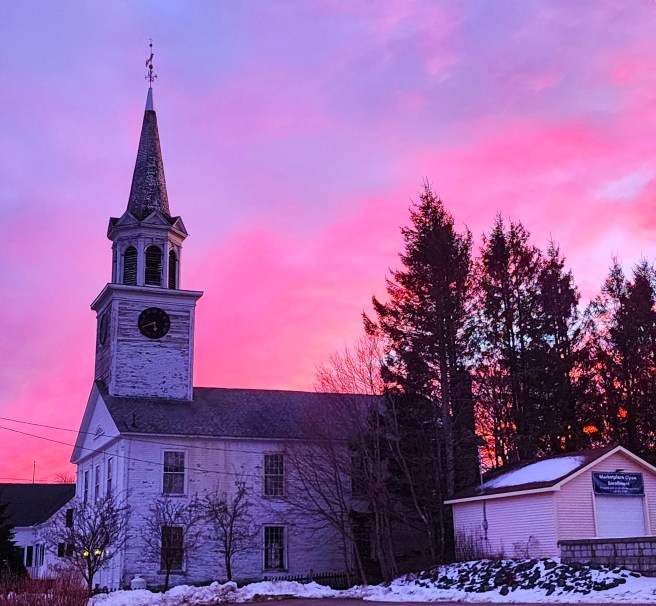
The historic Seaman’s Church on Middle Street has weathered many changes since it was built in 1828. Somehow this image seems fitting as we wind down another year.
You never know what we'll churn up in cleaning a stall
The historic Seaman’s Church on Middle Street has weathered many changes since it was built in 1828. Somehow this image seems fitting as we wind down another year.
Just consider:
There’s more, should you be interested. Like Ethiopia on September 11, with its 13-month calendar descending from the Egyptians.
Let’s leave it at that, for now. Instead, you may want to chill the bubbly.
Veuve
Costco
…
Poppa da
bubbly!
While I had once considered architecture as a career, I’m surprised how little I know about what makes a home work or, through the eyes of my coconspirators in this venture, how much a few imaginative strokes can transform an existing structure. Not all of them are budget-busters for folks in the lower half of the income bell curve, either.
It’s a long way from my ingrained tastes shaped by the clean 20th century lines of the Bauhaus school of design as well as my admired Shaker and Zen aesthetics. Historic New England home styles have come as a more recent appreciation along the lines of an “This Old House” public television series dimension. Still, after owning a traditional New Englander described in many of the earlier blog posts here, I had jokingly promised myself that the next house would be concrete, glass, and steel – nothing that would rot or need maintenance. At least, with the move to Eastport, it wasn’t in the pine box I had once jokingly expected at the end of my Dover sojourn.
At least I’m no longer left with a state of anxiety each time a nor’easter barrels our way. Despite all the asphalt shingles on the sidewalks and streets I had found after each of those, fortunately most of ours stayed in place. As we’ve since discovered, the biggest wonder was that our roof itself had withstood so much for so long in its condition.
But I’ve also been haunted by an “This Old House” series that followed a renovation of a Nantucket Island home, if I recall right, and the way it overran budget and led to its sale shortly afterward.
You would have thought we would have had our plan down pat long before the renovations began. Maybe it was a good thing we didn’t.
I mean, with three years of looking for a contractor, there was lots of time for planning. Except that we kept it in the nebulous dream stage rather than some hard decisions.
And then, once we found one, we had hoped to have the entire roof component buttoned up before last winter but had to settle on getting the back half done first and then tackling the front come springtime, as you’ve seen in these weekly posts. So here we are, more than a year later.
We’ve made some mistakes, of course. We spent money on CAD specifications in a design done through a local lumberyard only to find out what our contractor needed wasn’t what we thought he was looking for. Looking back, I’m not sure they could have delivered, considering what we were really facing and then revised as we went..
And the wood stove’s metal chimney didn’t have to go up next to the brick chimney, meaning that it had more bending than was necessary. Oops. At least it draws the smoke well.
On the other hand, much of the rest has been pretty straight-forward.
We even know that it will never, ever, really be finished.
Sometimes my own writing goes beyond anything I can explain. For instance:
Meanwhile, over the years:
Remember, you can find my works in the digital platform of your choice at Smashwords, the Apple Store, Barnes & Noble’s Nook, Scribd, Sony’s Kobo, and other fine ebook retailers. You can also ask your public library to obtain them.
Our custom is to bring the tree indoors on Christmas Eve and decorate it then. Sometimes we’ve even waited till that very morning to head out to the tree farm to harvest the one we had tagged earlier. But that was back in New Hampshire.
Here in Real Downeast Maine, we instead initially gleaned our Yule tree in the neighboring forests, sometimes even along country roads under utility lines, first in tabletop sizes and then full-size. The vegan member of our circle, however, complained that they weren’t full enough. She wanted something more classically ideal. Definitely nothing Charlie Brown.
Well, the natural – organic – ones do tend to grow mostly on one side, nestled in with others, unless you fell a taller evergreen and lop off the top five or six feet. Not that such an argument went anywhere. Even so, the rest of us were perfectly delighted with what we put up and strung lights on and all the rest.

Against that background, we finally relented and were then astonished at one nearby family tree farm that goes along for perhaps a half-mile in clearings along an unpaved lane into the bigger forest. There are probably enough trees for every child, woman, and man in the county, and the prices are ridiculously low in comparison to what you just paid, wherever.
The kids in the family will even come around with electric chainsaws to cut it down for you. What more could you ask? Well, maybe that netting before we jam it into the hatch of our car?
What you see here is us claiming one to be ours, that is “tagging” it with ribbon and an identifying label, ahead of time. We trust that nobody else will ignore those markers. (It’s happened to us only once, back in more populous Dover. We still found a fine replacement. Maybe better?)
My, those needles y do smell good, outdoors and in.
Here’s wishing you and yours and happy and memorable togetherness.
Technically, most of this is actually Advent. The real 12 Days of Christmas are another matter, something I’ve thoroughly come to appreciate.
The French learned some harsh lessons in their attempt to establish their first North American settlement on a small island perhaps ten miles north of where I know live.
“It was difficult to know this country without having wintered there; for on arriving in summer everything is very pleasant on account of the woods, the beautiful landscapes, and the fine fishing for the many kinds of fish we found there,” Samuel Champlain wrote. “There are six months of winter in that country.”
I’ve previously contended that New England has a five- or six-month winter, so that passage offers me some confirmation.
As that winter dragged on, however, more than half of the men and boys developed what Champlain called a “mal de la terre,” or “land sickness” – scurvy, a disease caused by Vitamin C deficiency. It was common among sailors stuck on ships for months at a time, and many captains knew to keep citrus fruits on board, or beverages made from evergreen tree needles. During the European Age of Sail between 1500 and 1800, it was assumed that half of all crews would die of scurvy.
It wasn’t pretty.
“Their teeth barely held in place, and could be removed with the fingers without causing pain,” Champlain wrote of the horrific suffering the settlers endured over the winter of 1604-1605. “This excess flesh was often cut away, which caused them to bleed extensively from the mouth.”
Eat your apples and oranges and grapefruit, then, as well as lemons and limes.
Stone
Bone
Cone
 Jnana's Red Barn