Urban deer, oh dear

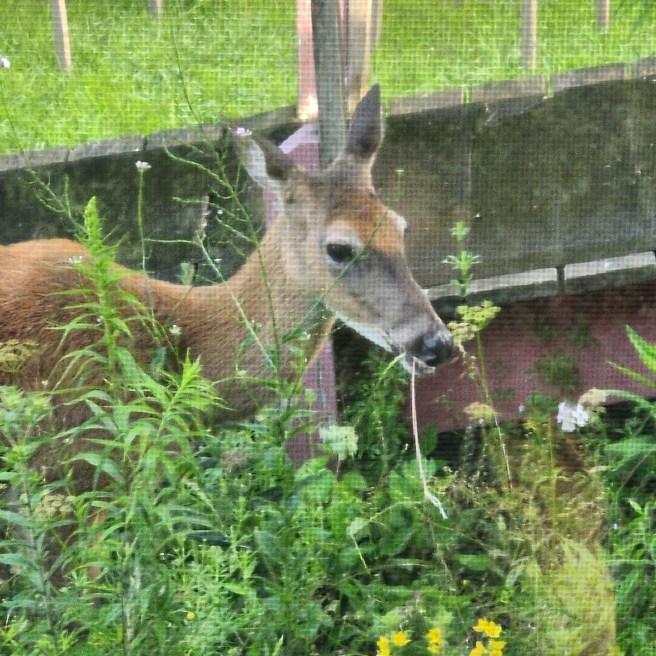
Eastport – centered on Moose Island – is one of many small cities being overrun by deer. You may have met some of the culprits here at the Red Barn.

Here are some random bits as a result.

  1. In the Wampanoag language, they’re known as “the ones with wet noses,” for the way they investigate the world around them.
  2. Why do fawns have white spots? I suspect it could be a good opportunity for a storyteller to develop. Along with the question of why fawns eventually lose them.
  3. They like apples. Man, do they. Some will dance on their hind legs in reaching for the branch overhead.
  4. They can destroy a garden overnight.
  5. That said, they’ll eat just about anything. One even swallowed a spigot on our bird feeder.
  6. Speaking of which, a bit of cayenne pepper in the feeder seems to repel them. As the adage goes, better late than never, regarding some lessons.
  7. They’ll eat out of your hand if you’re patient. Not that I advise that.
  8. Bucks get bumped out of the circle as they come of age.
  9. The most we’ve counted in our small yard at one time was ten.
  10. We’ve had an albino in the north end of town. I first thought it was a goat in the night.
Here’s a shot from our dining table. Or hers, as well.

Much of what our commercial fishermen catch isn’t ‘fish’

Eastport’s fleet doesn’t use nets to fish. Rather, they use dragging gear or baited traps, mostly.

Technically, the bulk of what they catch isn’t fish, which are vertebrates, have gills, and lack limbs with digits. Fish fall into the scientific superclass of Osteichthyes, as noted in a previous Tendrils.

Shellfish, meanwhile, are invertebrates, have external skeletons, and are classified as molluscs, crustaceans, and echinoderms. See a more recent Tendrils.

So today, let’s look at what the local commercial fishermen catch. Or, in some cases, used to.

  1. Lobsters. The mainstay.
  2. Scallops. Some of the world’s best, in our humble opinion. The haul, though, is tightly regulated.
  3. Clams. While many of these are raked on sand or mud flats at low tide, others are dredged by boats at sea. They add up to the state’s third most valuable fishery.
  4. Urchins. A specialty niche making a comeback. Japanese foodies love them, but the market’s tricky.
  5. Crabs. See a previous Tendrils.
  6. Alewives, herring, and mackerel. Often caught for use as lobster bait.
  7. Shrimp. Well, not anymore, but we can keep hoping the stock will rebound.
  8. Mussels. There are some interesting attempts to establish farmed beds around here. Now that would be lovely.
  9. Cold. I’m talking about the crusty fishermen. They do bundle up in the depth of winter, though, and rarely complain.
  10. The sunrise. They head out early, all seasons of the year. Some of the views they catch are unbelievable.

Let’s not overlook salmon, a major product here, which are farmed in pens and harvested directly by special boats using tubes that work something like a giant vacuum hose. Not kidding.

This is a clue to what really occupies my mind some days

Ten random notes in no particular order:

  1. I’m still learning to spell Katahdin.
  2. Was it a mama moose I hit that cold night on my commute back from the office, rather than a deer? Now that I’m getting to know deer, I think the collision involved something bigger.
  3. Red states? They’re where nobody really wants to live. Or at least the paying jobs.
  4. How dark the house is at night in an electrical power outage! There’s no ambient light from the street lamps or apparatus power-on buttons.
  5. Glyphs = little typographic devices.
  6. I dreamed I was playing violin again. In an orchestra, no less.
  7. How deeply backpacking as a youth shaped my values (forget efficient as a factor). It’s that travel light thing.
  8. After living in New Hampshire, I’m still not used to a sales tax.
  9. English country dance lyric, “If love were an ocean / and water was gin / I’d walk a long plank / and throw myself in.” It’s not from “Robin, Mad Robin,” is it?
  10. A voicemail message for today: “Let me a message or text me. I’ll get back.”


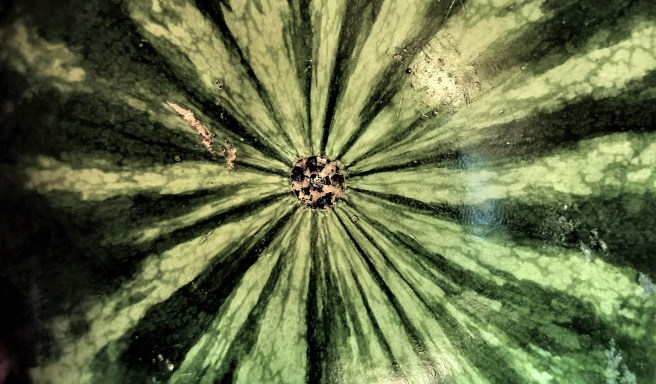
Does anything celebrate summer more than a watermelon?

And here I was about to investigate all kinds of melons, starting with cantaloupe.

That said, just consider:

  1. A watermelon is one of the few foods to be classified as both a fruit and a vegetable. Wish I could count it twice on my daily dietary requirements but guess that would be cheating.
  2. It’s a relative of both pumpkins and cucumbers.
  3. It’s far and away the most popular melon in America.
  4. There are more than 1,200 varieties, but the seedless hybrids are the only ones you’ll likely find nowadays at the market, at least in the USA.
  5. Those seedless versions aren’t genetically modified. Technically, they’re simply sterile with white seeds that are perfectly safe to eat.
  6. Watermelons originate in Africa and have been cultivated in Egypt for 5,000 years. That’s why they really do need a long stretch of summer.
  7. Based on weight, watermelon is the most consumed fruit in America.
  8. It’s 92 percent water yet rich in vitamins and contains only six percent sugar. By the way, there’s no bad fat or cholesterol.
  9. Its flesh isn’t always red – orange, green, yellow, or white are other options.
  10. In Japan they’re grown in glass boxes to maintain the unnatural cubed shape.


I’m sold on Maine’s crab

Ours are smaller than the glorious Dungeness of the Pacific Northwest or Chesapeake Bay’s popular Blue delicacy, named for the color of their tips.

But that’s not to say Maine doesn’t have crabmeat that’s as sweet. Ours comes from two species.

Here’s some perspective.

  1. Jonah crabs are the slightly larger and more celebrated of the two. They’re reddish with large, black-tipped claws, and found primarily in deep waters offshore.
  2. The meat comes from the claws. When Jonahs show up in a lobster trap, a fisherman typically removes one claw and throws the rest of the crab back. The crab, we’re told, can survive on one claw while the other grows back.
  3. Jonahs are regulated by an interstate commission that places a 4.75-inch minimum size on keepers and prohibits the retention of egg-bearing females.
  4. Atlantic rock crab, or “peekytoes,” live in bays and tidal rivers closer to shore. These measure just five inches across and are the most commercially caught crab in the state.
  5. Peekytoes cannot be shipped live, presumably because they’re too delicate. Instead, they’re cooked and hand-picked before shipment.
  6. Both commercial and recreational crabbers require a license from the state and must observe strict limits on their take. At least, those specifically going after them. See the lobstermen, above, for a clue to exemptions.
  7. Locals in the know say that picking the meat from a crab is a nearly lost art. They admit they can’t avoid getting hard bits of shell in the tender flesh, no matter how carefully they try. Instead, as they advise, go to Betty’s in Pembroke or Earle’s down in Machias for your supply.
  8. Favorite dishes around here are crab rolls, crab salad, and crabcakes. Our house also celebrates a heavenly crab imperial. Others make them into a dip or spread. And, in some circles, Jonah crab claws make an appetizer served like a shrimp cocktail.
  9. They can be harvested year-‘round, though fall, when crabs are most packed with meat, is the peak season.
  10. Smaller, invasive, nasty green crabs have been proliferating as Maine waters warm, decimating other marine species and their breeding grounds. Some enterprising chefs, though, see tasty opportunity in some dishes to counter that.

Me? I haven’t yet had to complain of having too much. Now, please pass the Old Bay.

Now, for our big whirlpool

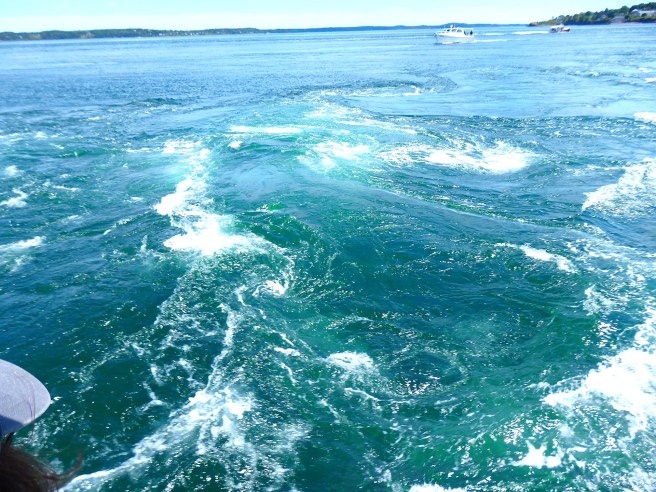
One of Eastport’s travel attractions is the “Old Sow,” the world’s second biggest whirlpool or the biggest one in the Western Hemisphere.

~*~

Before you make reservations to come see it, let me point out a few things.

  1. Its intensity varies greatly, depending on the gravitational tides cycle. It’s best about three hours before high tide, especially around the new and full moons when 40 billion cubic feet of water flood through the half-mile-wide passage to Passamaquoddy Bay.
  2. Its swirling diameter can reach 250 feet or drop 12 feet into its vortex, but it’s also likely to appear as a series of boiling countercurrent piglets and eddies.
  3. Most of the time, it’s not particularly visible from land. It is, however, a regular feature on Butch Harris’ whale watch runs. And even then, it will likely be a disappointment if you’re expecting to see a big hole in the water.
  4. It remains, nonetheless, a hazard to small boaters and has claimed lives, most notably in 1835 when a mother watched from shore as a two-masted schooner was sucked down with her two sons. The young men were never seen again.
  5. Another account, from the late 1800s, tells of two men with a barge loaded with logs, that went under and the bodies never found.
  6. It’s closer to Deer Island, New Brunswick, than Eastport, Maine, in part a consequence of public works construction of a causeway to the north during the Great Depression that pushed the current eastward.
  7. The name likely derives from the mispronunciation of “sough” as “sow” rather than “suff,” reflecting a “sucking noise” or “drain.” Or even “grunting.”
  8. The phenomenon arises from a unique funneling of powerful currents over a sharp trench on the seafloor, with water rising abruptly from 400 feet to 119 feet. It then intersects other trenches to thicken the action.
  9. The upswell brings nutrients and small sea creatures from the depths to the surface.
  10. The channel’s ferocious currents can run six to seven knots, a special hazard for divers as well as small boats.


This is the big day for pyrotechnic displays

Unabashedly, I am a snob when it comes to putting big fireworks together in an aesthetic whole, rather than something that resembles an action movie big car smashup.

A smart design team can use the entire sky as a canvas of evolving colors, combined with the timing of a sharp comedian.

That said, here’s some perspective.

  1. A show like Boston’s on the Charles River Esplanade fires off 5,000 pounds of explosives in its half-hour glory. That performance requires a computerized launch system for five barges floating on the water.
  2. Macy’s, the nation’s biggest, goes for an average 1,600 shells a minute – more than three times as many as a typical town display uses for the entire night. That show has more than 40,000 shells fired from six barges in the Hudson River.
  3. China produces 85 percent of the world’s fireworks.
  4. Many of the styles are named for flowers such as peony, chrysanthemum, or dahlia. Others, after trees, as in willow and palm tree.
  5. Prices vary wildly, especially when you’re looking for some serious color intensity and blending rather than honky-tonk garish.
  6. Shells are sold by tube diameter, commonly six-, eight-, and ten-inches, with each additional inch typically adding another 100 feet of elevation to the shot. Are some of those bursts really a thousand feet overhead?
  7. An aerial shell contains six parts. Or more, depending on what bells and whistles are added on.
  8. Larger shells cost average around $336 apiece and may require an 840-foot display radius.
  9. Even a small-town show will run between $7,500 to $15,000 to produce, just for the fireworks. Add to that set-up and clean-up labor, sanitation, musicians, and public safety expenses. The average municipal show costs $25,000. In contrast, a wedding show is tabbed for $1,500 to $3,000. But don’t hold me to those figures. Other estimates I’ve seen simply soar.
  10. Injuries send about 10,000 Americans to the emergency room every year, two-thirds of them males, and many of the injuries are to children. That’s in addition to 7.9 fatalities. As another safety consideration, more fires are reported on July 4 than any other day of the year – some 19,000.

Have you ever been to Acadia National Park?

Maine likes to tout itself as Vacationland, and Acadia National Park is definitely a star attraction. I know people who gush that it’s their favorite place ever. Not that I’d go that far.

Still, let’s consider:

  1. With four million visitors a year, it’s among the 10 most popular national parks. Most of them crowd in during the prime summer months.
  2. The official version has the park being named after Arcadia, a region of Greece that it supposedly resembles. New France, however, referred to eastern Maine as Acadia before being expelled by the English in 1763. In their migration, some of those Acadians became known as Cajuns down in Louisiana. I’m siding with the French here, despite my fondness for Greek culture.
  3. It was the first national park established east of the Mississippi and encompasses 47,000 acres, mostly on Mount Desert Island. Not that there’s any desert, it’s just wild. Additional, less well-known tracts are on Schoodic Peninsula (my favorite) and Isle au Haut as well as smaller islands. And a fourth of the land total is privately owned but under easements and similar arrangements.
  4. With 108 square miles, Mount Desert Island is the biggest island in Maine and the sixth largest in the contiguous United States.
  5. The park has 158 miles of maintained hiking trails spanning mountainous terrain, panoramic views, rocky Atlantic shoreline, mixed forests, and lakes. Former carriage roads are also popular with bicyclists.
  6. There’s a private trolley service for those who’d prefer to view the scenery more than the traffic jam.
  7. Backcountry camping and overnight parking are not permitted, but there are campgrounds and lean-tos for those who plan well ahead.
  8. French explorer Samuel de Champlain gets the creds as the first European. He encountered the place in September 1604 when his boat ran aground on a rock. He applied the name Isles des Monts Deserts, or island of barren mountains, to the bigger scene. Well, some are pure rockface.
  9. In the 1880s, the island became a summer retreat for Rockefellers, Morgans, Fords, Vanderbilts, Carnegies, and Astors who built elaborate vacation dwellings they called “cottages.” Many of those were destroyed by a vast wildfire in October 1947.
  10. Its principal gateway is Bar Harbor, a city of 5,000 full-time residents that swells with summer people and their second homes, tourists, and often a big cruise ship or two that add several thousand more people to the crowd. Be warned that parking is at a premium in high summer.

For more adventurous souls, let me suggest exploring two hours to the east, to the Bold Coast, for a less spoiled alternative.

Let’s crack into shellfish

We’re too far north to harvest oysters, at least for now. Ours come mostly for midcoast Maine. But our Downeast waters are famed for their scallops and other shellfish.

Last year, a Tendrils focused on lobsters, and I’m thinking of a few others in that vein looking ahead.

So today, let’s look at shellfish more broadly. You know, things like the fact they’re spineless and have hard shells. Now, for a few specifics, working around the fact that scientifically, they’re classified in three groups.

  1. Mollusks include snails, clams, mussels, scallops, oysters, octopus, cuttlefish, squid, slugs, and abalone. They form the second-largest phylum of invertebrates, making up 23 percent of the named marine organisms and also widespread in freshwater and terrestrial environments. The oceanic ones are usually very tiny.
  2. The expression of “happy as a clam” is more accurately understood in its fuller version, “happy as a clam at high water.” Or should that be “high tide”?
  3. The chemistry of creating their calcium-rich calcareous shells remains largely mysterious. Chalk, for one, is comprised of their deposits.
  4. But some of them, especially the larger species, have no bones at all. Can they even be considered shellfish?
  5. The second group, crustaceans, includes lobsters, crabs, shrimp, crawfish, krill, and barnacles. They come with a segmented body, two pairs of antennae, and a tough, semitransparent exoskeleton. That chitinous covering is something they have in common with butterflies, crickets, beetles, and caterpillars.
  6. A single shrimp can lay a million eggs. Of course, humans are far from alone in having a fondness for a shrimp dinner.
  7. Crabs communicate by thumping their claws and drumming in a kind of Morse code.
  8. And finally, echinoderms, which are found as adults on the sea bed at every depth. They include starfish, sand dollars, sea urchins, and sea cucumbers. They’re recognizable by their radial symmetry.
  9. In general, shellfish blood is blue, not red, because it relies on copper, rather than iron. And many shellfish rely on plankton for their diet.
  10. My favorite shellfish all seem to go well with melted butter and lemon.

There’s more to the legacy of New Hampshire’s Hiltons

While Edward Hilton is hailed as the father of New Hampshire and was early on joined by his older brother William, both drifted away from my history Quaking Dover. Still, some points of interest remain.

Among them:

  1. His son, Edward Hilton Junior, married Anne Dudley, daughter of Puritan minister Samuel Dudley, allying his line with a prominent early New England family in Exeter. I sense there’s much more to this union that is presented.
  2. Edward’s grandson, Colonel Winthrop Hilton, was slain by Natives in 1710 while harvesting mast trees in Epping. He had succeeded Richard Waldron as head of the New Hampshire militia. His other grandfather was Massachusetts governor John Winthrop. So much for high connections.
  3. Winthrop Hilton’s brother Dudley was carried off in the attack and never heard from again.
  4. Edward’s nephew Captain William Hilton mapped an island in South Carolina in 1663, naming the location Hilton Head Island. He also mapped Cape Fear that year. He sailed out of Charlestown on Boston Harbor but acknowledged finishing the maps in the home of Nicholas Shapley in Maine – that is Shapleigh, a major figure in my book. Just look at Billy’s uncle’s second wife.
  5. That is, the elder Edward’s second wife, the widow Katherine Shapleigh Treworgy, who had a daughter marry into the equally prominent Gilman family.
  6. Into the late 1900s, one line continued to live on the farm settled in Newmarket around 1630. In fact, they claimed it was the oldest homestead in the state.
  7. Descendant Daniel Hilton, born in 1794, removed from Newmarket to Meredith, where he had 18 children and left an estate of 80,000 acres by the time of his death in 1867. His ancestry also included Thomas Wiggin, who had brought many of the first wave to settle in Dover after the Hiltons.
  8. Daniel’s son Charles became chief engineer of the New York Central railway, in charge of the building of bridges over the Hudson River and a viaduct in Albany in addition to Grand Central Station and grain elevators in New York City. So much for humble Granite State beginnings. He was also a high-ranking Free Mason.
  9. The Hilton family burial ground along State Route 108 in Newfields, just across the town line from Newmarket, rather thickens the plot.
  10. There’s no connection to Conrad Hilton and his hotel chain.