It’s bound to appear, the bumper sticker, at least where I live:
LET’S DEFLATE
ROGER.
You never know what we'll churn up in cleaning a stall
It’s bound to appear, the bumper sticker, at least where I live:
The land was often golden in the bright sunlight. Not green, but a permanent range of yellowish brown only flecked with green in a few weeks of spring passing.
Once I adjusted to its palette and air, I hoped we’d live there forever.
~*~
It’s the background for some of my novels and poetry now appearing at Thistle/Flinch editions. To read more, click here.

A soft drink of local note – or notoriety, depending – is thick, dark, bitter Moxie. Think molasses. Or patent medicine, as it originated.
The soda has a cult following, something that mystifies many of us. Well, in our part of New England it’s something like Dr. Pepper is elsewhere. Hardly a universal taste. Either you get it or you don’t.
Well, there’s also Red Bull, which commonly gets teamed up with Jagermeister – as the Jagerbomb. The rumor is it’s so popular with underage drinkers that anyone buying Jagermeister at the State Liquor Store will get carded, regardless of age.
So the other day I noticed one of our neighbors sitting out in the sun and sipping … Moxie.
What, no Jagermeister with it?
No, he said smoothly. Moxie goes with Captain Morgan.
Is the Donald about to go Missing in Action? Or is he just a Prisoner of Wordiness?
Or, more critically, did he just misjudge his fan base … and their power to fire him?
We didn’t expect anything this damaging to Trump’s White House campaign this early in the race. He already has the largest paid Republican staff in the state. Who knows about real grassroots volunteer motion. But I, for one, expect a new frontrunner each week on the GOP side … a lot like the last time around. And maybe the time before that.
Who will be the next to implode? Please stay tuned. And it’s just beginning to be summer, heating up, in New Hampshire. It really can be a sport to watch.
Gee, it’s rather incredible to hear all the new voices finally recognizing that this Supreme Court, with its longest members and majority appointed by their side, is indeed running wild.
Activist? Where were they when the high bench, for the first time in history, crowned a president? Or later transformed our republic into a government by the super-rich, for the super-rich, and of the super-rich, as it has in Citizens United?
Utter silence.
But now, with a few recent flukes in its record, just listen to the outrage. If you’re trying to make sense of their decisions, good luck.
You can count me among the outraged, long ago – when our cries were ignored. When esteemed law school deans and professors warned of the top justices’ threats to our very legal system and its foundations. When we scratched our heads for any underlying sustained rudder in their course from one ruling to the next.
I’d crow now, except that the problem remains.
In its polarized atmosphere, the question keeps coming down to the swing vote — and it’s like watching a pinball machine. Which flipper will sway the course of action? The question everyone asks is who was the swing vote this time?
Who, even before Why.
With every ruling, we watch, often with horror. Will it be on the side of broad justice or instead on the side of big money? Will it be for the common American and justice for all? Or for something else, however vaguely defined?
My conclusion? What we’re seeing is not so much a matter of deciding case by case on its merits as it is an imposition of personalities from the bench. An opinion that includes “just ask a hippie” is hard to take seriously, no matter if you agree or disagree with the vote. America needs more judges of the people, for the people, and by the people throughout its ranks — more humanity and compassion rather than pompous circumstance. Not more political ideologues for the wealthy, as Republican senators have been doing in asserting privilege to obstruct presidential nominations. They even cloak themselves in anonymity in doing so without any grounds whatsoever.
When a Senate majority seeks a rubber-stamp to endorse one side only, perhaps an activist court is a foregone conclusion. And as long as we’re stuck with a Supreme Court lacking a stable center, we’ll have to wonder where the real authority is. The kind that endures rather than sways in the wind.
Maybe, in the new outcry, we in the public can come together. Wouldn’t that be something?
Being employed as a newspaper editor meant I had to be scrupulous about avoiding the slightest appearance of partisanship in public. Too many people assume bias on any pretext and extend that to an assumption you cannot hear their position fairly. In reality, these are the ones who want you to be actively in their group rather than neutral in reporting both sides.
Admittedly, I’ve long felt a tension between avoiding any appearance of having a position and upholding moral values. Can you be objective without any sense of what’s true or how it all fits together?
For many of us, there are unwritten rules about what’s acceptable and what’s not, and the code I followed came largely from the Kansas City Times, where your community participation is limited largely to your church. I wonder how it would have handled my joining a denomination known for its social justice witness – one where I could gently encourage others in the congregation to activism, even if I could not act with them.
Early on, as a cub reporter, I learned you cannot wear a candidate’s button or apply the bumper sticker, even if you can distance yourself in critical thinking. Some fine journalists refrain from even voting in elections, which in turn raises some questions about democratic responsibility in the aftermath.
Retirement, though, is allowing me to slowly move away from that, and this is the first time in my quarter-century-plus in the Granite State I’m attending presidential primary events – on both sides of the political divide, at that.
It’s been eye-opening.
My wife, on the other hand, is an old-pro at these things and often explains nuances to me, the one with the degree in political science. (OK, my focus was on political theory and policy analysis rather than the nitty-gritty of campaigning, elections, and legislative maneuvers.) And one daughter, seasoned in the behind-the-scenes work of running a candidate for office, has convinced me of the importance of organization, planning, and staff discipline.
It’s still early in the fray – a wonderful opportunity to observe, actually. And it’s as much fun to watch the crowd, large or small, as it is the candidate or staff. They cover the range.
One thing I notice, though, is the working press and the video crews. CNN, C-SPAN, and, I’m guessing, MSNBC News have a trio of cameras side by side staffed by college-fresh crews just about everywhere. Just in case? Who knows. The metro reporters, in their suits and loose ties (if that), are looking for the telling detail, likely for a wrap-up later, while the frumpier local papers just want a story for the next edition, daily or weekly.
And that’s had me wondering just how I would cover the typical event. Most of these appearances, after all, are pretty standard repetition of policy positions easily available online. There’s nothing new there – and thus no news.
Well, the Q-and-A portion in what many bill as a town meeting can be interesting, if the questioners are actually from the public and not just campaign plants.
We got a flash of that yesterday at Dover City Hall when Hillary Clinton was heckled by a juvenile but orchestrated ban-fracking group. From everything we saw, she responded admirably, calmly, professionally – and got a loud, standing ovation in response. Not that you’d know that part from the headlines or news stories.
The strident outburst seized the coverage and nearly hijacked the event. But it was also allowed to remain, standing silently, with its banner, in one corner of the hall. Did it advance its cause?
I doubt it. We come to these appearances to hear positions, not to dictate their answers. We want honesty, not pandering.
As we heard Ohio Governor John Kasich say earlier in the week, in front of a much smaller gathering, New Hampshire voters serve as an X-ray machine, looking at both a candidate’s outer and inner qualities. He’s right. It’s not a responsibility we take easily. Just consider standing more than an hour in a long line snaking through the steamy summer confines of a city hall corridor before standing another hour-and-a-half through the event itself, as the audience did for Hillary.
I’d urge the protesters, by the way, to take their banner and voices to stand outside the Republican hopefuls’ events and see where that goes.
In the meantime, I’m reminded of the gap between what is often experienced in a situation like this and what we read of it in the news story. What I experienced and what I read aren’t the same. And, no, I wouldn’t accept a campaign sticker – I was there to watch and listen.
As for that public responsibility? We’d hoped to get up to Laconia later in the afternoon, where the Donald was to appear at a rally – no Q-and-A, I presume. But we agreed, we’d had enough for one day. You can absorb only so much at a time. And, as I search for that coverage this morning, apparently there was nothing newsworthy to report there.
Not every desert is a Sahara or a place of giant cacti. The interior Pacific Northwest is a prime example. Its dry grasses rattle like swords in the unobstructed wind.
 ~*~
~*~
It’s the background for some of my novels and poetry now appearing at Thistle/Flinch editions. To read more, click here.
The SUV pulls out from in front of a neighbor’s house and tosses a plastic iced-coffee cup, straw, and lid onto the elderly woman’s driveway across from me as I’m weeding.
I retrieve it, put it in our recycling bin.
So they want a clean interior?
It’s not their vehicle that needs purging.
Oh, Lord, help us!
“Fellow citizens, we cannot escape history,” Abraham Lincoln wrote to Congress in December 1862.
Wednesday night, in her impassioned and reasoned impromptu plea to her colleagues in the South Carolina House of Representatives, fellow Republican Jenny Anderson Horne broke through a logjam of tactical delays so that her state – and the entire South – might finally address history.
We’ve long heard the argument that the War Between the States (there was nothing civil about it) was over states’ rights rather than slavery – a bogus case, at best, when one considers the 1857 Dred Scott v Sanford Supreme Court decision that stripped Northern states of their right t0 defend the human liberty of escaped slaves. No, the South decisively denied states’ rights. Or at least its powerful slaveholders did, when they wanted.
Like Horne, I have Southern roots – not as many or as distinguished as hers, but enough to make me aware of the complications Southern whites faced. On my father’s side, the North Carolina Quaker identity long meant opposing both slavery and the bearing of arms. Theirs was a difficult witness, long before the war and in its destructive aftermath. And I have a copy of the memoirs of another family member, my great-great-grandmother’s uncle, an Ohio farm boy who died from wounds in the Battle of Stones River, one of the deadliest outbreaks in the war. My mother’s side included slaveholders and soldiers, mostly Confederate, along with a wealthy individual not enlisted who gunned down isolated Union troops he ambushed as a guerrilla – one who was apparently hanged, not that we ever heard that story. Instead, it was always my great-great-grandfather’s long walk to deliver the last message of a comrade to his family – the journey that planted the family in Bowling Green, Missouri.
Still, I’ve long been offended by the flying of the Confederate flag. Its intention has been all too blatant … and racist. Period.
If you want another view of the cost of slavery on the South, black and white, look up Wendell Berry’s essay, The Hidden Wound, arising in his own childhood in Kentucky. He saw through any pretense of honor masking at least one prominent citizen.
Most remarkable in Horne’s speech was her readiness to move beyond family identity. As she told the Washington Post after the vote, “It’s not about ‘Oh, my great-grandfather was killed in the Civil War and he gave his life.’ That’s not what we are here to talk about. What we’re here to talk about is what’s in the here and now. And in 2015, that flag was used as a symbol of hatred.”
As she emphasized, “We’re not fighting the Civil War anymore. That war has been fought. It’s time to move forward and do what’s best for the people of South Carolina.”
All the people.
What a contrast to Rep. Michael Pitts, a white Republican, who had told the House earlier in the debate: “I grew up holding that flag in reverence because of the stories of my ancestors carrying that flag into battle.”
Maybe he should have heard the “into battle” part more clearly – battle against freedom for all. Battle, however indirectly, against his black neighbors, as well, and not just the North. And often in battle against the poor.
More telling for me was Rep. Eric Bedingfield, also a white Republican and defender of the flag, in his declaration: “I have wept over this thing. I have bathed this thing in prayer. I have called my pastor to pray for me,” before adding, “You can’t erase history.”
No, you can’t. The history is the war’s over – and the Confederate flag lost. Put it away. Look at the full history, then, black and white, rich and poor. As much as I love genealogy, it fits into a larger story — and rare is the family chart without shame or guilt or human failure somewhere.
History? The Confederate cause has been accurately described as a rich man’s war fought by the poor. I still wince reading of the brutal torture of pregnant women or the elderly at the hands of the Home Guard – in North Carolina, at least, comprised largely of men owning 20 or more slaves and thus exempted from Confederate Army service. We need to break out of the prevailing mythology or fairy tales and instead open out on the wider story stripped of its masks.
As for the prayers, you and your pastor weren’t listening – Moses could tell you about slavery in Egypt and the way Pharaoh’s losing army was swept away in the Sea of Reeds (or Red Sea). Maybe there are good reasons Cairo never bothered with its side of the encounter. Later prophets in the Hebrew Bible could tell you about slavery in Babylon and its emotional burden. It’s all there in the open to be read.
If anything, the decision to remove the rebel battle flag from the state capitol dome can be seen as a response to the flood of prayers in the aftermath of the Charleston church massacre. In the eyes of many, a photo of the accused killer and the flag said everything. In contrast to my fellow citizens — or my fellow Christians.
The reality could no longer be ignored. It was all about racial hatred.
The Post report continues: “Some call it the war between the states, some call it the Civil War,” Pitts said, defending the Confederate flag. “Growing up, in my family, it was called the war of Northern aggression; it was where the Yankees attacked the South, and that’s what was ingrained on in me growing up.”
Hidden in that defense is a slap at the rest of the country. Black and white. Along with a denial of what the North experienced as escalating Southern aggression in the decades building up to Fort Sumter.
You can’t erase history. You can’t escape history. You can get trapped in it, when it’s distorted, the way propaganda does.
You can, however, make history. And break free.
The way Jenny Anderson Horne has, for us all.
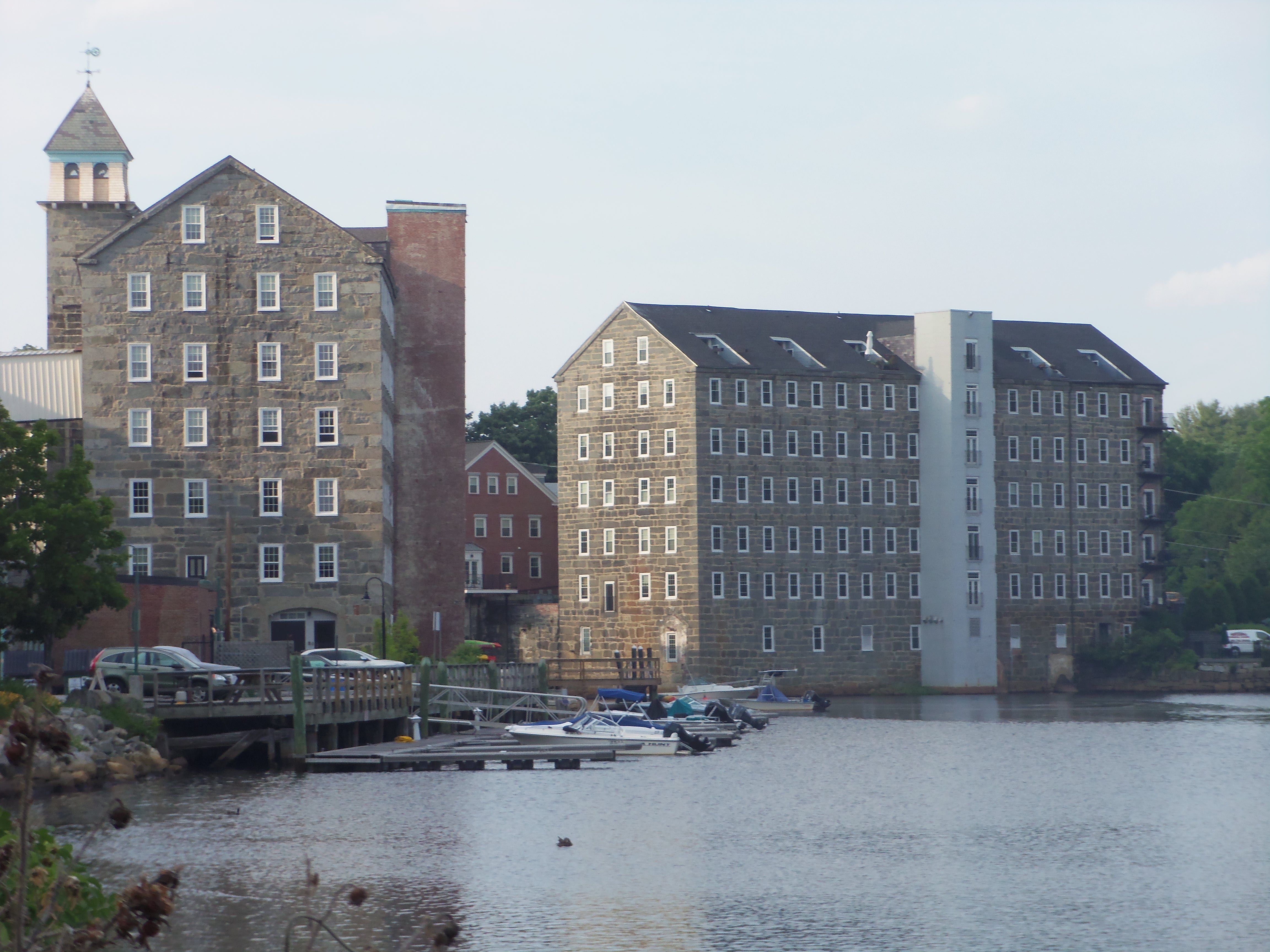
Like Dover, the town of Newmarket flanks Durham and its state university campus, and as a former textiles mill town, it, too, is home to a number of University of New Hampshire students and the kinds of businesses one would expect as a consequence – small restaurants, bars, pizza parlors, bookstores, yoga studios, nightspots, and so on. The Stone Church Meeting House has long been a venue for emerging musical acts.


The town of approximately 9,000 also has a strong blue-collar side, which also feeds into a distinctly funky feel.
But to me there’s always been a sensation that the place isn’t fully New England. It somehow reminds me more of small cities in central Pennsylvania or even Galena, Illinois, near the Mississippi. I think that has to do with the way the central street twists through downtown and the prevalence of stonework rather than the traditional brick in the mills and a few prominent houses. It’s picturesque, all the same.
Key to its industrial development was a large inland saltwater estuary that allowed extensive shipping. In generic usage, Great Bay also encompasses Little Bay and a host of small-town waterfronts where humble rivers fall to sea level. These include Durham and its Oyster River; Exeter and the Exeter/Squamscott; and Newmarket, with the Lamprey River, before passing Dover Point and emptying into the Piscataqua River on its way to the Atlantic. It’s a major breeding ground for fish populations all along the East Coast, and the current at Dover Point is always intense.
Hope you enjoy this quick tour.