ONE MORE NOTABLE FAMILY

Boston's Back Bay is viewed from the stone tower in Mount Auburn Cemetery. The Fullers are buried nearby.
Boston’s Back Bay is viewed from the stone tower in Mount Auburn Cemetery. The Fullers are buried nearby.

Mount Auburn Cemetery, at the edge of Cambridge and Watertown in Greater Boston, not only lays claim to being the first garden cemetery in America but also boasts some of the most notable names in the nation’s history.

This small family plot, for instance, holds the remains of Transcendentalist leader Margaret Fuller and pioneering architect Buckminister Fuller.

100_2346
Margaret Fuller Ossoli’s inscription reads, in part: By birth a child of New England, By adoption a citizen of Rome, By genius belonging to the world.


100_2341


WHERE ARE THE CANDIDATES’ OFFICES?

In remarking about the failure of the presidential candidates to get out and do the ground-level face-to-face meet-and-greets that are the foundation of New Hampshire’s first-in-the-nation primary, I’ve failed to notice a conspicuous change in this particular campaign. I live in a county seat, one of ten in New Hampshire, and usually by this point in the campaign, we’d have prominent campaign headquarters downtown.

Not this time.

No, it finally dawned on me. Nada!

(Well, since drafting this, we got a phone call saying Hillary just opened an office here, just not downtown. Still, something’s akimbo.)

In fact the Republicans, who ought to be the most active in staking out territory, had only eight offices across New Hampshire by mid-September – all in Manchester, the largest city, an hour away from where I live. Much more from the further reaches of the state.

Contrast that to the Democrats: eight offices for Hillary Clinton alone, at the time, four for Bernie Sanders, and two for Martin O’Malley. Fourteen in all. And Joe Biden’s still waiting in the wings.

The local office is where a candidate’s organization offers literature and answers questions to passers-by, does its phone-banking, encourages supporters to meet, plans canvassing and visibility events. It’s where each candidate gains visibility – and credibility – every time a driver or pedestrian comes past.

Maybe the Republicans think advertising will fill the gap. It won’t. Each region of my adopted state is different. I’ll leave it at that.

I’ve also mentioned the lack of living room meetings and am surprised to see the only ones listed on the Republican side are all in Scott Brown’s Rye home – that is, the former U.S. Senator from Massachusetts. Hardly bread-and-butter invitations to the faithful, right?

AN ABOLITIONIST NEXUS

Coming upon Moses Brown Square in Newburyport, Massachusetts, one evening threw me for a loop. The plaque said this Moses, 1742-1827, was a prominent shipbuilder and merchant active in the slave trade. (Not to be confused with a Capt. Moses Brown, 1742-1802, a privateer – that is, a licensed pirate living nearby — also on the wrong side of my moral compass.)

The ringer, as I read, was that Newburyport, with all its wealth based on the rum, sugar, slave trade triangle, was hostile to abolitionists, and its Moses had soon become its wealthiest resident. So that was the funding for those glorious houses on High Street, not the whaling trade? I hadn’t suspect this turn.

What a contrast to the more famous Moses Brown (1738-1836), a Rhode Island Quaker convert who became both an avid abolitionist and a pioneer of the Industrial Revolution in America – himself quite wealthy and a founder of what’s now the prestigious Moses Brown School in Providence, adjacent to Brown University.

I’m guessing they were all cousins, given the naming patterns and wealth.

What further intrigues, though, is the other statue in the square, this one for William Lloyd Garrison, an abolitionist who was also from Newburyport. There you learn of the depths of the town’s virulent support of slavery and their collaboration with its institution.

Curiously, Garrison “the Great Liberator” found two important colleagues from upstream on the Merrimack River.

The first was John Greenleaf Whittier, the Quaker poet living in neighboring Amesbury, Massachusetts, kitty-corner upstream.

And the other was the journalist Horace Greeley, born in Amherst, New Hampshire, further upriver.

What I see in all this is a hint at the hot pockets, pro and con, on a contentious issue of the time – sometimes within a stretch of the map, sometimes with a family. Not that things are always any different today.

TOMBSTONE: THE PREMISE

One late October afternoon, after most of the foliage had fallen, Randy Kezar and I simultaneously looked up from our pathway and beheld a large red maple fully aflame in sunlight as we strolled through the burial ground behind our Quaker meetinghouse. It was the embodiment of the single detail that says everything, the flash of perfection; this individual tree expressed the season as much as all of the previous color change and shifting light we had savored in the previous weeks. “I suppose if we were Japanese, we’d sit down and write a haiku on the spot, in celebration,” he said. Later, I took up the challenge and came up with a few lines I hope come close:

Somehow each New England autumn
comes down to boughs in a graveyard

– a common of stone and bone –

But my provocation and observations kept ranging wider, invoking a calendar not just of the place across  a year but also the epochs that fill what went from a boneyard and burial ground to a Victorian cemetery to the present, as well.

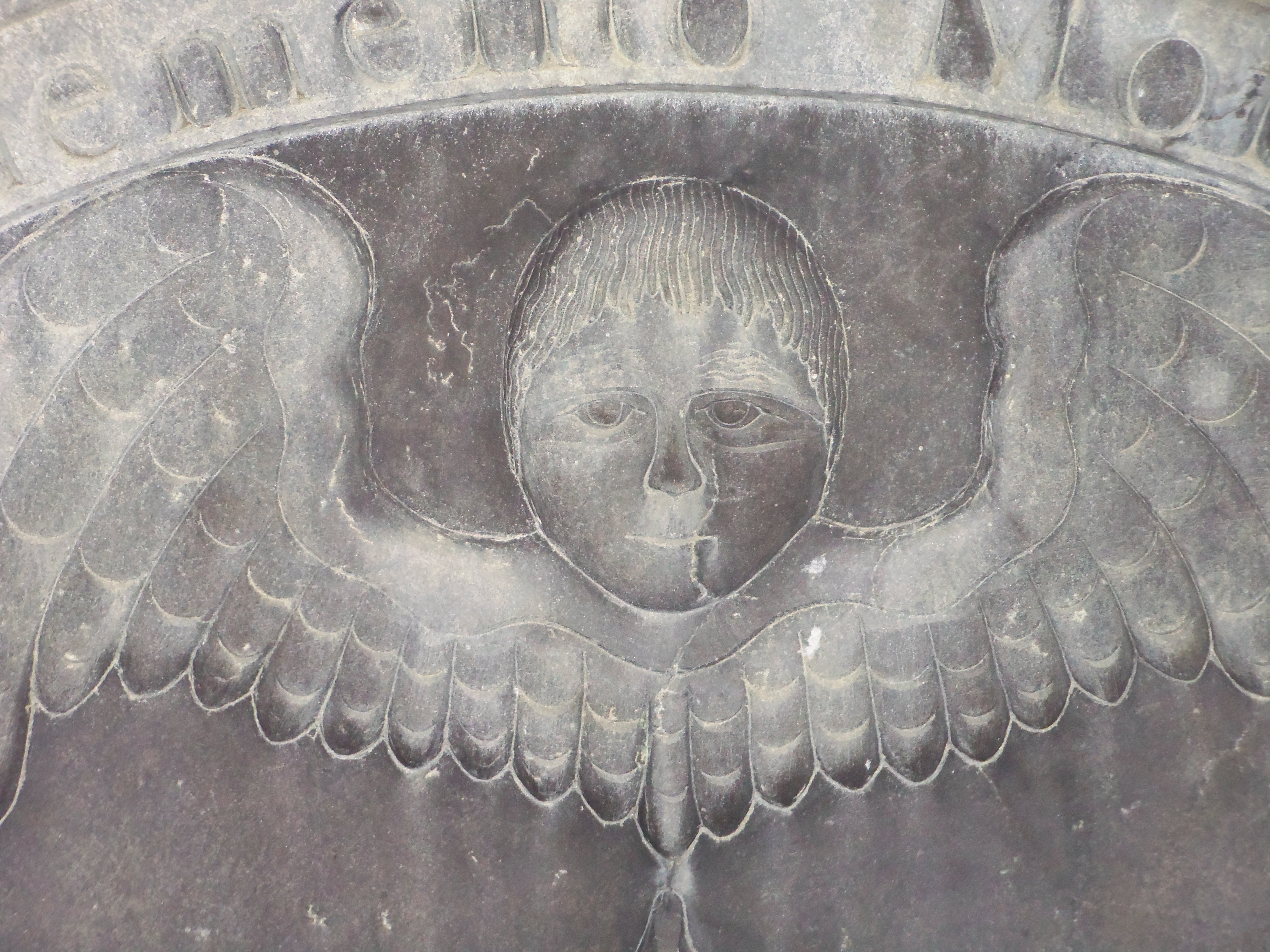
The winged death's head is a common gravestone motif in New England. This example is in Watertown, Massachusetts.
The winged death’s head is a common gravestone motif in New England. This example is in Watertown, Massachusetts.

The poems that resulted have one foot in Portsmouth and Dover, New Hampshire, and another in Portsmouth and Newport, Rhode Island, where I quote from the 1664 will of Alice Shotten Cowland and some of the activities of her son-in-law, Robert Hodgson – sometimes spelled Hodson, as well as Hutchin. (I detail what is known of their lives in my genealogy blog, The Orphan George Chronicles.) She was part of the early dissent against Puritan authority, first with Samuel Gorton and then as one of the first Quakers in the New World. I love Robert’s memorial minute, which calls him “an ancient traveler in the Truth.” He arrived in America on the historic voyage of  the tiny Woodhouse, causing turmoil in Manhattan and Long Island before heading on to Boston. As far as I can determine, he was no relation to my line, no matter how much many have tried to find the link.

~*~

Winged Death 1To see more, click here.

LOOKING AT THE GOP WHITE HOUSE HOPEFULS

Looking at the pack, I wonder how many voters can even say something about each of the names on the full slate. Even in simply determining each candidate’s state, as a starter, or the major offices he or she’s held.

That’s even before the question of finding some significant way one stands out from the rest.

I’m even asking if they’d make a decent Cabinet, put together.

Here’s hoping things start to get lively. Let us see who they are. Really are.

ABANDONED MILLWORKS AND REDEVELOPMENT

In many communities across the Northeast, the once neglected mills along the running waters have found new life as commercial real estate. Often, high-tech firms and other startups find them to be flexible incubators. Other times, floors are occupied by stylish residential condos or office suites.

The small city where I live proves that, three decades after the boarded up windows were once again open the light and the spaces within refurbished. The new tenants were the key to a revitalized downtown, especially.

Before relocating to New Hampshire, though, I envisioned something similar while drafting my novel, Big Inca Versus a New Pony Express Rider. Actually, I had no idea that was about the same time the mills were being restored one by one by developers like Joseph Sawtelle. Not that he was anything like Bill’s mysterious Boss.

Oh, how I love the mills – even before we get to the intrigue in my novel.

Inca 1


THOSE FIRST BLUSHES OF AUTUMN COLOR

Last weekend, we got away to the Northwest corner of Vermont for a lovely, make that magical, gallivant enhanced by a Friend’s gracious hospitality.

The jaunt began with a long overdue stop at the Saint-Gaudens National Historic Site in Cornish, New Hampshire. Admittedly, sculpture – especially public statuary – has taken a lower rung on my visual awareness to painting, drawing, and printmaking. Let me say simply that this visit to the home – originally summer residence – of the American genius Augustus Saint-Gaudens was a revelation. The National Park Service has done a remarkable job in preserving not just his house and studio but in displaying his studies and castings of his memorable monuments. The glade devoted to the “Shaw Memorial” alone was worth the visit. And, let me add, the floral displays in the gardens at this time of year, when relatively little is blooming, were delightful. As for his work designing American currency, at the invitation of Teddy Roosevelt? The short take is we’re ready to return, soon.

That was followed by a late afternoon jaunt across the Cornish-Windsor covered bridge spanning the woefully low Connecticut River, due to an ongoing drought, into Vermont and eventually through the Green Mountains, taking a questionable route our host suggested through Rochester Gap and Middlebury Gap, one I doubt we would have found via GPS but altogether perfect. This was the real Vermont, not just twee but also working-class hanging in there, apparently happily so. We’re still wondering how many of these folks get to work through the winter.

Not much later we were sitting on his deck, sipping hard cider we’d brought from the Granite State and munching some amazing cheese from his locale. Oh, yes, while watching a feathery sunset stretching toward us from the New York State’s jagged Adirondack mountain range. Does life get any better than this?

The next morning brought my reason for being here, a committee meeting an hour to the north, and the first of two breath-taking mornings with a drive that included Adirondacks in the distance on one side of the highland farm country I traversed (with its seemingly contented dairy cows and huge barns), and the Green Mountains, a wall on the other side, along with glimpses of long Lake Champlain far below to the west.

Still, we weren’t seeing what we’d anticipated: signs of frost. Not all that long ago, northern New England – especially this far north – would have had a killing frost by mid-September. Instead, where we live, we’ve been able to get to the end of October with an occasional throwing blankets over the garden. In other words, global warming is real. And that frost, by tradition, is essential to the famed New England fall foliage.

Leap to Sunday morning, when we ventured off to Appalachian Gap in a second crisp, dewy morning with the mountains veiled in a haze – breathlessly, as it were. What surprised us the most was how quickly some trees were already in prime foliage, albeit surrounded by green. The color comes in waves, actually, and much of the glory depends on the ephemeral angle and quality of light more than the leaves themselves. So the autumn foliage was beginning to arrive. Just like that.

In the week since, it’s starting to appear where we live, too. And, to heighten our awareness, we know all too well what will follow, just a month hence.

~*~

My essays and photographic slide shows on New England autumn foliage are available in the archives of my Chicken Farmer I Still Love You blog. Take a peek!