COLLECTING LEAVES TO COMPOST

Dealing with clay soil like ours has convinced me of the value of compost. Not that I hadn’t composted before. But over the years here, I’m watching the ground become more supple and workable and productive, thanks to the effort.

The first autumn, I collected more than 200 bags of leaves from the neighborhood. (Each year, I try to reduce the figure, only to find some of neighbors now expect me to come over for the haul.) To that, we’ve added our garbage (thus reducing our expenditure on the city’s green trash bags). Once we acquired rabbits, their droppings and the hay from their bedding started going into the pile as well.

The process is incredible, watching the volume decrease to a fraction of what it had been. Consider the amount of heat the decomposition produces, and then the arrival of the red wigglers (or wrigglers, I’ve heard both), the friendly worms that do the big work of transformation. Forget his insights about evolution, it’s Darwin’s observations of worms I treasure. What’s left in the end is a gardener’s pure gold.

On a spiritual level, this humus and humility have a lot in common. So much can flourish from their nourishment and grounding.

A RIVER CRUISE FOR PERSPECTIVE

Many of these Red Barn postings have illustrated the historic seacoast region of New Hampshire where I live. While our downtown is 16 or 17 miles inland from the Atlantic, the tides roll in all the way up to the waterfalls and mill dam at the heart of our city, and then roll out, usually twice a day. In fact, Dover was an active seaport until floods and silting took their toll early in the 20th century.

Situated on the Cocheco River, as well as the Bellamy and a stretch of the Salmon Falls, Dover was once a major textiles manufacturer and railroad center. It’s part of a cluster of small cities and adjacent towns, each with its own character, that drain into the Piscataqua River before it, in turn, pours into the ocean.

In contrast, downstream on the full Piscataqua, Portsmouth boasts of an active port – one with iconic red tugboats, oceanic freighters, and active passenger cruises around the harbor, its islands, and coastal sights – stretches familiar to us from both the shoreline and ventures out on water. On the Maine side of the river, the Portsmouth Naval Shipyard builds and repairs nuclear submarines.

Upstream, however, has remained far more mysterious. Since it’s hard to glimpse much of the waterway from public roads, we’ve long wondered how the route would appear. Long ago I discovered how different a shoreline fits together when viewed from a boat rather than the lands around it. This is, after all, a major part of where we live.

The MV Heritage in Portsmouth Harbor.

At last, hearing of the Inland River Fall Foliage Cruise offered each September and October aboard the 49-passenger MV Heritage, my wife and I got a chance to see for ourselves. Depending on the timing of high tide, its daily two-and-a-half hour trip ventures from downtown Portsmouth to downtown Dover 11 or 12 miles upriver or, as an alternative, into Great Bay, itself a remarkable estuary.

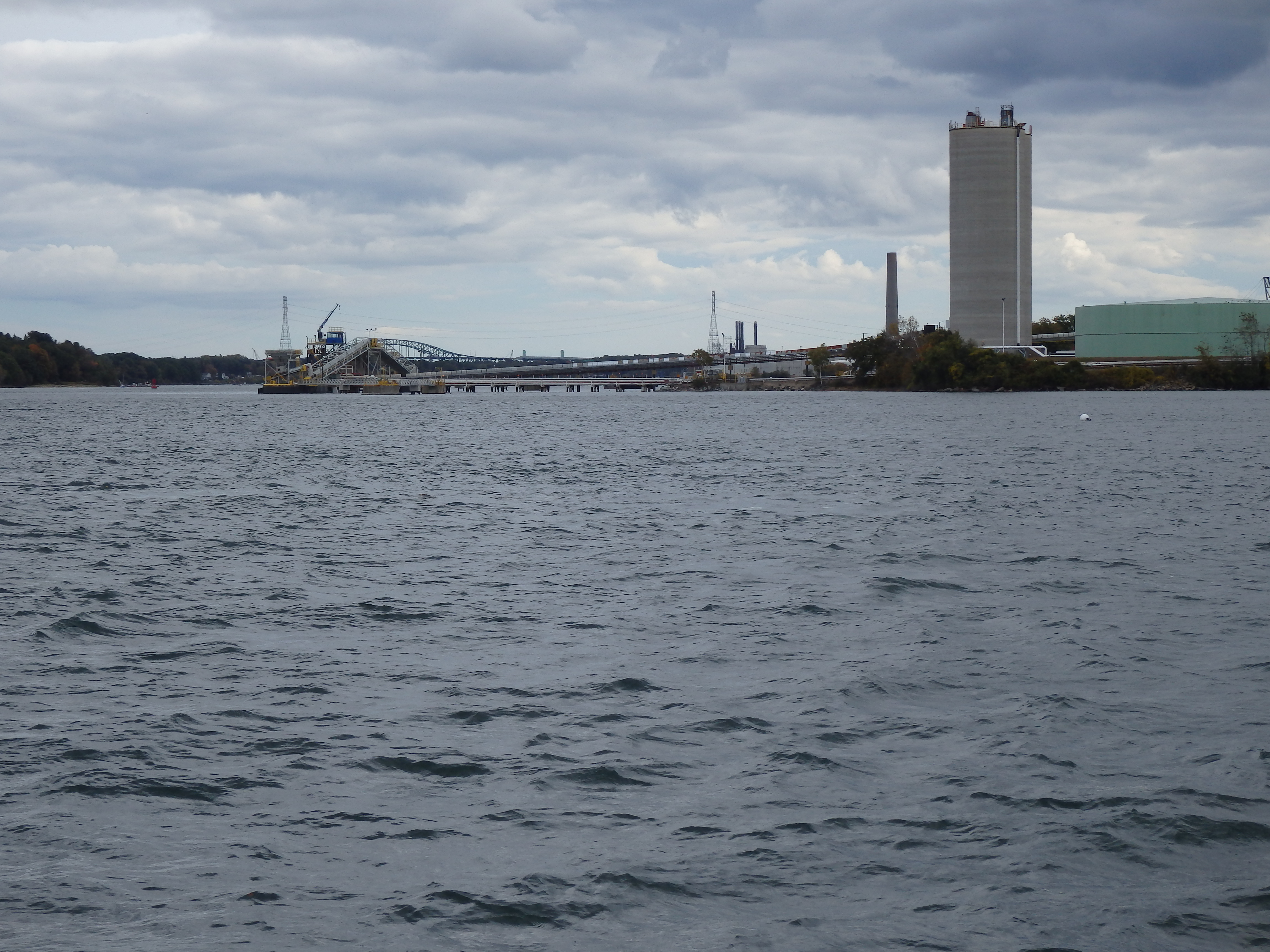
It was an eye-opener. Once we left the familiar, picturesque Colonial-era Portsmouth Harbor, we began passing all of New Hampshire’s industrial waterfront, which includes three electrical power plants, the world’s largest lobster operation, an oceanic underwater cable producer, oil tank farms, and the like – each with major docking facilities for oceanic freighters or other vessels. I hadn’t envisioned the extent of this activity. Nor had we anticipated the width of the passageway, in many places approaching three-quarters of a mile. Not what most folks would call beautiful, but it was impressive, even if we were grateful Aristotle Onassis failed in his attempt to put an oil refinery a bit upstream.

Clouds and a sharp breeze arrived quickly after we left the dock and started passing industrial waterfront.

Once we’d passed the mouth to Great Bay, we were surprised by how much of Dover itself sits on the Piscataqua – and how much very expensive waterfront housing with expensive docks to match have been built there, mostly, as we were told, in the past two decades, now that the river’s been cleaned up from its earlier industrial pollution. In fact, looking at this and at the Maine side of the river gave the impression of passing high-profile lake shores with their ever more imposing year-round mansions. To be frank, we were a bit stunned by the wealth we were witnessing – where are these people in our otherwise modest city and what’s their source of income? Theirs is a different world, we’d say.

That’s not to say there weren’t stretches of colorful foliage or fascinating wildlife. In addition to a host of herons, gulls, and cormorants (we most loved the ones who stood atop mooring buoys marked “private,” as if the birds defiantly owned them), we viewed a soaring osprey and then a bald eagle in flight, an impressive hawk high in a pine overlooking the river, and a seal or two – all close to home.

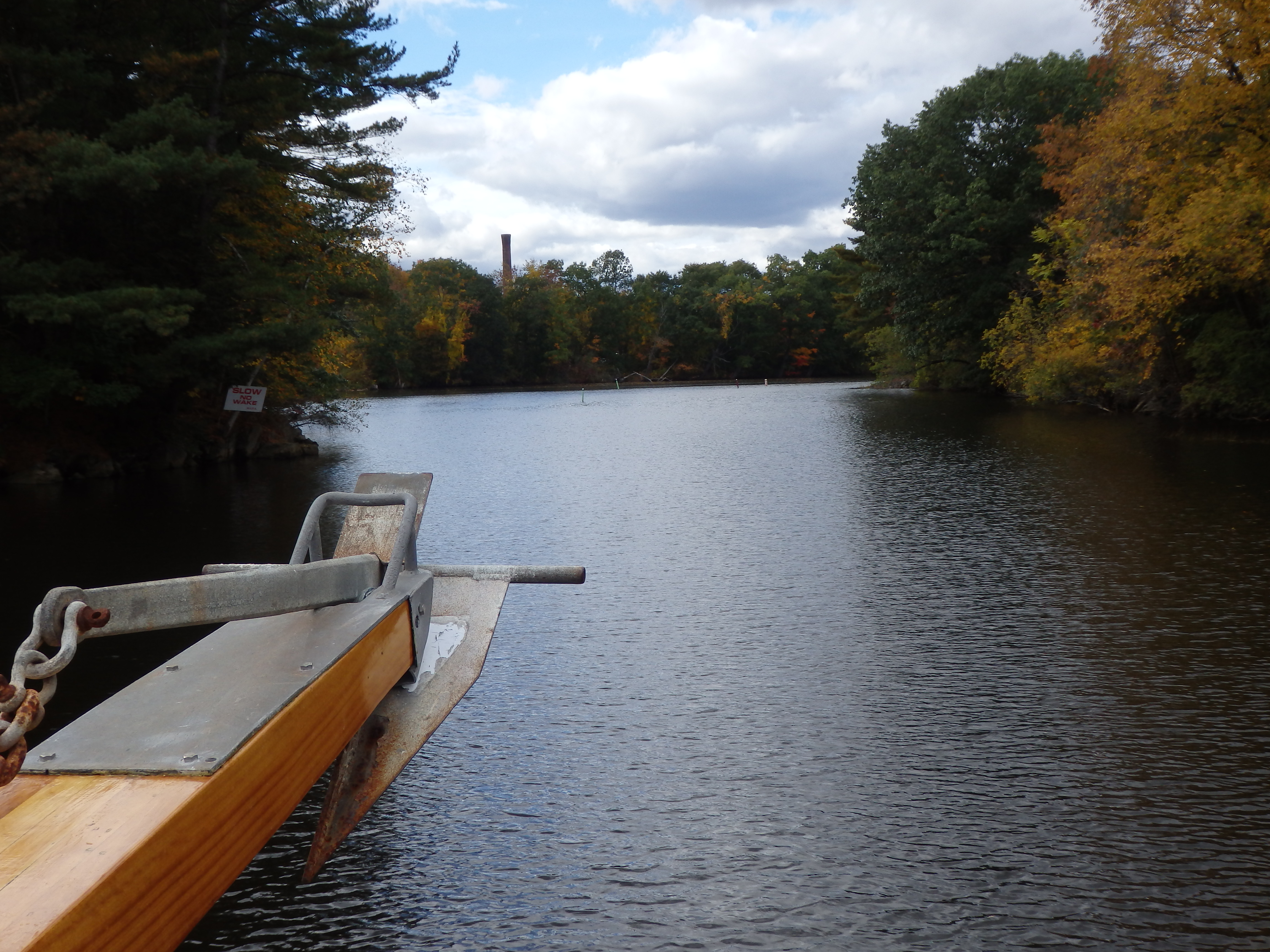
The Pisacataqua originates at the fork of the Salmon Falls and Cocheco River, which we then followed as it narrowed on its way to downtown Dover.

What a contrast!

At one broad pool, we were told that tall-mast ships turned around here before reaching the mills by being poled by hand on high tide or pulled by oxen the final few miles. And, at the upper narrows, we appreciated a friend’s work with the Army Corps of Engineers in dredging power-plant tar from the river to reopen the passage. (That could be another posting in its own right.)

We passed the marina at the edge of downtown and circled, to retrace our journey.

The final passage into downtown Dover narrows and twists. Here it is at high tide.

Why is it, the return always seems to go faster than the first part, outward?

On our drive home after debarking,  we stayed close to the rivers. Surprising how discrete the lanes to the big houses! You’d never, ever, suspect they were there if you hadn’t taken the cruise. Makes us wonder how much more is hidden just out of view.

WITH FLAMES AND A DEMON OR TWO

Anais Nin once contended that each of us has a demon. My response was – and remains – Just one?

Each demon, we should note, is different.

Our struggle is what thickens the plot – or dulls it. It can draw us together in intimacy – or drive us apart.

The eleven prose-poems of Harbor of Grace reflect that energy.

They tell of intense friendship propelled by a shared faith that flames and then explodes. Of the Old Ways bordering Amish and other Plain peoples in addition to urban conflict over the horizon. Of commitment and human shortfalls, too.

Harbor of Grace is the translated name of the town at the mouth of the Susquehanna River where the dedicatee of this collection was born.

harbor cover.jpg.opt370x493o0,0s370x493~*~

For the chapbook, click here.

WHERE SMALL TOUCHES ADD UP TO DELIGHT AND PLEASURE

My wife is big on “quality of life” touches that affect our sense of living. They don’t have to be big expenses, either, as many of her yard-sale finds demonstrate.

The concept hit me while changing the bed the other day in my gratitude regarding a new set of striped flannel sheets, unlike the old floral patterns.

Just wait till we slip in, I thought. Oh, the sweet anticipation!

WHERE ARE THE GROWNUPS IN THIS PARTY?

“No” is no way to lead.

That’s the lesson from watching two-year-olds or, for that matter, all too many parents.

The only thing the so-called Freedom Caucus members of Congress seem to know how to do is vote “No.” In that way, they’re two-year-olds. And don’t tell me, No, they’re not.

Just see what happens when it comes to voting for their own party leadership. No Speaker.

It’s no way to lead. The grownups in the room need to assert their authority. Perhaps, too, some parenting lessons are in order. If there’s anyone who can teach them.

DISPLACEMENTS

Any scholar of language will be struck by the ways some words drift from one meaning to something quite different. At the time of the King James Bible, for instance, “to prevent” meant “to precede,” from the root “to come before,” rather than “to hinder.” In our own time, we’ve seen “enormity” go from meaning “great evil” to simple “immensity,” and we’ve lost a powerful word in the process. Both “gay” and “queer” have lost timeless, innocent concepts. There are countless other examples where an author from the past tries to tell us something quite different from our current interpretation.

I’ve come to call these shifts “displacements,” especially when they happen by degrees over time and particularly as they relate to religious practice. For example, a cousin who was also a pastor in the Church of the Brethren likes to point out how the “Holy Sabbath” changed over generations to “the Sabbath” and then just “Sunday” before becoming what we know as “the weekend,” preferably of the three-day kind – each stage losing something along the way. I could argue how “my perception of the Truth” is quite distinct from “my truth,” one embracing the ideal of a single verity while the other presents an infinite array of conflicting, what, sensations or tenets, maybe? The “Inward Light” that early Friends proclaimed was quite different from the “Inner Light” version appearing two centuries later. Or “that of God in each person” is quite distinct from each person being a god unto himself or herself. Or even the way the quest for fun has displaced a work ethic and social consciousness. As for “Christmas” turning into “Holiday Season,” remember, it’s not far from becoming a more candid “Shopping Season” altogether. Keep your eyes open; these shifts are all around us, probably in every field of endeavor.

Returning to root meanings can be empowering. “Radical,” after all, comes from the word “root,” and Native American culture tells us, “roots are strong medicine.” Good roots, as gardeners know, are essential for healthy plants. In the world of thought and action, examining the roots can also restore the original vision. Hmm. “Look” and “see” aren’t exactly identical, are they?

SPEAKING OF SPEAKERS

Sometimes a detail from a specialized strand of knowledge opens up an insight on a broader field. In this case, it springs from my awareness of Quaker history and the naming of children.

One of the pivotal figures in the schisms within the Society of Friends in the first half of the 1800s was a wealthy English banker and evangelist who traveled widely through the United States from 1837 to 1840. Joseph John Gurney (1788-1847) was so popular that “Joseph Johns” became a synonym for potluck dishes in parts of the American South, and many infant boys were named Gurney in his honor. He was even invited by Henry Clay, the Speaker of the House, to use the Capitol’s Legislation Hall to address members of Congress. In the end, a large branch of American Quakers came to be known as Gurneyites.

All that came to my mind while scanning a list of Speakers of the House and wondering if any had become president. (As noted earlier, one had – James K. Polk, who defeated Clay in that election.)

But the name of another Speaker caught my eye: Joseph Gurney Cannon, a Republican from Illinois who led the House of Representatives from 1903 to 1911.

Could there be link to the English evangelist?

As it turns out, yes.

Although Cannon’s biography has him born a Quaker in 1836 in Guilford County, North Carolina, (home of my Hodgson ancestry for many generations), I find no Cannons in the genealogical minutes. His mother, on the other hand, came from an established Friends family, which would have provided Quaker contact but not membership. In fact, her marrying a non-Friend meant losing her own membership in 1828, though she could still attend worship. Joe moved with his family to Indiana in 1840, eventually married in a Methodist service, joined a Masonic lodge, and died a Methodist in 1926. It’s a common story, actually.

What’s more interesting is the argument that “Uncle Joe” was the most dominant Speaker in the history of the House, as well as being its second longest. Time magazine’s first issue (March 3, 1923) featured his portrait on the cover, for good reason. Cannon was the longest-serving Republican in the House, totaling 40 years in office.

So much for the image of meek Quakers, no matter how tenuous the connection. Not just outspoken and pugnacious, Cannon was apparently tyrannical, leading to a crisis not unlike the one facing Congress at the moment. He was stripped of much of his ironfisted control in something resembling a coup by progressive Republicans aligned with Democrats. Sound familiar?

Cannon’s history also plays into another line of mine. He was followed as Speaker by Champ Clark of Missouri, who was somehow closely affiliated in business dealings with one of my mother’s ancestors.

START FILLING THE GROCERY CART … WITH BOOKS AND VIDEOS

As I blogged during the summer of 2014, the No. 1 topic of discussion across much of New England concerned the dramatic battle for control of the Market Basket supermarket chain. In an unprecedented reaction to moves by one-half of the family owning the company to sell the popular stores to more expensive rivals, its management, devoted workers, trusted suppliers, and loyal shoppers united to bring the enterprise itself to a halt. A grinding halt. And it worked.

After months of earlier rebuffs and daily headlines, the part of the family actually running the stores announced an agreement to buy the entire operation from its hostile relations.

It was a complicated story, with some long-festering feuds in the not-so-recent background. The kind of story that’s bound to show up as movie adaptations. Maybe even as a television mini-series. Maybe not Dallas in Boston, but as rich in its material.

We’ve been waiting for the book-length analyses, and the first one is finally making the rounds: We Are Market Basket (the title comes from a slogan at the time) has been published by an American Management Association affiliate.

Authors are frequently advised to “know their audience,” with the implication of tailoring their work to assumed demands. In this case, the book can be seen aiming at two audiences: New Englanders who remember the revolt and likely participated in some part of it, and then business majors and managers around the world. It’s both a strength and weakness for the volume.

Reading the text, it’s easy to see which part was written by which coauthor: Lowell Sun newspaper reporter Grant Walker drafted the day-by-day narrative, while associate business professor Daniel Korschun provided the chapters on business management. It’s all good stuff, though a bit repetitive, as one might expect from daily news reports that have to recap earlier developments. And I started wishing Walker had more sources to draw on. Still, they underscore the point of their book.

As the subtitle says, The Story of the Unlikely Grassroots Movement That Saved a Beloved Business, this was a remarkable event. Korschum uses it as a platform to argue for an awareness of stakeholders in a company – not just stockholders. It’s a theme Bernie Sanders has been pressing in his presidential campaign, and he’s not alone it saluting its importance. Workers, suppliers, and entire communities have investments of one sort or another in the companies that operate in our presence. For Market Basket, with prices typically 16 percent lower than its major competition, customers have a definite reason for supporting the stores, which, as it turns out, are remarkably profitable, despite or (as Korschum argues and others of us believe) because of their culture of contrarian instincts.

You can read the book for the reasons why. The list of down-to-earth practices throughout the operation, where the lowest level workers are encouraged to find ways to improve the business, is worth the read alone. You won’t walk through any store quite the same afterward.

My interest in the topic goes back decades before this, as I saw the operations of a smaller but similar grocery operation run by my then-girlfriend’s father. His own father had started out with a produce cart that went door to door. Besides, my own inclination has been for smaller, typically family, operations rather than monolithic corporations – as I demonstrate in my novel Hometown News and pursued for most of my employment as a journalist.

As I was perusing We Are Market Basket, I kept thinking of business books like Tom Peters’ In Search of Excellence series. They’re fun to read and make their point, though there just might be more to the story. In this case, I definitely feel there is.

Yes, when we come to the stakeholders argument, we can look to John Henry Patterson’s benevolent leadership at the National Cash Register Co. in Dayton, Ohio, or the glory years of the cereal makers in Battle Creek, Michigan, or Aaron Feuerstein’s moves in the aftermath of the Polar Fleece fabrics’ devastating factory fire in Malden, Massachusetts. Essentially, these provide similar models of enlightened leadership along the stakeholders’ ideal. But this book also leaves me wondering about the next generation after Arthur T. Demoulas’ leadership – he is, after all, pictured riding a white horse. So there’s a need for a management text on maintaining leadership a generation or two down the pike, which this book glides over as one of simply maintaining the historic company culture. There’s a lot of repetition on Market Basket’s culture in these pages, perhaps to drive the point home or, as I suspect, perhaps because of slack editing. But will that culture be enough?

On another front, there’s a volume yet to appear that puts the Market Basket experience in perspective with other leader-defined companies. Yes, we love our heroes, but they’re hardly the stuff of corporate America these days. More often, they’re anonymous and invisible. What kind of executive would be needed to fill Arther T.’s shoes?

And there’s another round of writings that might relate Market Basket to other family-owned companies and their survival or failure in moving from one generation to another. Family ownership issues have become a distinct subset of a business school curriculum. You don’t get fired from being a brother or a sister or cousin or grandkid — it’s a lifetime position.

We Are Market Basket skims over the earlier family conflicts that erupted into ugly, protracted, and costly court battles only years before the events at the heart of this book. To understand the bitterness of the most recent round, I’d love to see a volume – or at least one more open to both sides – more detailed than what this one presents. Not that the other side made itself in any way sympathetic in the 2014 accounts. Even so, the events were not quite as black-or-white as they seem to appear. An astute reader senses the authors’ desire not to antagonize their sources, meaning the book’s told basically from one side.

Another fascinating dimension also appears in corporate ownership that’s not quite split evenly 50/50. Television viewers may remember an episode of Ed Asner’s Lou Grant series where the newspaper was threatened by such a division – not that much different from the Seattle Times, actually, where one percent held the sway vote.

When it comes to Market Basket, we have one crucial family voter who switched. Why? Everyone wants to know.

So I’m still hoping for a more definitive volume than this entry. Maybe by the crack team from the Boston Globe, which could throw far more reporters at the story than the suburban Lowell Sun could – reporter/author Welker at least had the advantage of having the Demoulas family grocery stores originating in Lowell and putting their headquarters one town over, in Tewksbury, but he was a Lone Ranger in the face of a large reporting and editing staff in Boston.

Another of the case studies waiting to happen would look at Market Basket since the uprising. Can it sustain the large debt load and still maintain its generous employee bonuses and profit-sharing, along with its low prices? A year-after report by the Globe found that the company is indeed prospering in its rebirth. But long-term questions remain.

Will the fuller story ever come out?

For me, more and more, I’m looking for another current example, somewhat the way scientists want an experiment that can be replicated — another stakeholder over stockholder victory.

In the meantime, we’re still shopping – almost religiously – at Market Basket.