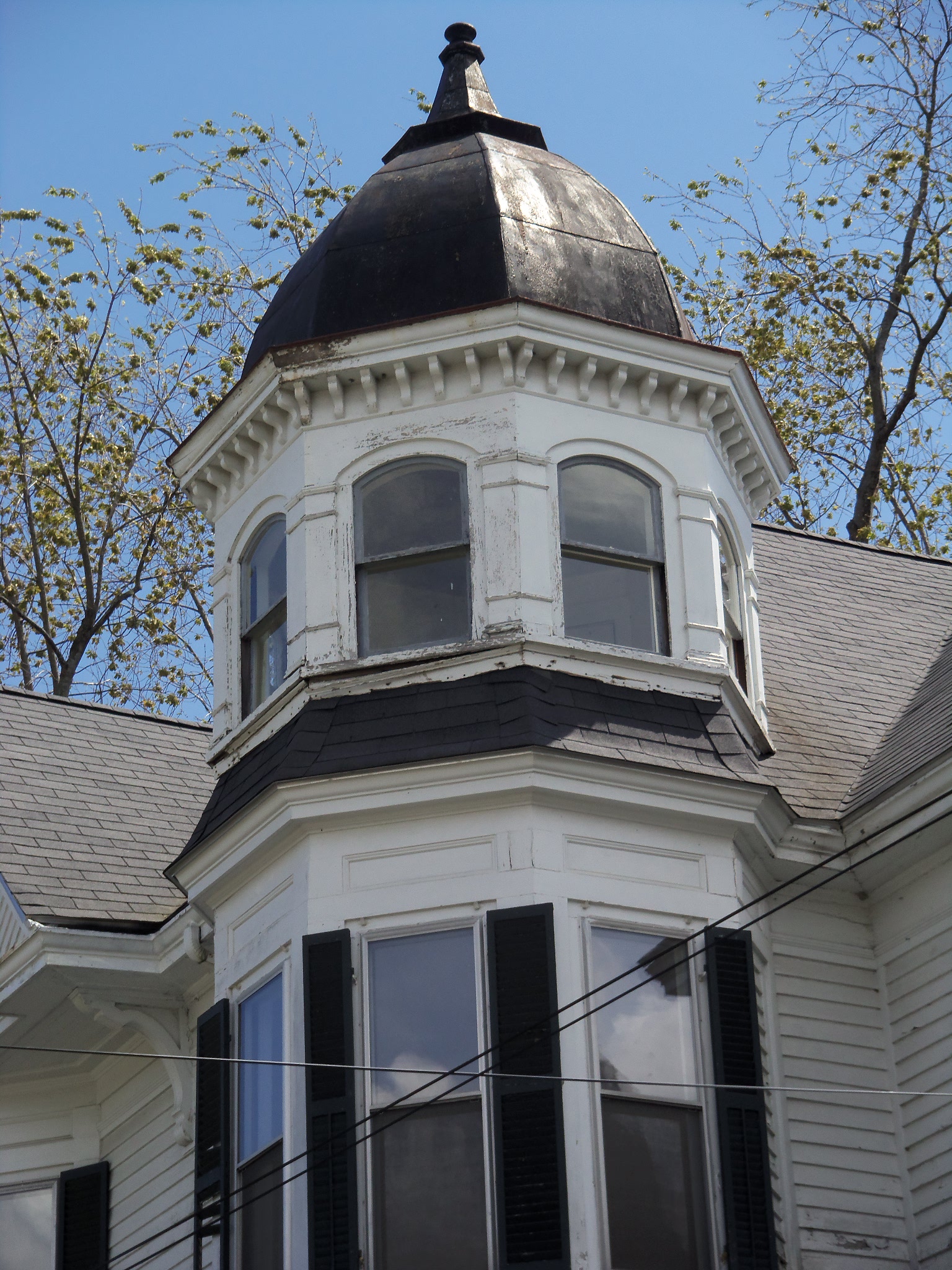
Towers and turrets make for a room with a view.
 Strolling Dover: for more, click here.
You never know what we'll churn up in cleaning a stall
Towers and turrets make for a room with a view.
Strolling Dover: for more, click here.
The first printing press in America arrived in 1638 at Harvard College in Cambridge, Massachusetts, where it was used to publish Puritan religious materials, including the Bay Psalm Book, free from censorship in England.
Perhaps its most remarkable book, though, was its first complete Bible, which appeared not in English but a Native language in a translation by John Eliot, a task that required him not only to translate all 66 books of the English Christian Bible but also to create a new alphabet altogether.
The resulting 1,180-page volume, now known as the Eliot Bible, appeared in 1663, a translation into Algonquin of the Geneva version used by the Puritans.
(At the time, sects found important distinctions in the texts of their translations. For example, before her execution by Massachusetts Puritans in 1656, the Quaker Mary Dyer’s letters challenging her charges quoted the King James, or Authorized, version, something that would not have gone unnoticed by her accusers.)
With our overwhelming abundance of printed materials today, it’s impossible for us to imagine the immensity of this task. I’m still amazed that small typefaces could be cut as cleanly as they were and then be cast into metal. Hand-setting the resulting type is slow and arduous labor, and each sheet of paper would have been printed individually, rather than in the continuous rolls we now use. (I remember the blur of newspapers on the press, measured in the thousands per hour.) In Colonial times, to store, collate, and bind all of those pages into all of those volumes required both strategy and space in a time when most buildings were small, especially by our standards. As for ink and paper itself? These things were precious.
My first encounter with an actual Eliot Bible came at the Roger Williams National Memorial in Providence, Rhode Island, where Williams’ volume is displayed, along with his notes in the margins, done in his own style of shorthand. Think of that twist: the founder of the first Baptist church in America, banished from Massachusetts by the Puritans, was also concerned enough with spreading the Gospel that he, too, learned the Native language and reflected on ways to open its message.
In these early literary efforts, then, we see glimmers that relations with Native populations in the Northeast could have gone in much more peaceful ways than the violent turns they took in the hands of others.
As we learn in other, more tragic, pages.
Understanding that we don’t see light itself but rather what light illuminates opens a fresh way of envisioning the divine Spirit of life.
As I examine the writings of the early Quaker movement (Society of Friends), I find a remarkable wisdom emerging within their application of the metaphor of Light and through that, an alternative Christianity itself.
Consider the argument and then its applications.
 ~*~
~*~
For your own copy, click here.
When I see this …
… I think of this.
 For the free ebook novel and more, click here.
Is it true that Donald Trump’s hairstylist is among his finalists for vice president?
Makes as much sense as anyone, so far. Would anyone else dare get that close?
It started when we had some trees removed – the box elder that was shading a third of the Swamp, another shading the kitchen garden, and then a dead elm. We kept the flakes from the cutters’ chipper, rather than having them go to the dump. Repeatedly since, when we hear tree cutters in the neighborhood, we ask if they could give us the truckload, and they oblige, grateful to be spared the city dump charge.
Those chips work great for lining the pathways through our garden or around the yard. Eventually, of course, they decompose and enrich and soften our clay soil. It’s just another of the many lessons we’ve had in assuming an old house and barn and reclaiming a garden and grounds. I’m glad I’ve collected those stories, an indication how far we’ve come over the years, as well as reminders how far we have yet to go.
~*~

For more home and garden poems, click here.
Donald Trump’s refusal to release his income-tax filings naturally spurs suspicions. What’s he trying to hide? What’s he afraid they’ll show?
What, you think he’s squeaky clean? Please! The fact-checkers have found little in his outrageous claims that’s really true. We don’t need a liar-in-chief, we need someone we can trust.
So Trump’s financial dealings are bound to be fair game as the campaign spirals on.
For one thing, they give us a clearer view of how a candidate handles money. The Obamas, as we discovered, are really quite frugal, even conservative. Trump, on the other hand, seems to employ a lot of sleight-of-hand, as his loans-to-donations-to-himself demonstrate. (How many times can you count the same dollar, anyway?)
Well, we can assume the accountant-types will have a feast with whatever is there, as will the tax experts and financial gurus and businessmen large and small.
In the meantime, it’s fodder for the pundits.
Among the possible reasons Trump won’t release his income-tax filings? Are there clues to indicate:
Well, right or wrong, it’s a start. The facts will either support his claims or knock them flat.
Any other wags want to weigh in?
As the title of my poetry collection about gardening goes, There Is No Statuary in Our Garden Except for the Plastic Spacemen Occasionally Surfacing, working the soil here turns up many surprises. Bits of broken glass and metal, definitely, and endless rocks.
A few weeks ago I came across a wiggly something I first thought might have been a petrified snake or, a bit later, a skink. As I extracted its clay-encrusted fullness and pulled bits away, I slowly realized what I had was a three-inch-long tail to a plastic ‘gator or croc’, the body and snout adding about two more inches.
Forget trying to take a photo. Even cleaned up, it’s hard to make out.
I’m sure this was never one of our kids’ toys, which leaves a question of just how long since there were other children living on the property and then just what use they made of this stretch of the side of the house we call the Swamp.
Maybe they knew something after all.

