ALONG THE MAIN DRAG
You never know what we'll churn up in cleaning a stall
The demands of settling the New World left little time for the first waves of immigrants to attend to the fine arts. Unlike Europe, with its ongoing traditions, America had no courtly patrons or vested institutions. No Lorenzo de Medici or cathedrals, for instance. In fact, many of the Protestants looked askance at the vanity running through many of the arts or questioned the truthfulness of entertaining fictions. The Puritans banned theater, after all, as well as social dancing, at least until yielding where I live on New England contradance. The Quakers and Baptists went further, forbidding music from their worship services altogether.
Something had to bend and, over time, did. Slowly native voices took shape in literature, painting, and music, mostly. To us today, these “primitives” can be refreshing encounters.
In music, much of this impulse surfaced along vocal lines. (Little wonder, considering the rarity of instruments and teachers.) And out of this came a desire for choral music, a community activity of a social nature.
In the absence of trained musicians, though, some music masters, mostly self-taught, opened workshops known as “singing schools” and eventually created a unique notation style we know as “shape-note” scores. These pages have the staves, time signatures, sharps and flats like the scores generally used today, but rather than having the notes themselves be round, some are square or triangles – and each of those markings designates a fa, so, la, ti, do – an ancient foundation for singing.
When singers pick up a hymn from a shape-note book, they run through the music the first time by using the words fa, so, la, ti, do rather than the lyrics, which are introduced once the singers have their musical lines and harmonies in place. And away they go.
Boston tanner William Billings (1746-1800) is regarded as the first American choral composer, and increasingly as an original, even startling, voice. His four-part “fuguing tunes” of one voice after another embracing and embellishing a phrase create bright polyphonic tapestries on Biblical and patriotic texts. Henry Cowell, a major 20th century American composer, has argued that had we heeded Billings rather than later reformers, we would have had a unique serious American musical tradition much earlier than we did. Other observers have said that hearing Billings is like encountering the wonders of music for the first time. I’d agree. While Billings, himself a singing-school master and publisher, did not employ shape notes, much of his music has survived in that style.
In Virginia, the Mennonite Joseph Funk (1778-1862) created a seven-note system still in use among Mennonites and Brethren. Many of those hymns were published in both English and German. (I have several editions of these volumes.) The crossroads where he lived and is buried is now known as Singers Glen. It’s a lovely site.
Best known today is the Sacred Harp, taking its name from a 1844 tunebook once New England choral singing took root in the American South. It’s a loud, lively, even raucous style of four-part a cappella activity – with many of the hymns composed by Billings, in fact.
Historical purists can argue whether shape-note music should be performed in the Sacred Harp style or in the more lyrical piety of the Mennonites and Brethren, which I favor. What I do know is the joy we feel as a choir when we take up pieces from this stream, as well as how difficult and challenging they can be. For the record, we use standard notation, rather than the shape-note scores. No need to further confuse us.
For related poetry collections, visit Thistle/Flinch editions.
I used to like the Public Broadcasting System series, back before I bought an old house. Now it’s too painful. Look at all this old wiring, the plumbing problems, the rot and warping, the fact the bulkhead needs replacing. The flaking paint, again. (Bulkhead? Didn’t even know what that was beforehand.)
What else do you want to know about New England?
~*~

For more on my poetry collection and others, click here.
When I see this …

… I think of this.
 For the free ebook novel and more, click here.
For someone who has engaged in a writing life his whole adulthood, I’ve had a rather checkered career as a reader. After a precocious outburst in the classics – Robinson Crusoe, Tom Sawyer and Huckleberry Finn in second- or third- or fourth-grade (not as class assignments, of course – who knows what we were reading there), I found myself largely oblivious to fiction. My attention turned to history and biography (the Landmark series, especially) and then science and politics. Non-fiction, with a sense of content. Fiction came later, in high school, curiously through political fiction – Brave New World, Lord of the Flies, 1984, rather than any of the traditional British canon. Throw a little Shakespeare in, and I was off – into journalism. (Let me mention that Huck Finn was much harder reading in my junior year of high school than it had been when I was younger; as a novice reader, I wasn’t tripped up by the strange spellings of dialect.)
In college, for whatever reason, I developed a passion for Samuel Johnson. Not for his moralizing as much as the sarcasm, I’d say, as well as a fascination with the baroque richness of his style. Maybe it was just the force of personality projecting from the writing. And then came Virginia Woolf, Kurt Vonnegut, Richard Brautigan, Jack Kerouac … the widening stream.
Surprisingly, a major turning point occurred in the span when I had the fewest opportunities to read – my years living in the ashram, a monastic community in the Pocono mountains of Pennsylvania. Out of the practice of meditation and reflection, however, I began to approach literature in a new way. The quietude opened poetry to me, both as a reader and a writer. The experience also introduced me to mythology, with the Hindu stories being more fantastic and meaningful than anything I had encountered in the Greek and Roman stream. Later, I was able to leap from this into the stories of the Bible as well, returning me to my previously unknown roots.
Others have written of being a promiscuous reader. I wouldn’t say I’m addicted to reading that way – at least, not any more. One of the ashram exercises, in fact, was a “reading fast,” meaning written words, rather than food. It’s all a matter of focus. That is, when I’m eating, I want to choose to concentrate on my food rather than a text. When I’m traveling, I want to see where I’m going. (Airport terminals, on the other hand, or stretches before takeoff, are another matter — they are among those place of limbo.) Later, when the newspaper first comes off the press, I found I could no longer focus on the stories – not after a shift of heavy editing. If anything, my head was so full of disjointed stimulation I needed to slow down to savor what I’d already encountered. For that matter, I prefer walking to jogging, with its restoration of a natural pace. I rush too many places and deliver on too many deadlines as it is. When I enter someone’s home for the first time, I must take care to pay attention to them more than the spines on their bookshelves. Now what were you saying?
I read, then, with greater focus these days. More selectively. I can no longer have classical music playing in the background. (It used to provide a barrier for noise from my family or neighbors.) Now, I immerse myself in what is before me. The text, then, as in scripture.
~*~
Out of all of this, my own work emerges. As a writer, I strive to create a linear progression. That is, the parts must advance is some sort of logic. Curiously, in my own work, I am often inspired by a Hegelian model – thesis, antithesis, synthesis – as drawn from cinema theory. On a wider scale, my earlier interests surface in new ways, resulting in something more akin to a matrix or spiral or collage than a straight line. I have been called a Mixmaster, with good reason. On top of it all, in my many moves about the continent, I’ve found myself exploring the soul of each place – something wine aficionados consider, in a smaller range, when they discuss terroir.
Around here, if you mention New Englander as a style of house, everybody knows what you mean. Gable end to the street, perhaps a bay window beside the front door, typically two full stories and a usable third floor. Not Greek Revival, except in a stripped-down way with some carpenter gothic touches, and definitely not Colonial Revival. Modest, middle-class – maybe even working class – sometimes even as a duplex.
But try looking it up and the best you can find is an accusation that it’s New Hampshire Realtor BS.
Well, that’s where we live. Ours seems to be from the 1890s.
~*~
My poems on the challenges of renovations, repairs, and relating as a husband are collected as Home Maintenance, a free ebook at Thistle/Flinch editions.
One of the challenges facing contemporary society is the shrinking percentage of active readers. (I say percentage, but fear what we face is more a shrinkage of actual numbers.) It’s not simply the decline in readers of fiction or the number of people who recite poetry from heart, but the lack of literary engagement of any kind. So I rat on myself early here, with my belief that the act of reading carries social value – especially when serious literature is the subject.
It is no mere coincidence that Americans’ widespread ignorance of history and our political system has accompanied the growing addiction to a sensual media orgy – large-screen television, movies, rock music – while habitual reading, including newspapers, has been declining. That is, what is superficial and easy – and ephemeral — has the upper hand. Little is demanded of the receptor, and loud excitement, rather than a deepened awareness, is the expectation; escapism, rather than engagement with life itself. Several European writers have suggested something more troubling is at work – the loss of reflective people, contemplative individuals – a theme I see developed, obliquely, in Stephen L. Carter’s Integrity and the labor of moral discernment. In other words, is the mind being enlarged or merely numbed? The fact that so many people cannot name their own senators or governors or are largely ignorant of geography, yet recognize countless actors and rockers points toward a disintegration of community and social service.
Paradoxically, the act of reading is largely a private enterprise. It’s a dialogue between a reader and a writer, sometimes separated by continents or centuries. It requires more activity from the receptor than a movie, short song, or television sit-com does – in fact, one of the concerns these days is the atrophied state of the imagination among those who have been raised on “electronic media” rather than the printed word or, for that matter, stories read aloud or in radio broadcasts. (There are, after all, degrees of imaginative challenge.) In the act of reading, there are no visible intermediaries – no actors, soundtrack, directors, sets, or costumes. The editor or printer or bookseller is of an entire order altogether. Here, the reader and the writer engage in a dance of the soul or a passionate argument. (Serious readers can be as demanding as lovers when it comes to this relationship.)
But the act of reading can also take us into the existence of another person, viewing the world from within that context. A movie, in contrast, leaves us looking at that person, hoping for a hint of emotion or profundity. The author can reflect on the situation, suggest ranges of experience, voice moral struggles in ways a movie might only touch in passing.
Here I think, too, of large-scale musical compositions – symphonies or string quartets, for instance – that demand intense listening, inducing reflection and emotional awareness. Like reading, the audience for serious music is in decline – and with it, a link to the riches of the past and its aspirations and wisdom.
More and more, when I look at a dream house, my reaction turns the other direction. Is that where I’d want to live? Who keeps it clean? How do you get truly comfortable? Make a mess? The kitchen, especially, looks like nobody’s used it for anything more than microwaving a frozen entree.
~*~
My poems on the challenges of renovations, repairs, and relating as a husband are collected as Home Maintenance, a free ebook at Thistle/Flinch editions.
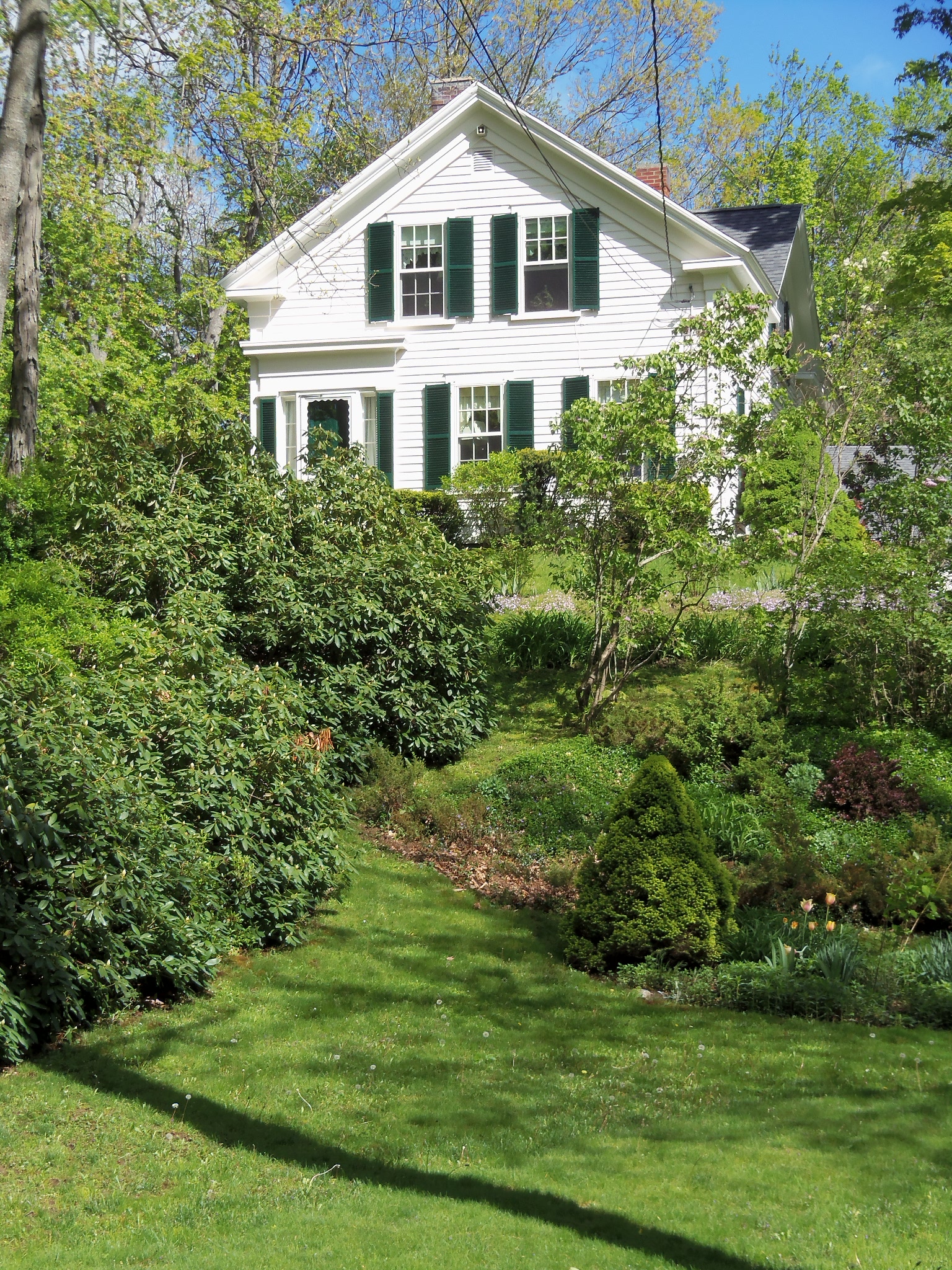
Here’s a local example of the Greek Revival style, which flourished 1820-1860.
 Strolling Dover: for more, click here.
These home renovation projects – I hate to call them remodeling, which points in some other direction – have established a pattern. The latest, the bathroom and utility room round, is one more in a sequence that began with saving the barn from collapse and then inserting a mother-in-law apartment 16 years ago, then redoing the kitchen five years later, followed by opening up the barn loft for easier access and three-season use just seven years ago. Looking back on photos taken before each of these always startles me. I could have kept living with that?
Each project begins with a vague sense of definition or direction. OK, I did make drawings for the mother-in-law apartment, and my wife had to order the kitchen cabinetry and plan for what would go where in that undertaking. But other than that, much more has happened – should we say been improvised? – along the way than I’d care to admit. Want to talk about lighting, for instance?
The pattern itself begins with ripping away obstacles. Even the first barn project had drywall to come down, windows and doors to trash, improper wiring to tear out.
That, in turn, leads to an urban archeology stage as we discover clues about earlier residents.
The barn, for example, had been inhabited by what we concluded had been an artsy set – the cable television line remains, no matter how outdated its specs – even though their arrangements were simply not allowed by zoning or building codes. Or so the inspector told us. A horse or a goat, we assume, had chewed away at some of the framing years earlier.
The kitchen, in a one-story el extending from the main house, had been added in 1928, as we concluded from Boston newspapers used as insulation next to the sheathing. As one of my favorite headlines optimistically proclaimed, automobile sales and production would just keep soaring through the coming years. So much for the Great Depression right around the corner. Our mudroom had been a pantry with a door where our stove had been, rather than the entry right around the corner. So the original kitchen had been somewhere in our current dining room or utility room?
Framing we find for former doorways often makes no sense now. Rooms have definitely been shuffled around. A hallway ran through two bedrooms, and then the bathroom was added – a small window there had been a full-size two-over-two. The closet to the front bedroom had apparently been just an opening atop the staircase, which would have let daylight in. Was there a second staircase in the back of the house? And were the stairs to the third floor moved from elsewhere? What we often see is how little had been done “right.”
We reflect on what we’ve heard about the previous owners and speculate on which ones made which decisions – many of which we’ve come to regret. Somewhere in the ’60s or ’70s, according to our calculations, two-inch-diameter holes were bored about a foot apart in a horizontal line along the exterior walls so that foam insulation could be pumped in along the framing. Great idea, except that in the subsequent years, the foam itself has dried out and turned to dust or useless puffballs. In reality, we have no insulation against New England winter. Still, I have to wonder about the asbestos siding, just when it was added – whether it was pried away for the foam project or added at the time.
As more and more debris comes down and goes out the door, the remaining exposed rough, dark wood leaves me feeling hemmed in. The windows grow small in response. It’s all part of the pattern.
In the next stage, though, I find myself staring at the open space. Think of an artist looking at a blank canvas or a writer, well, we used to have blank paper. This, though, is something else. For me, it’s Zen. The open framing, unfinished flooring, freedom from furniture – it’s all potential we will soon fill in. Unlike many who prefer lush surroundings, I love openness. The wiring and, if needed, plumbing need to go in, along with insulation and then drywall. We need to make decisions about lighting and color scheme. Toward the end comes the actual painting.
Add furniture. Then get used to the results.
As I said, it’s a pattern.
~*~
My poems on the challenges of renovations, repairs, and relating as a husband are collected as Home Maintenance, a free ebook at Thistle/Flinch editions.

