FINGERINGS

many classical musicians regard a score
more through their hands (as instrumentalists)
or the eye, according to the sheet (as composers)
or even the mouth (as singers)
than through the ear, much less the heart.

in that light, Beethoven’s mastery in deafness
should appear no miracle

unlike Charles Ives, off-limits
when the circle needed completion
– without the ripple of applause or engagement
or critical test of application –
only the stone-dead silence of scorn or indifference

let us touch, then, releasing these birds
from rows of ink on a page
as if this were another spring morning

Poem copyright 2016 by Jnana Hodson
To see the full set, click here.

OF MASTS, SPARS, AND BROKEN YARDS

1

in moonlight
Cape Ann, two months after the Perfect Storm
maybe three
while standing back on a broad outcropping
25 feet above the roiling and ebb

unpredictably, a wave explodes above me
from behind
washes around my feet

I could have been swept away

so step back, gingerly, if you will

2

driving a ridge, no view of shimmering expanses

between country club and great estates
sand plowed like snow
two feet deep, both sides of the state highway

mixed with kelp

3

nothing to trifle with
this fluid motion
in its hypnotic attraction

all recitative
with cymbals and snare drum

Poem copyright 2016 by Jnana Hodson
To see the full set of seacoast poems,
click here.

THIS IS IT?

I’ve long been fond of collage as an art form. These Tendrils continue the stream.

~*~

  1. Ground Hog’s Day marks the end of solar winter, in contrast to the standard calendar’s use of the equinox on March 20. We have as much daylight now as we did around Halloween, back t the end of October. It’s another reason I view the year as eight seasons rather than four.
  2. I’ve previously posted about the ways observing Advent as the days leading up to Christmas Day – which then ushers in the Twelve Days of Christmas –greatly alters our way of experiencing the holidays. As a result, since we don’t put up our tree until Christmas Eve, we leave ours up much longer than our neighbors. Long after theirs have headed for the dump, ours is still casting magical light around our front parlor (the room we call the library) while the mass of tiny lighted bulbs outside the bay window are also still glowing. Deep winter’s much more tolerable this way.
  3. When the evergreen tree does go out of the house (meaning any day now), its place in the bay window is soon taken up by flats of seedlings we’ll transplant to the garden, likely in May. My task now is to retrieve the appropriate shelves and bars of lighting from the shed – out in the brittle cold. We always seem to be behind schedule there.
  4. How sad to see so many so-called conservatives turning barbarian, intent on destruction – pillaging civilization and culture.
  5. My last days at the office included erasing my tracks. A lot of stuffed folders went into the trash.
  6. I finally acknowledge my past lovers would have never made me a suitable spouse. How blessed I am now.
  7. Think of the books we keep returning to. Or simply journals. Which of them keep you on track?
  8. There’s a day, as the rabbi admits, for sex and delight, free from the usual intrusions. It’s called Sabbath. Seriously.
  9. Goose – all dark meat, a lot of good tasty fat – a spoonful is great for favoring other dishes while cooking.
  10. Someday has come.

~*~

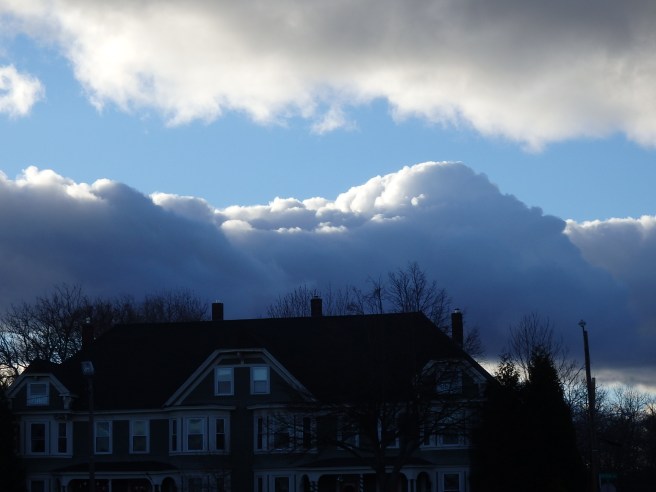
Afternoon winter sky over Dover.

GENESIS

Each seed, each root, each bud
unfurls on schedule. Melting
and rain come together.

In the daylight you open
so slowly you do not hear
their snap. Between pale tendril

and miniature leaves, we will gaze,
then, no longer doubting
our own inward spiraling galaxy.

Poem copyright 2015 by Jnana Hodson
To see the full Green Repose collection,
click here.

A BACK BAY FLOURISH


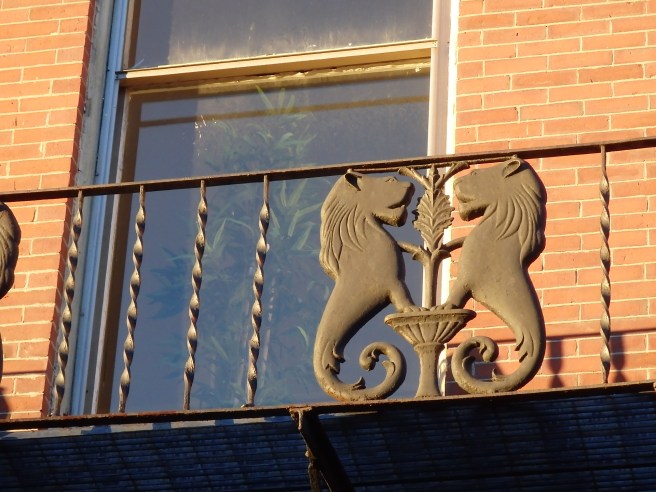
In the second-floor railing ...
In the second-floor railing, they strike me as a cross between lions and seahorses.

A distinctive railing adorning a Beacon Hill house somehow fits in with the district’s predominantly federalist style.

Boston is a rich and varied destination – the Hub of New England, or the Universe, as they used to say. Living a little more than an hour to the north, we’re well within its orb.

OH, BOY, WHAT A MESS

from the heart of the building in the night

“I hate your ass!”
countered by
“do I look like somebody who’d put you away”

and then she just screamed

~*~

behind the scenes at the fancy restaurant

a cook got shot
the maitre d’ was in the hospital with food poisoning
and the chief dishwasher overdosed on something

how many knives went missing

~*~

with all the Freudian potential

“Daddy, I LOVE you!”
drawing the twisted
“I want you out of here”

oh, boy, what a mess

To continue, click here.
Copyright 2015

MULTIPLE MAPPING

Knowing how far to go — and when to turn back, to the best effect — are difficult matters. The wise traveler relies on those who have gone there already and returned. You hope they speak truthfully. Often your life will depend on their directions. Even knowing what to pack and what to omit may be based on their counsel. Mountains and rivers are only the beginning.

When there’s too much to remember, a map begins forming. That or a guidebook. But the map presents more possibilities than the book, with its linear narrative confined to one route at a time — even maps with vast portions blank or missing. Take two points on a map and connect them, this way or that. Add a third. And then a fourth.

I never would have arrived in this desert without maps. The airliner’s navigation charts, of course. And then the highway atlas. Many others, as well, become useful. Those that show back roads. Others, topography. Still others, property divisions — including the Indian reservation and Army artillery range, both declared off-limits. Maps of emotions, economies, explorations. Maps of oceans, weather, the heavens.

Disembark and you go to work filling in details and then connecting points like a spider. What’s around that corner? What’s over that ridge? Where will we stay, and what’s the best way to get there? A single map is only an blueprint. The particulars never quite fit. Especially in two dimensions. A breeze lifts the web. Coyote walks through it.

Each one distorts — some far more than others, and rarely by intention. Who made the map in your hands? And to what purpose? Some were mathematicians of few words. Others were empire builders or real estate developers. Some weave the directions into the stories they tell beside the campfire. Some ignore shadows. Fail to repent, ask forgiveness, extend blessing. Others know survival, as well as play, requires definition and decision. Obligates searching within, as well as around, in fullest candor. Some even deceptively point you away from your destination (why should they reveal their secrets?).

Those who were born and raised here know it in a different way from those who have migrated. Magpie will tell you one thing; a Canada goose, another. Same goes for where they’re positioned. Jackrabbit and dragonfly take separate pathways, as does beaver. You simply log where they cross and hope to find meaning.

I had thought maps were the essence of geography. Now the definitions spill over into history, geology, meteorology, political science, psychology, and much more. Because many misunderstandings afflict each life, there are bound to be collisions. Sometimes you move into a thorn that pierces consciousness, but even that rarely brings clarity. You see there’s endless discord among individuals, clans, tribes, nations, denominations — all to be traversed and mapped in the search for ways out and back safely. In this knowledge, jobs, aspirations, faiths, possessions, social standing are merely reflections of fundamental conflicts between human consumption and the good earth itself. No one can dwell anywhere without disturbing the whole; individuals and collectivities distort and contort to their own ends, some more benignly than others. The lines on the page do not hold their place. Without a divinity as a guide knowing these connecting pathways, then, there’s no return to full measure and health. The breath people exhale, fires they build, grains and flesh they devour are diverted to their chosen applications. “Tell us something better,” I implore. “Teach us the highest way.” Where anyone takes it from here is another matter.

Sadly, whether this transformation’s harmonious and renewing, guiding individuals as merciful stewards and co-creators with the divine, or self-centered and destructive as thieves, is rarely considered. Just observe how communities rationalize, arguing that the welfare of their women and children comes first, even as they bankrupt the farm to support worldwide armies or strip timberlands in a rutting for coal and iron.

You could perceive many aspects of this in these orchards within desert. While the choice of irrigating and producing fruit sustains many more humans than the arid range would, also ponder the long-term impact of the poisons applied through each season. Kill harmful insects and molds, but what else? And how soon before it seeps into the groundwater and household wells? It’s all an interplay of good and evil, which I observed through a giant spider web. As a practice within my spiritual discipline, the Dedicated Laborious Quest, I place maps atop other maps and find they are drawn to different scales. Many of the words require translation, which introduces its own misunderstandings. Some of the maps are even of places far from here, landscapes in memory.

Too many details and the sheet becomes a scribble. Maybe that’s why here, at an extremity of the continental United States, I now comprehend the American Midwest of my childhood and early adult years as something other than a uniformly Protestant corn belt. Even overlooking ecological differences between woodlands and prairies, or between the Great Lakes and the Missouri or Ohio river valleys, I reconsider its varied ethnic traditions and the hidden cost of the melting-pot focus. Speaking with other exiles like myself, I become aware of unique distinctions some of our ancestors resolutely upheld, at the cost of their own lives, if necessary. There were strains of Scandinavian Lutherans in the Dakotas, Russian Mennonites in Kansas, and Scottish Presbyterians in Iowa, whose distinct cultures were eroding like the topsoil itself. You would hear, too, why so many had fled. Some, desperately hoping to forget forever their terrors or shame, buried the evidence as best they could. Others, however, defiantly kept it aloft as a reminder of their liberation and a warning.

For more insights from the American Far West and Kokopelli, click here.
A FEW NOTES ABOUT READING MUSIC

On one of her first nights at the helm, our new director asked the choir, “Do you read music? Raise your hand if you do.”

Well, ability to read a score is not one of the requirements for joining and we have no auditions, so it was a fair question.

To my surprise, my hand stayed down. Just what did Megan Henderson mean by “read music”? Hear it in my head, the way a composer, conductor, or professional performer would? Not me!

Immediately identify a note on the staff? Well, I studied violin, but that was in the treble clef and I sing in the bass clef and that causes a delay when I have to translate what I see as G to a the B it really is before I pipe up.

Sight read? Well, sometimes yes. For many of the notes on the page, I know how they feel or fit in my throat and on my tongue.

And then there’s the matter of keeping time. Sometimes I’m a stickler for the beat, but sometimes I miss. Just saying.

It helps being in a good section, surrounded by strong musicians. But then it’s also fun when we sing mixed, surrounded by the other parts instead.

So do I read music? I really should have raised my hand – halfway.

MY CALL

for dancing, I want fiddles or flutes
more than saxophones or electric basses
for the measure

how true when they say accomplished waltz
extends either romance or seduction

moving either toward shelter or some dangerous
fascination, all the same

when we link together in a line or a circle
we will pivot and fly . take me away, then

with equipoise into the periphery

Poem copyright 2016 by Jnana Hodson
To see the full set, click here.

LET’S CAST THE SPOTLIGHT AWAY FROM POOR JOB

Could it be that the Book of Job isn’t so much about the suffering of Job, a man of faith, as it is a critique of conventional religion and religiosity itself?

In my volume Eden Embraced, I approach Job’s plight as if the text were a Hebrew Upanishad, one paralleling a type of classic Hindu writings. Yes, the thread holding the plot together follows one innocent man’s spiritual journey through unspeakable suffering. Blameless as he is – and uncomforting as God’s role is here – Job would have every right to turn in other directions, though he chooses to remain faithful.

The story is endlessly troubling, especially for those who read it from a legalistic perspective. From the outset, God is arrogant, even vain and cruel, rather than compassionate or even all-knowing. And Satan, a member of the sacred council, could be a favored golfing buddy arranging another wager.

The setup can easily lead to contortions as a believer attempts to reconcile other, more conventional, definitions of the Holy One with the action at hand, especially when Job’s buddies begin to weigh in with their platitudes. In many interpretations, Job’s faithfulness is held up as an example to emulate, no matter what. Fat lot of encouragement, right?

As a writer, though, I can see the axiom of trying to address a situation by taking an opposing, uncommon position, which is where I see the story of Job originating. After all, we are faced with the question of just where does evil originate, along with human suffering. Why not blame the Creator?

Is there even a large measure of humor in this? Take the events over the top, asking just what more can happen to poor Job? And that’s where his so-called friends step in, adding misery to his plight and their condemnation rather than comfort.

Would it be nearly as compelling if they did the right thing? If Mother Teresa had showed up instead?

By the way, I delight in the happy ending, which many purists object to as a later revision that doesn’t fit with the general thrust of the plot. Feel free to weigh in as you will.